How Much Monthly Income Can ₹10, 15, 20 or 25 Lakh Give in Retirement?
Last updated: 20 October 2026 · Reviewed by the Money n Wealth research desk
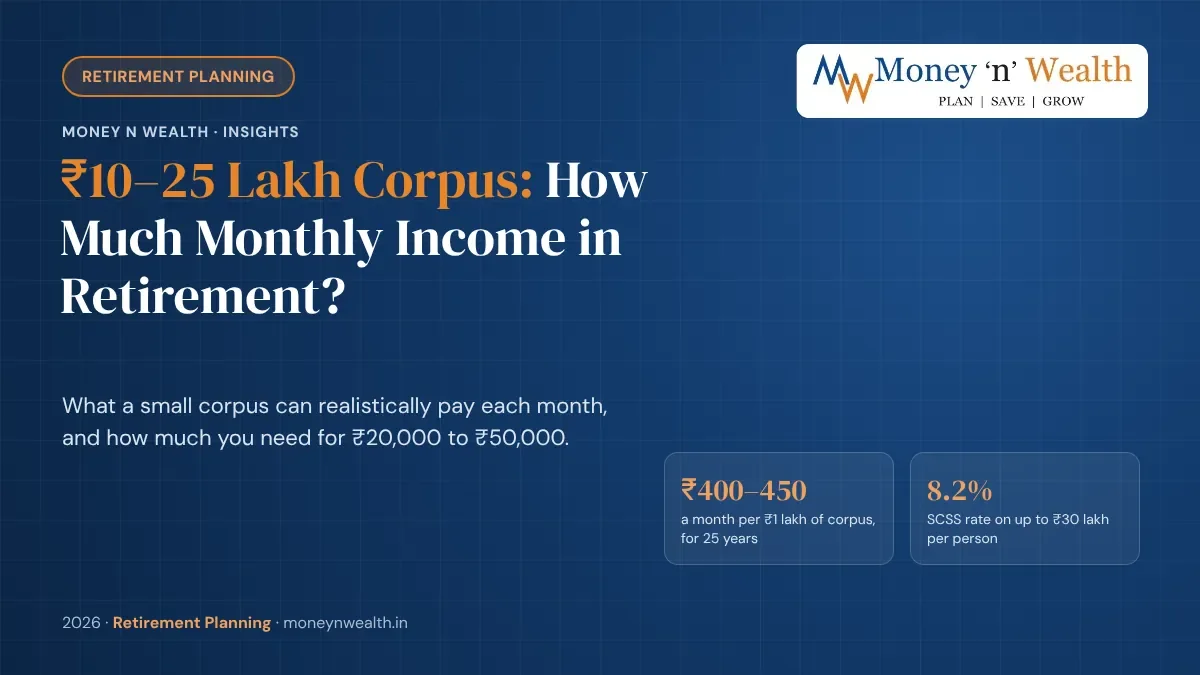
Quick answer (Monthly Income): A small retirement corpus can give a useful top-up income, but not a full salary replacement. At an assumed 8% return and 6% inflation, ₹10 lakh supports about ₹4,300 a month for 25 years, ₹20 lakh about ₹8,550 and ₹25 lakh about ₹10,700, rising every year with prices. A ₹30,000 monthly need from ₹16 lakh would use up the money in about five years; sustaining it for 25 years needs roughly ₹70 lakh.
Last updated: 20 October 2026 · Reviewed by the Money n Wealth research desk Quick answer (Monthly Income): A small retirement corpus can give a useful top-up income, but not a full salary replacement. At an assumed 8% return and 6% inflation, ₹10 lakh supports about ₹4,300 a month for 25 years, ₹20 lakh about ₹8,550 and ₹25 lakh about ₹10,700 , rising every year with prices. A ₹30,000 monthly need from ₹16 lakh would use up the money in about five years; sustaining it for 25 years needs roughly ₹70 lakh . Key takeaways Rule of thumb: each ₹1 lakh of corpus supports roughly ₹400 to ₹450 a month for 25 years, if the withdrawal rises with inflation. SCSS pays more upfront: 8.2% on up to ₹30 lakh per person, about ₹683 a month per ₹1 lakh, but the payout is fixed and does not rise with prices. High withdrawal rates drain fast: taking 20% or more of the corpus each year empties it in about five years. Other income matters: a pension, rent or a spouse's SCSS account can close much of the gap. Protect the corpus: health insurance and an emergency reserve stop one large bill from wiping out years of income. Not every retiree has crores saved. Many families reach 60 with ₹10 to ₹30 lakh from PF, gratuity, a maturing policy or the sale of a small property, and the question is simple: how much monthly income can this give, and for how long? Recent news coverage asked whether a ₹16 lakh lump sum can sustain ₹30,000 a month. This guide answers that and gives the numbers for other corpus sizes, with all assumptions stated. How much monthly income can ₹10, 15, 20 or 25 lakh give? There are three common ways to look at it: the fixed interest from the Senior Citizens' Savings Scheme (SCSS), a 4% starting withdrawal, and the highest withdrawal that rises with inflation and still lasts 25 years. SCSS at 8.2% for October–December 2026, for one person; the rate is reset quarterly and the payout is fixed for the five-year term. The last column assumes an 8% return after costs and before tax. *A couple can each invest up to ₹30 lakh. Illustrative, not a forecast. Corpus SCSS interest per month (8.2%) 4% rule, per month Lasts 25 years, rising 6% a year ₹10 lakh ₹6,800 ₹3,300 ₹4,300 ₹15 lakh ₹10,250 ₹5,000 ₹6,400 ₹16 lakh ₹10,900 ₹5,300 ₹6,850 ₹20 lakh ₹13,700 ₹6,700 ₹8,550 ₹25 lakh ₹17,100 ₹8,300 ₹10,700 ₹30 lakh ₹20,500 ₹10,000 ₹12,850 ₹50 lakh ₹20,500 (₹30 lakh limit)* ₹16,700 ₹21,400 SCSS gives the highest income in the early years, but the amount never rises and the scheme runs for five years at a time (extendable in three-year blocks). The inflation-linked column is lower at the start but is designed to keep its buying power for 25 years. Monthly retirement income from a ₹10, 15, 20 and 25 lakh corpus for 25 years Can ₹16 lakh sustain ₹30,000 a month? ₹30,000 a month is ₹3.6 lakh a year, which is 22.5% of ₹16 lakh. No mainstream investment earns that safely, so the capital itself gets spent. The table shows how long ₹16 lakh lasts at different monthly withdrawals, at an assumed 8% return. ₹16 lakh corpus, 8% assumed return after costs and before tax. Illustrative. Monthly withdrawal If raised 6% a year If kept flat ₹10,000 about 16 years does not run out ₹15,000 about 10 years about 15 years ₹20,000 about 7 years about 9 years ₹30,000 under 5 years about 5½ years So ₹16 lakh can support ₹30,000 a month only for a short bridge period, for example until a pension starts or a property is sold. As a long-term income on its own, about ₹7,000 a month rising with inflation, or about ₹10,900 a month fixed from SCSS, is more realistic. How much corpus is needed for ₹20,000 to ₹50,000 a month? Withdrawal rises 6% a year; corpus earns an assumed 8% after costs and before tax. Illustrative. Monthly need today To last 20 years To last 25 years To last 30 years ₹20,000 ₹39 lakh ₹47 lakh ₹54 lakh ₹30,000 ₹59 lakh ₹70 lakh ₹81 lakh ₹40,000 ₹78 lakh ₹93 lakh ₹1.07 crore ₹50,000 ₹98 lakh ₹1.17 crore ₹1.34 crore These figures assume no other income. A ₹15,000 pension, for instance, halves the corpus needed for a ₹30,000 lifestyle. For larger corpus sizes, see Is ₹1 crore enough to retire? (/insights/is-1-crore-enough-to-retire-india-magic-number) and Is ₹2 crore enough to retire? (/insights/is-2-crore-enough-to-retire-india) Ways to stretch a small retirement corpus Use both spouses' limits: SCSS allows up to ₹30 lakh per eligible person, and a joint POMIS account takes up to ₹15 lakh at 7.4%, paid monthly. Keep a reserve: one year of expenses in a savings sweep or liquid fund avoids breaking SCSS or FDs early, which carries penalties. Add a little growth: leaving a portion in hybrid or equity-oriented funds for the long term helps the later years keep pace with inflation, accepting that its value will move with markets. Bridge, then switch: a short period of higher withdrawals can make sense if a pension, rent or annuity income starts later. Insure health first: a senior citizen health policy, ideally bought before 60, keeps a hospital bill from consuming the corpus. Work a little longer: two or three extra years of earning, without touching the corpus, improve the outcome more than almost any investment choice. Tax points for small retirement incomes (FY 2026-27) SCSS, POMIS and FD interest is taxable at slab rates. In the new regime, the rebate makes normal income up to ₹12 lakh tax-free, so most retirees in this income range pay no tax. For senior citizens, banks and post offices deduct TDS only when interest from one payer exceeds ₹1 lakh a year (Section 393(1) of the Income-tax Act, 2025, earlier 194A). Form 121 replaces Forms 15G and 15H for those with no tax liability. In the old regime, up to ₹50,000 of deposit interest is deductible for senior citizens under Section 153 (earlier 80TTB). How Money n Wealth helps Money n Wealth is the investment distribution and planning practice of Predics Fintech Services Pvt Ltd, based in Thergaon, Pune. We help retirees map their corpus, pension and other income into a month-by-month plan using our online planner (/planner) and a portfolio review (/portfolio-review) . We are an AMFI-registered mutual fund distributor (ARN-121995) and an APMI-registered PMS distributor (APRN07444). To discuss your situation, contact the team (/contact) . Disclaimer: Educational information only; not a personalised investment, tax or insurance recommendation. All projections are illustrative and based on the stated assumptions; actual returns, inflation, interest rates and tax rules will differ. Mutual fund investments are subject to market risks, read all scheme related documents carefully. Past performance is not indicative of future returns. Consult a qualified professional for your circumstances. Related reading on Money n Wealth Is ₹2 crore enough to retire? (/insights/is-2-crore-enough-to-retire-india) Is ₹1 crore enough to retire? The magic number (/insights/is-1-crore-enough-to-retire-india-magic-number) Senior Citizens' Savings Scheme guide (/insights/senior-citizens-savings-scheme-scss-guide) Post Office Monthly Income Scheme guide (/insights/post-office-monthly-income-scheme-pomis) Senior citizen tax planning: interest, pension and rent (/insights/senior-citizen-tax-planning-interest-pension-rent) Browse all Money n Wealth Insights (/insights) Sources and further reading Small savings interest rates for October–December 2026 (https://www.angelone.in/news/personal-finance/finance-minister-announces-small-savings-interest-rates-for-october-december-2026-quarter) TDS on interest under Section 393(1) (https://blog.tdsman.com/2026/05/tds-on-interest-other-than-interest-on-securities-section-3931-section-194a/) Form 121 replaces Forms 15G/15H (https://cleartax.in/s/form-121) Section 153 of the Income-tax Act, 2025 (https://ebizfiling.com/blog/section-153-of-the-income-tax-act/) MoSPI: CPI press release for September 2026 (https://www.mospi.gov.in/uploads/latestreleasesfiles/1791801549227-Press%20Release%20for%20the%20month%20of%20September,%202026.pdf) Frequently asked questions Can ₹16 lakh give ₹30,000 a month in retirement? Not for long. ₹30,000 a month is ₹3.6 lakh a year, or 22.5% of ₹16 lakh. At an assumed 8% return, a flat ₹30,000 lasts about five and a half years, and less than five years if it rises with inflation. Placed in the Senior Citizens' Savings Scheme at 8.2%, ₹16 lakh pays about ₹10,900 a month. How much monthly income can ₹10 lakh give? About ₹3,300 a month at a 4% withdrawal rate, about ₹4,300 a month if the money must last 25 years with yearly inflation increases (at 8% returns and 6% inflation), or about ₹6,800 a month as SCSS interest at 8.2% for five years. How much corpus is needed for ₹30,000 a month after retirement? About ₹70 lakh for 25 years and ₹81 lakh for 30 years, if the ₹30,000 rises 6% a year and the corpus earns 8%. A pension, rent or a working spouse's income reduces the corpus needed. Is SCSS interest enough to live on? SCSS pays a fixed rate (8.2% for October–December 2026) every quarter for five years, up to ₹30 lakh per person. It is reliable but does not rise with inflation, so its buying power falls each year. Many retirees use it as one income layer alongside other sources. What can be done if the corpus is too small? Common levers are working a few years longer, part-time income, combining SCSS, POMIS and a spouse's account, lowering fixed expenses, keeping adequate health insurance, and, for some, converting part of the corpus to an annuity for lifelong income. The right mix depends on age, health and other income.
Frequently Asked Questions
Can ₹16 lakh give ₹30,000 a month in retirement?
Not for long. ₹30,000 a month is ₹3.6 lakh a year, or 22.5% of ₹16 lakh. At an assumed 8% return, a flat ₹30,000 lasts about five and a half years, and less than five years if it rises with inflation. Placed in the Senior Citizens' Savings Scheme at 8.2%, ₹16 lakh pays about ₹10,900 a month.
How much monthly income can ₹10 lakh give?
About ₹3,300 a month at a 4% withdrawal rate, about ₹4,300 a month if the money must last 25 years with yearly inflation increases (at 8% returns and 6% inflation), or about ₹6,800 a month as SCSS interest at 8.2% for five years.
How much corpus is needed for ₹30,000 a month after retirement?
About ₹70 lakh for 25 years and ₹81 lakh for 30 years, if the ₹30,000 rises 6% a year and the corpus earns 8%. A pension, rent or a working spouse's income reduces the corpus needed.
Is SCSS interest enough to live on?
SCSS pays a fixed rate (8.2% for October–December 2026) every quarter for five years, up to ₹30 lakh per person. It is reliable but does not rise with inflation, so its buying power falls each year. Many retirees use it as one income layer alongside other sources.
What can be done if the corpus is too small?
Common levers are working a few years longer, part-time income, combining SCSS, POMIS and a spouse's account, lowering fixed expenses, keeping adequate health insurance, and, for some, converting part of the corpus to an annuity for lifelong income. The right mix depends on age, health and other income.