Is ₹2 Crore Enough to Retire in India? Monthly Income and How Long It Lasts
Last updated: 19 October 2026 · Reviewed by the Money n Wealth research desk
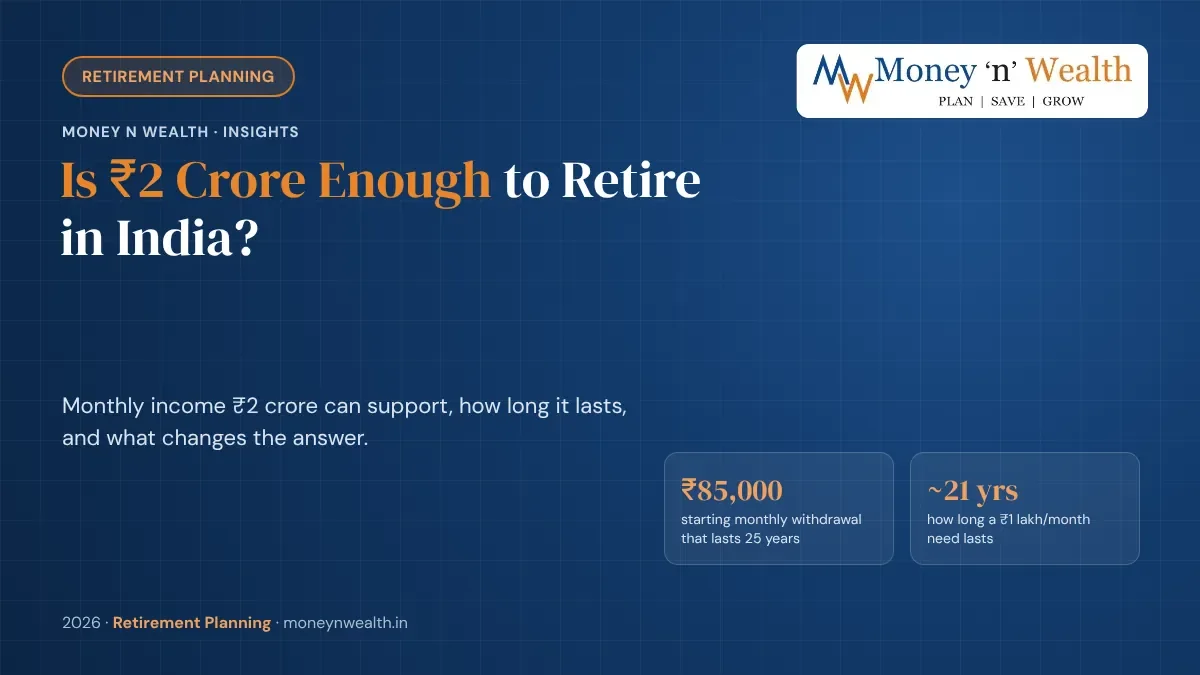
Quick answer (₹2 Crore Enough to Retire): ₹2 crore can fund a comfortable retirement for many Indian families, but how comfortable depends on three numbers: monthly expenses, the number of years the money must last, and other income such as a pension or rent. At an assumed 8% return and 6% inflation, ₹2 crore supports a starting withdrawal of about ₹85,000 a month for 25 years or ₹74,500 a month for 30 years, rising every year with prices. A ₹1 lakh monthly need that grows with inflation would use it up in about 21 years.
Last updated: 19 October 2026 · Reviewed by the Money n Wealth research desk Quick answer (₹2 Crore Enough to Retire): ₹2 crore can fund a comfortable retirement for many Indian families, but how comfortable depends on three numbers: monthly expenses, the number of years the money must last, and other income such as a pension or rent. At an assumed 8% return and 6% inflation, ₹2 crore supports a starting withdrawal of about ₹85,000 a month for 25 years or ₹74,500 a month for 30 years , rising every year with prices. A ₹1 lakh monthly need that grows with inflation would use it up in about 21 years. Key takeaways Income range: a 3% to 6% starting withdrawal gives ₹50,000 to ₹1 lakh a month from ₹2 crore. Inflation matters most: at 6%, ₹1 lakh of expenses today becomes about ₹1.79 lakh in 10 years and ₹3.2 lakh in 20 years. Horizon: retiring at 60 usually means planning for 25 to 30 years; retiring at 50 means 35 years or more. Other income stretches the corpus: a pension or rent that covers part of the bill lowers the withdrawal rate sharply. Structure: splitting the corpus into short, medium and long-term buckets helps manage both income and market falls. "Is ₹2 crore enough to retire?" is one of the most common questions families ask once their savings cross the crore mark. The honest answer is that ₹2 crore is a large sum, but a retirement can last 25 to 35 years, and prices keep rising throughout. This guide shows, with clearly stated assumptions, how much monthly income ₹2 crore can support, how long it lasts at different withdrawal levels, and what changes the answer. For the ₹1 crore version of this question, see Is ₹1 crore enough to retire? (/insights/is-1-crore-enough-to-retire-india-magic-number) How much monthly income can ₹2 crore give? The simplest way to think about it is the starting withdrawal rate: the share of the corpus taken out in the first year. Lower rates leave more room for a long retirement and bad market years; higher rates suit shorter horizons. Corpus of ₹2 crore. First-year figures before tax. In later years the withdrawal is usually raised with inflation. Starting withdrawal rate First-year income Per month 3% ₹6 lakh ₹50,000 3.5% ₹7 lakh ₹58,300 4% ₹8 lakh ₹66,700 5% ₹10 lakh ₹83,300 6% ₹12 lakh ₹1,00,000 A 6% rate gives the headline-friendly ₹1 lakh a month, but it is the rate at which the corpus runs down fastest, as the next table shows. How long will ₹2 crore last? The table below assumes the monthly withdrawal is raised by 6% every year to keep up with inflation, and that the remaining money earns the return shown, after costs. Taxes are ignored. ₹2 crore corpus; withdrawals rise 6% a year; returns are assumed steady after costs and before tax. Illustrative, not a forecast. Starting monthly withdrawal At 7% return At 8% return At 9% return ₹50,000 about 41 years about 54 years does not run out in a normal lifetime ₹66,700 (4%) about 29 years about 35 years about 45 years ₹75,000 about 26 years about 30 years about 36 years ₹83,300 (5%) about 23 years about 26 years about 30 years ₹1,00,000 (6%) about 19 years about 21 years about 23 years ₹1,25,000 about 15 years about 16 years about 17 years Two patterns stand out. First, each extra ₹25,000 of starting withdrawal takes years off the corpus. Second, a 1% difference in return changes the outcome by several years, which is why the mix of investments and their costs matter as much as the corpus itself. How many years ₹2 crore lasts at monthly withdrawals from ₹50,000 to ₹1.25 lakh How much can be withdrawn so ₹2 crore lasts 25, 30 or 35 years? Turning the question around: if the money must last a set number of years, what is the highest starting monthly withdrawal it can support? Highest starting monthly withdrawal from ₹2 crore, rising 6% a year, that lasts the full period. Before tax; illustrative. Money must last At 7% return At 8% return At 9% return 20 years ₹93,800 ₹1,02,500 ₹1,11,500 25 years ₹76,800 ₹85,600 ₹95,000 30 years ₹65,400 ₹74,500 ₹84,100 35 years ₹57,400 ₹66,600 ₹76,500 40 years ₹51,300 ₹60,700 ₹70,900 For a 60-year-old planning to age 90, the 30-year row is the most relevant: roughly ₹65,000 to ₹84,000 a month to start, depending on returns. Someone retiring at 50 is closer to the 35 or 40-year rows. Why a flat ₹1 lakh a month looks safe but is not At 8%, ₹2 crore earns about ₹1.29 lakh a month, so a flat ₹1 lakh withdrawal never seems to touch the principal. The catch is buying power. At 6% inflation, ₹1 lakh a month buys what about ₹56,000 buys today after 10 years and about ₹31,000 after 20 years . A plan that never raises the withdrawal quietly cuts the family's standard of living every year. Read more in what ₹1 crore will be worth in future (/insights/inflation-value-of-1-crore-future) . Worked example: a couple retiring at 60 with ₹2 crore Consider a Pune couple, both 60, with a paid-off home, separate health insurance and monthly expenses of ₹80,000. They want the money to last to age 90 (30 years) and have no pension. The gap: at an assumed 8% return, ₹2 crore supports about ₹74,500 a month for 30 years, slightly below the ₹80,000 need. Small part-time income, rent, or trimming discretionary spending by about ₹5,500 a month closes the gap; so does working two more years. Bucket 1, years 1–2 (about ₹19 lakh): two years of expenses in a savings sweep, liquid fund or short deposits, so that a market fall never forces a sale. Bucket 2, income (about ₹75 lakh): the Senior Citizens' Savings Scheme allows up to ₹30 lakh per individual (₹60 lakh for the couple) at 8.2% for October–December 2026, paid quarterly, which is about ₹4.9 lakh a year in interest. A joint POMIS account of up to ₹15 lakh at 7.4% adds about ₹1.1 lakh a year, paid monthly. Bucket 3, growth (about ₹1.06 crore): diversified equity or hybrid funds for the long run, used to refill the first two buckets every year or two. This is an illustration of the structure, not a recommendation for any couple's actual allocation. Rates on small savings schemes are reset every quarter. Tax on retirement income (FY 2026-27) Interest from SCSS, POMIS and deposits is taxed at slab rates. For senior citizens, TDS on interest applies above ₹1 lakh a year per payer under Section 393(1) of the Income-tax Act, 2025 (earlier Section 194A). Form 121 replaces Forms 15G and 15H from tax year 2026-27. Old regime: senior citizens can deduct up to ₹50,000 of deposit interest under Section 153 (earlier 80TTB). New regime: the rebate makes normal income up to ₹12 lakh tax-free, and pension gets a ₹75,000 standard deduction. Mutual fund withdrawals: in a systematic withdrawal plan only the gain part of each withdrawal is taxed. Equity fund long-term gains are taxed at 12.5% above ₹1.25 lakh a year; most debt fund gains on units bought after 1 April 2023 are taxed at slab rates. Because each source is taxed differently, the order in which money is withdrawn can change the after-tax income noticeably. See five tax-efficient withdrawal strategies (/insights/retirement-tax-planning-five-withdrawal-strategies) . Five things that change the answer Health costs: Aon projected India's medical cost trend at 11.5% for 2026, well above general inflation. Adequate health cover, bought before retirement, protects the corpus. Longevity: planning to 90 or beyond is safer than planning to average life expectancy, especially for the younger spouse. Housing: a paid-off home removes the largest single expense; a family that pays rent needs a noticeably larger corpus. Dependants and goals: support for parents, a child's wedding or gifts to grandchildren come out of the same pool. Order of returns: a market fall in the first few years of retirement hurts more than the same fall later, which is why the short-term buckets exist. How Money n Wealth helps families plan retirement Money n Wealth is the investment distribution and planning practice of Predics Fintech Services Pvt Ltd, based in Thergaon, Pune. We help families work out their own number with a year-by-year projection, using our online planner (/planner) , and review existing portfolios through a portfolio review (/portfolio-review) . We are an AMFI-registered mutual fund distributor (ARN-121995) and an APMI-registered PMS distributor (APRN07444). To discuss your situation, contact the team (/contact) . Disclaimer: Educational information only; not a personalised investment, tax or insurance recommendation. All projections are illustrative and based on the stated assumptions; actual returns, inflation, interest rates and tax rules will differ. Mutual fund investments are subject to market risks, read all scheme related documents carefully. Past performance is not indicative of future returns. Consult a qualified professional for your circumstances. Related reading on Money n Wealth Is ₹1 crore enough to retire? The magic number (/insights/is-1-crore-enough-to-retire-india-magic-number) Retirement income strategy for India (/insights/retirement-income-strategy-india) Retirement income: pension, rent or SWP for 25 years (/insights/retirement-income-pension-rent-or-swp-25-years) Senior Citizens' Savings Scheme guide (/insights/senior-citizens-savings-scheme-scss-guide) Browse all Money n Wealth Insights (/insights) Sources and further reading MoSPI: CPI press release for September 2026 (https://www.mospi.gov.in/uploads/latestreleasesfiles/1791801549227-Press%20Release%20for%20the%20month%20of%20September,%202026.pdf) Small savings interest rates for October–December 2026 (https://www.angelone.in/news/personal-finance/finance-minister-announces-small-savings-interest-rates-for-october-december-2026-quarter) Section 153 of the Income-tax Act, 2025 (senior citizens' interest deduction) (https://ebizfiling.com/blog/section-153-of-the-income-tax-act/) TDS on interest under Section 393(1) (https://blog.tdsman.com/2026/05/tds-on-interest-other-than-interest-on-securities-section-3931-section-194a/) Form 121 replaces Forms 15G/15H (https://cleartax.in/s/form-121) Aon: India 2026 medical trend at 11.5% (https://www.aon.com/apac/in-the-press/asia-newsroom/2025/india-outpaces-global-average-with-2026-medical-trend-at-11-5-percent-aon-reports) Frequently asked questions Is ₹2 crore enough to retire in India? It can be, depending on expenses, age and other income. At an assumed 8% return and 6% inflation, ₹2 crore supports a starting withdrawal of about ₹85,000 a month for 25 years or about ₹74,500 a month for 30 years, with the withdrawal rising every year to keep pace with prices. Families who need more than that, or who retire early, usually need a pension, rent or a larger corpus alongside it. How much monthly income can ₹2 crore generate? At a 3% to 6% starting withdrawal rate, ₹2 crore gives roughly ₹50,000 to ₹1 lakh a month in the first year. Rates of 3.5% to 4.5% are commonly used for retirements of 30 years or more; higher rates suit shorter horizons. How long will ₹2 crore last if I withdraw ₹1 lakh a month? If the ₹1 lakh is raised by 6% every year for inflation, ₹2 crore lasts about 19 years at a 7% return, 21 years at 8% and 23 years at 9%. A flat ₹1 lakh that never rises looks sustainable on paper, but its buying power roughly halves every 12 years at 6% inflation. Can ₹2 crore last 30 years? Yes, if the starting withdrawal is modest. At 8% returns and 6% inflation, a starting withdrawal of about ₹74,500 a month, increased every year, lasts about 30 years. At 7% returns the figure drops to about ₹65,000 a month. Where is a retirement corpus usually kept? Many retirees use a bucket approach: one to two years of expenses in liquid funds or short deposits, the next several years in income options such as the Senior Citizens' Savings Scheme, POMIS, deposits and debt or hybrid funds, and the long-term portion in diversified equity or hybrid funds for growth. The split depends on other income, health and comfort with market ups and downs.
Frequently Asked Questions
Is ₹2 crore enough to retire in India?
It can be, depending on expenses, age and other income. At an assumed 8% return and 6% inflation, ₹2 crore supports a starting withdrawal of about ₹85,000 a month for 25 years or about ₹74,500 a month for 30 years, with the withdrawal rising every year to keep pace with prices. Families who need more than that, or who retire early, usually need a pension, rent or a larger corpus alongside it.
How much monthly income can ₹2 crore generate?
At a 3% to 6% starting withdrawal rate, ₹2 crore gives roughly ₹50,000 to ₹1 lakh a month in the first year. Rates of 3.5% to 4.5% are commonly used for retirements of 30 years or more; higher rates suit shorter horizons.
How long will ₹2 crore last if I withdraw ₹1 lakh a month?
If the ₹1 lakh is raised by 6% every year for inflation, ₹2 crore lasts about 19 years at a 7% return, 21 years at 8% and 23 years at 9%. A flat ₹1 lakh that never rises looks sustainable on paper, but its buying power roughly halves every 12 years at 6% inflation.
Can ₹2 crore last 30 years?
Yes, if the starting withdrawal is modest. At 8% returns and 6% inflation, a starting withdrawal of about ₹74,500 a month, increased every year, lasts about 30 years. At 7% returns the figure drops to about ₹65,000 a month.
Where is a retirement corpus usually kept?
Many retirees use a bucket approach: one to two years of expenses in liquid funds or short deposits, the next several years in income options such as the Senior Citizens' Savings Scheme, POMIS, deposits and debt or hybrid funds, and the long-term portion in diversified equity or hybrid funds for growth. The split depends on other income, health and comfort with market ups and downs.