Post Office Monthly Income Scheme (POMIS) 2026: Rate, Limits and Returns
Last updated: 13 October 2026
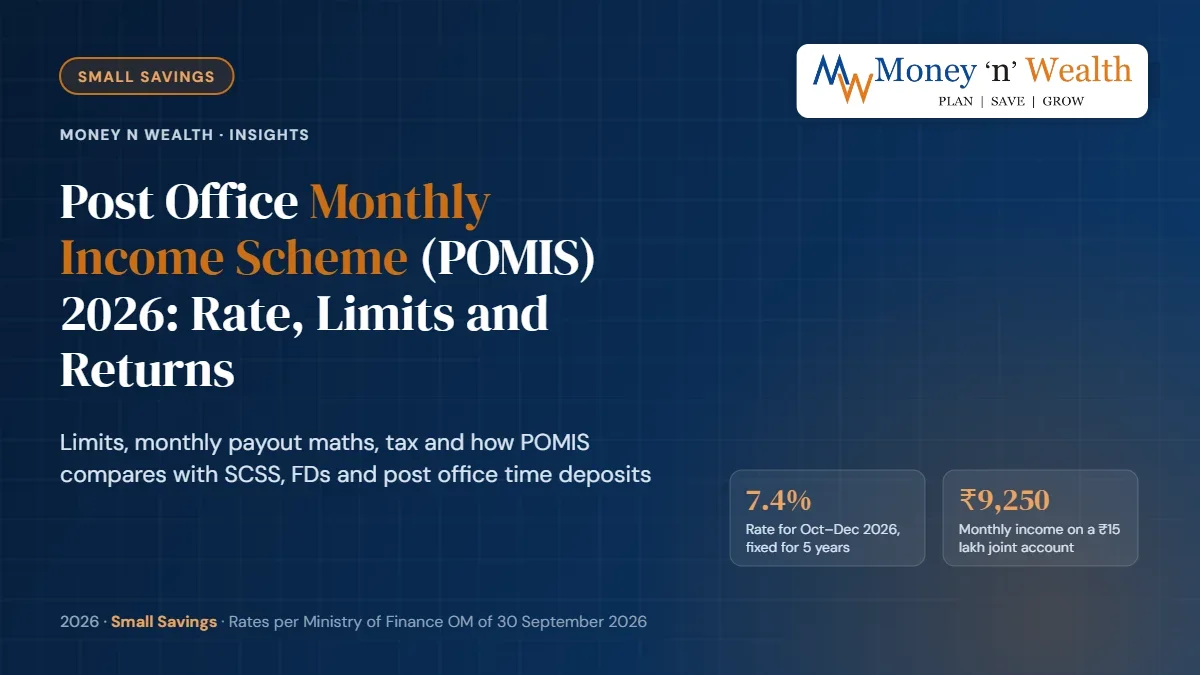
Quick answer: The Post Office Monthly Income Scheme (POMIS) pays 7.4% a year for October–December 2026, credited every month for five years. You can invest up to ₹9 lakh alone or ₹15 lakh jointly, earning ₹5,550 or ₹9,250 a month. The rate is fixed and government-backed, but interest is fully taxable and there is no section 123 deduction.
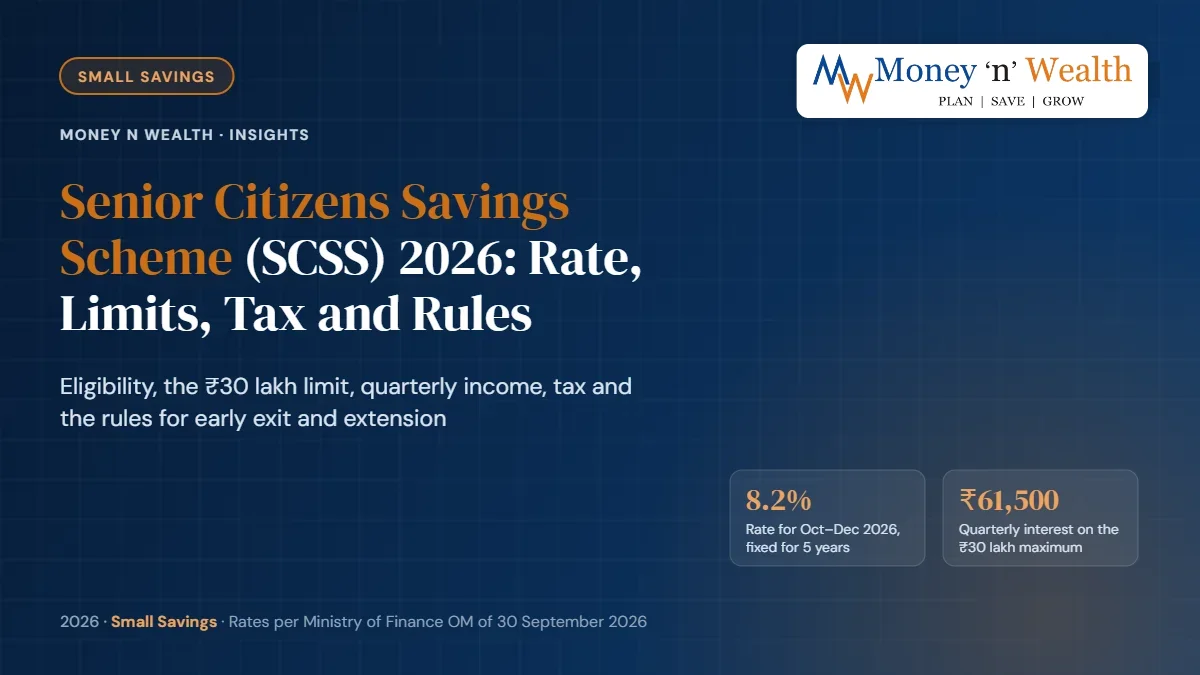
Last updated: 13 October 2026 Quick answer: The Post Office Monthly Income Scheme (POMIS) pays 7.4% a year for October–December 2026, credited every month for five years. You can invest up to ₹9 lakh alone or ₹15 lakh jointly, earning ₹5,550 or ₹9,250 a month. The rate is fixed and government-backed, but interest is fully taxable and there is no section 123 deduction. Key takeaways Rate: 7.4% for Oct–Dec 2026, unchanged since at least January 2024 and locked for your five-year term. Limits: ₹1,000 minimum; ₹9 lakh single and ₹15 lakh joint (up to three adults). Income: ₹5,550 a month on ₹9 lakh; ₹9,250 on ₹15 lakh. Tax: interest taxed at your slab; no deduction for the deposit. Exit: no withdrawal in year one; 2% of the deposit deducted in years 1–3, 1% after that. Ask a retired couple in Kothrud or Aundh what they want from their savings, and the answer is rarely "maximum return". It is usually "a fixed amount in the bank on the first of every month". The Post Office Monthly Income Scheme was built for exactly that. This guide explains the POMIS interest rate for October–December 2026, the deposit limits, the monthly payout maths, tax treatment, premature closure rules, and how POMIS stacks up against the Senior Citizens Savings Scheme, bank FDs and the post office's own five-year time deposit. What is the Post Office Monthly Income Scheme? The Post Office Monthly Income Scheme (POMIS) , officially the National Savings Monthly Income Account, is a five-year government small savings scheme that pays a fixed rate of interest every month on a one-time deposit. It is available only at post offices, not at banks. The Ministry of Finance's office memorandum dated 30 September 2026 kept all small savings rates unchanged for 1 October to 31 December 2026. POMIS therefore pays 7.4% a year . Like SCSS and NSC, the rate on the day you invest stays fixed for your full five years; later revisions affect only new deposits. Feature POMIS rule (as of October 2026) Interest rate 7.4% a year, fixed for five years Interest payment Monthly, at the end of each month from the date of opening Minimum deposit ₹1,000, in multiples of ₹1,000 Maximum deposit ₹9 lakh (single); ₹15 lakh (joint) Who can open Resident adults; up to three adults jointly; guardian for a minor; minor aged 10+ in own name Tenure 5 years; deposit is one-time Tax No deduction on deposit; interest taxable at slab Safety Sovereign obligation of the Government of India For the whole rate card, see small savings interest rates for October–December 2026 (/insights/small-savings-interest-rates-oct-dec-2026) . How much can you invest in POMIS? The Union Budget 2023-24 doubled the limits from April 2023. Today, an individual can hold up to ₹9 lakh across all single MIS accounts, and a joint account can hold up to ₹15 lakh . Joint accounts: up to three adults can hold one account, and each holder is treated as having an equal share. Overall cap: your total, counting single accounts and your share of joint accounts, cannot exceed ₹9 lakh. Multiple accounts: you can open more than one account at different post offices within that cap, which helps if you want staggered maturities. Minors: a guardian can open one for a minor, and a child aged 10 or above can open one in their own name. So a husband and wife can use a ₹15 lakh joint account, or hold ₹9 lakh each in single accounts for ₹18 lakh in total. Remember that if one spouse funds the other's deposit, the interest is clubbed back to the giver for tax. How much monthly income does POMIS pay? POMIS pays simple interest. Divide the annual rate by 12 and multiply by your deposit: ₹9,00,000 × 7.4% ÷ 12 = ₹5,550 a month. POMIS deposit Monthly income Yearly income Total interest over 5 years ₹1,00,000 ₹617 ₹7,400 ₹37,000 ₹5,00,000 ₹3,083 ₹37,000 ₹1,85,000 ₹9,00,000 (single maximum) ₹5,550 ₹66,600 ₹3,33,000 ₹15,00,000 (joint maximum) ₹9,250 ₹1,11,000 ₹5,55,000 At maturity you get your full principal back. Interest that you leave sitting in the savings account earns only the 4% savings rate, not 7.4%. Post Office Monthly Income Scheme POMIS monthly payout chart for ₹1 lakh to ₹15 lakh at 7.4% Turning POMIS into a compounding plan If you do not need the monthly income yet, India Post lets you route it into a five-year recurring deposit, which paid 6.7% in October–December 2026. Reinvesting ₹5,550 a month this way builds roughly ₹3.96 lakh after five years, against ₹3.33 lakh of interest received but not reinvested. Our guide to cumulative vs payout deposits (/insights/fd-calculator-cumulative-vs-payout-tds) explains why reinvestment matters. How is POMIS interest taxed? POMIS offers no tax break. The deposit does not qualify for the section 123 deduction (the old section 80C) under the Income-tax Act, 2025, and the interest is fully taxable at your slab rate as income from other sources, every year. Your marginal tax rate (with 4% cess) POMIS post-tax yield Monthly income kept on ₹9 lakh Nil 7.40% ₹5,550 5% 7.02% ₹5,261 10% 6.63% ₹4,973 20% 5.86% ₹4,396 30% 5.09% ₹3,818 Whether or not tax is deducted at source by the post office, the interest must be reported in your income-tax return. Check your Annual Information Statement, where post office interest is reported against your PAN. If your estimated tax for the year is nil and TDS applies to your post office interest, Form 121 (which replaced Forms 15G and 15H from tax year 2026-27) is the route to prevent deduction. For many retirees and homemakers, the new regime's nil slab up to ₹4 lakh and the section 156 rebate on taxable income up to ₹12 lakh mean the tax is zero anyway. See our senior citizen tax planning guide (/insights/senior-citizen-tax-planning-interest-pension-rent) and financial planning for homemakers (/insights/financial-planning-for-homemakers-and-women) . Can you withdraw from POMIS early? Yes, after the first year, with a deduction from your principal. When you close Deduction from deposit On ₹9 lakh Before 1 year Not allowed – After 1 year, before 3 years 2% of the deposit ₹18,000 After 3 years, before 5 years 1% of the deposit ₹9,000 On maturity (5 years) Nil ₹0 If the account holder dies before maturity, the account can be closed and the money paid to the nominee or legal heirs without a penalty. Keep a nominee registered on every account; our checklist for claiming a parent's investments (/insights/claim-deceased-parent-investments-checklist) covers the paperwork families face. There is no extension option. At maturity, you collect the principal and can open a fresh account at the rate then prevailing. POMIS vs SCSS vs FD: which pays more? For a senior citizen, SCSS usually wins on rate. For anyone below 60, POMIS is one of the few guaranteed monthly-income products from the government. Comparison of monthly income from ₹15 lakh in POMIS, SCSS and a senior citizen monthly payout FD Option (Oct 2026) Rate Payout Limit Eligibility Tax benefit on deposit POMIS 7.4% Monthly ₹9 lakh / ₹15 lakh joint Any resident adult None SCSS 8.2% Quarterly ₹30 lakh per person 60+ (some retirees earlier) Section 123, old regime 5-year post office time deposit 7.5% (compounded quarterly, paid yearly) Yearly No upper limit Any resident Section 123, old regime Big-bank senior FD (monthly payout) About 7.05–7.10% Monthly No limit; DICGC cover ₹5 lakh per bank Any Only 5-year tax-saver FD Two practical points stand out. First, the five-year time deposit's 7.5% compounded quarterly works out to about 7.71% a year: on ₹9 lakh it pays ₹69,422 once a year, against ₹66,600 from POMIS spread over twelve months. If you can wait for yearly income, the time deposit pays slightly more. Second, bank monthly-payout FDs are paid at a discounted monthly rate, so ₹15 lakh at 7.10% gives about ₹8,823 a month, below POMIS's ₹9,250. Side-by-side comparison of Post Office Monthly Income Scheme and Senior Citizens Savings Scheme A common structure for a retired couple is to fill SCSS first, use a POMIS joint account for smooth monthly cash flow, and keep an FD ladder for liquidity. Our SCSS guide (/insights/senior-citizens-savings-scheme-scss-guide) and FD vs SCSS vs RBI Floating Rate Bonds comparison (/insights/senior-citizen-fd-vs-scss-vs-rbi-floating-rate-bonds) go deeper. Who should invest in POMIS, and who should not? POMIS suits: Early retirees below 60 who cannot yet use SCSS but need monthly income. Senior citizens who have already filled the ₹30 lakh SCSS limit and want monthly rather than quarterly cash. Homemakers and parents who want a safe, simple income stream in their own name. Low-bracket taxpayers , for whom the 7.4% is close to the post-tax return. It is weaker for people in the 20–30% slabs, where the post-tax yield falls to about 5–6%, below September 2026's CPI inflation of 5.54%. For long horizons, a fixed monthly payout also loses purchasing power: at 5.5% inflation, ₹9,250 received five years from now will buy only what about ₹7,080 buys today. Retirees with a large corpus often add a systematic withdrawal plan from mutual funds (/insights/swp-systematic-withdrawal-plan-guide) for income that can grow, as explained in our retirement income strategy guide (/insights/retirement-income-strategy-india) . How to open a POMIS account Open a post office savings account if you do not have one; monthly interest is credited there. Fill the account opening form at the post office (or via India Post's internet banking if your savings account has it), choosing single or joint and naming a nominee. Submit KYC: PAN, Aadhaar and passport-size photographs. Deposit by cheque or cash; the account date is the date of deposit or cheque realisation. Optionally , give a standing instruction to move monthly interest into a recurring deposit. Four steps to open a Post Office Monthly Income Scheme account You can also use our goal and retirement calculators (/tools) to check how much monthly income your plan needs before choosing a product. Related reading Senior Citizens Savings Scheme (SCSS): complete guide (/insights/senior-citizens-savings-scheme-scss-guide) Small savings interest rates for October–December 2026 (/insights/small-savings-interest-rates-oct-dec-2026) NSC and Kisan Vikas Patra explained (/insights/nsc-kisan-vikas-patra-guide) FD rates compared: banks, SFBs and corporate FDs (October 2026) (/insights/fd-rates-comparison-october-2026) Retirement income for 25 years: pension, rent or SWP? (/insights/retirement-income-pension-rent-or-swp-25-years) Frequently Asked Questions What is the POMIS interest rate for October–December 2026? The Post Office Monthly Income Scheme pays 7.4% a year for accounts opened between 1 October and 31 December 2026, according to the Ministry of Finance office memorandum of 30 September 2026. The rate is fixed for the full five-year term of your account, so later rate cuts or increases do not change your monthly payout. How much will I get monthly if I invest ₹9 lakh in POMIS? At 7.4%, a ₹9 lakh single account pays ₹5,550 every month for five years, or ₹66,600 a year. Over the full term you receive ₹3,33,000 of interest, and your ₹9 lakh principal is returned at maturity. A ₹15 lakh joint account pays ₹9,250 a month. Is POMIS interest taxable? Yes. POMIS interest is taxed at your slab rate every year, and the deposit does not qualify for the section 123 (old 80C) deduction. Report the interest in your return even if no tax is deducted. Many retirees and homemakers pay no tax because the new regime makes taxable income up to ₹12 lakh tax-free. Can I withdraw POMIS money before five years? Not in the first year. Between one and three years, you can close the account with 2% of the deposit deducted; between three and five years, the deduction is 1%. On ₹9 lakh that is ₹18,000 or ₹9,000. The money is paid to nominees without penalty if the holder dies. Is POMIS better than SCSS for senior citizens? Usually not on rate: SCSS pays 8.2% against POMIS's 7.4%, and allows ₹30 lakh per person. POMIS pays monthly rather than quarterly and has no age condition. Seniors often fill SCSS first and use POMIS for additional monthly cash flow within its ₹9 lakh or ₹15 lakh joint limit. Can a minor or NRI open a POMIS account? A guardian can open an account for a minor, and a child aged 10 or above can open one in their own name. NRIs cannot open new POMIS accounts; the scheme is for resident Indians. If you are planning a move abroad, check with your post office how existing accounts will be treated. Can I open POMIS in a bank? No. Unlike SCSS, PPF and Sukanya Samriddhi, the Monthly Income Scheme is offered only at post offices. You need a post office savings account for the monthly interest credit, and many post offices also offer internet and mobile banking for existing customers. Sources: Ministry of Finance (DEA) office memorandum of 30 September 2026, as reproduced by StaffNews (https://www.staffnews.in/?p=168643) ; TaxGuru, Q3 2026-27 small savings rate table (https://taxguru.in/?p=1084242) ; Angel One, Oct–Dec 2026 small savings rates (https://www.angelone.in/news/personal-finance/finance-minister-announces-small-savings-interest-rates-for-october-december-2026-quarter) ; Business Today, Q3 FY27 rates (https://www.businesstoday.in/personal-finance/story/small-savings-scheme-interest-rates-unchanged-for-q3-fy27-check-ppf-scss-ssy-rates-558892-2026-09-30) ; Income Tax Department, Form 121 FAQs (https://www.incometaxindia.gov.in/documents/d/guest/form-121-faqs) ; National Savings (Monthly Income Account) Scheme, 2019 (India Post). Worked examples are Money n Wealth calculations. Building a monthly income from your savings? The right mix of POMIS, SCSS, FDs and an SWP depends on your age, tax slab and expenses. Talk to Money n Wealth (/contact) for a free portfolio review. This article is for general educational purposes only and does not constitute financial advice. Figures and examples are illustrative. Please consult a qualified financial adviser for guidance specific to your situation. Money n Wealth (Predics Fintech Services Pvt Ltd) is an AMFI-registered Mutual Fund Distributor (ARN-121995) and APMI-registered PMS Distributor (APRN07444); it is not a SEBI-registered investment adviser and may earn distribution commission on investments made through it.
Frequently Asked Questions
What is the POMIS interest rate for October–December 2026?
The Post Office Monthly Income Scheme pays 7.4% a year for accounts opened between 1 October and 31 December 2026, according to the Ministry of Finance office memorandum of 30 September 2026. The rate is fixed for the full five-year term of your account, so later rate cuts or increases do not change your monthly payout.
How much will I get monthly if I invest ₹9 lakh in POMIS?
At 7.4%, a ₹9 lakh single account pays ₹5,550 every month for five years, or ₹66,600 a year. Over the full term you receive ₹3,33,000 of interest, and your ₹9 lakh principal is returned at maturity. A ₹15 lakh joint account pays ₹9,250 a month.
Is POMIS interest taxable?
Yes. POMIS interest is taxed at your slab rate every year, and the deposit does not qualify for the section 123 (old 80C) deduction. Report the interest in your return even if no tax is deducted. Many retirees and homemakers pay no tax because the new regime makes taxable income up to ₹12 lakh tax-free.
Can I withdraw POMIS money before five years?
Not in the first year. Between one and three years, you can close the account with 2% of the deposit deducted; between three and five years, the deduction is 1%. On ₹9 lakh that is ₹18,000 or ₹9,000. The money is paid to nominees without penalty if the holder dies.
Is POMIS better than SCSS for senior citizens?
Usually not on rate: SCSS pays 8.2% against POMIS's 7.4%, and allows ₹30 lakh per person. POMIS pays monthly rather than quarterly and has no age condition. Seniors often fill SCSS first and use POMIS for additional monthly cash flow within its ₹9 lakh or ₹15 lakh joint limit.
Can a minor or NRI open a POMIS account?
A guardian can open an account for a minor, and a child aged 10 or above can open one in their own name. NRIs cannot open new POMIS accounts; the scheme is for resident Indians. If you are planning a move abroad, check with your post office how existing accounts will be treated.
Can I open POMIS in a bank?
No. Unlike SCSS, PPF and Sukanya Samriddhi, the Monthly Income Scheme is offered only at post offices. You need a post office savings account for the monthly interest credit, and many post offices also offer internet and mobile banking for existing customers.
Building a monthly income from your savings?
The right mix of POMIS, SCSS, FDs and an SWP depends on your age, tax slab and expenses. Talk to Money n Wealth for a free portfolio review.