NSC and Kisan Vikas Patra 2026: Interest Rates, Returns and Tax
Last updated: 13 October 2026
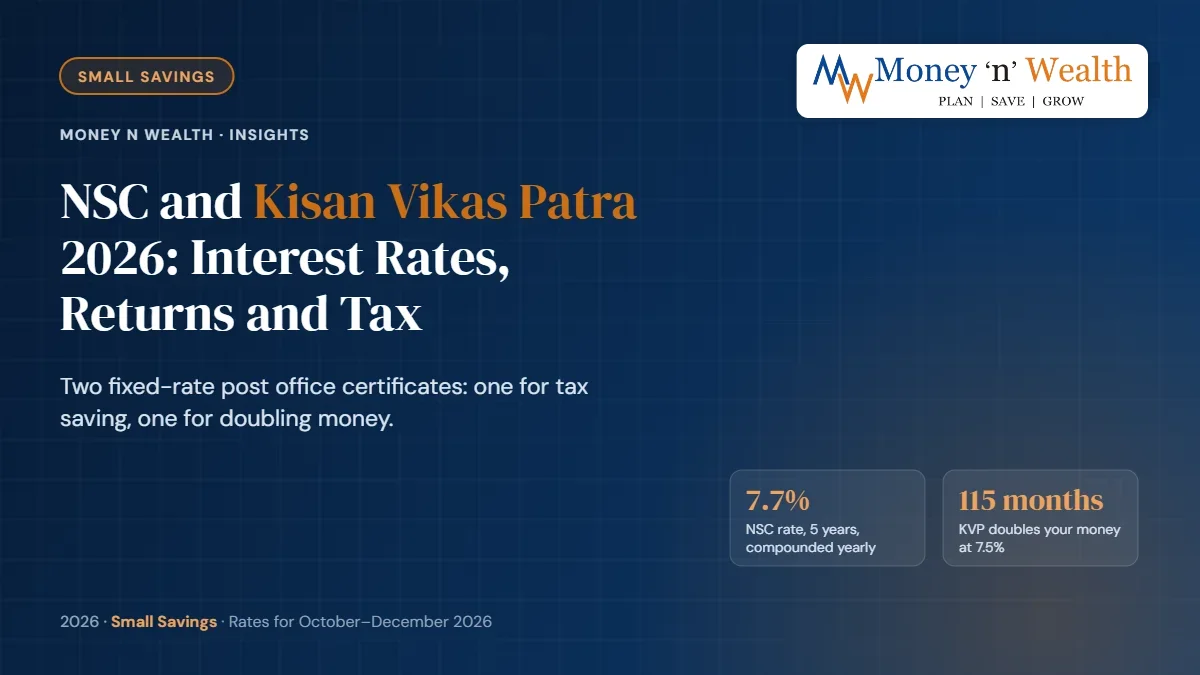
Quick answer: For October–December 2026, the National Savings Certificate (NSC) pays 7.7% and Kisan Vikas Patra (KVP) pays 7.5%, both compounded annually and fixed for the full term. ₹1 lakh in NSC grows to ₹1,44,903 in five years and qualifies for the old-regime tax deduction. KVP doubles money in 115 months, allows exit after 2.5 years, but offers no deduction.
Last updated: 13 October 2026 Quick answer: For October–December 2026, the National Savings Certificate (NSC) pays 7.7% and Kisan Vikas Patra (KVP) pays 7.5%, both compounded annually and fixed for the full term. ₹1 lakh in NSC grows to ₹1,44,903 in five years and qualifies for the old-regime tax deduction. KVP doubles money in 115 months, allows exit after 2.5 years, but offers no deduction. Key takeaways Rates: NSC 7.7%, KVP 7.5% for October–December 2026, unchanged since April 2023. Locked in: the rate on your purchase date applies until maturity, even if rates fall later. NSC: 5 years; deposit and reinvested interest qualify under section 123 (old 80C), old regime only. KVP: doubles in 115 months; premature encashment allowed after 30 months. Tax: interest on both is taxable at slab rate; no TDS is deducted. Walk into any post office in Pune and you will still find retirees and small-business owners buying NSCs and Kisan Vikas Patras, often the way their parents did. These two certificates have outlived many flashier products for a simple reason: a sovereign guarantee and a rate that cannot be cut once you buy. In October 2026 that fixed rate matters more than usual. The RBI has just raised the repo rate, but big banks have barely moved FD rates, while NSC and KVP still pay more than most bank deposits. This guide explains how each certificate works, what it really earns after tax, and which one suits which investor. What are NSC and Kisan Vikas Patra? The National Savings Certificate (NSC VIII Issue) is a five-year, fixed-rate savings certificate issued by the Government of India through post offices. Interest compounds annually and is paid with the principal at maturity. Its main draw is that the investment qualifies for the old-regime tax deduction. Kisan Vikas Patra is a fixed-rate certificate that doubles your investment over a set period, currently 115 months (9 years and 7 months). Despite the name, which means "farmer development certificate", any resident adult can buy it. Feature NSC (VIII Issue) Kisan Vikas Patra Interest rate (Oct–Dec 2026) 7.7% a year 7.5% a year Compounding Annual, paid at maturity Annual, paid at maturity Tenure 5 years 115 months Minimum / maximum ₹1,000 (multiples of ₹100); no maximum ₹1,000 (multiples of ₹100); no maximum Tax deduction on investment Yes, section 123 (old regime) No Premature exit Only on death, forfeiture by a pledgee, or court order After 2 years 6 months, or on death, forfeiture or court order Who can buy Resident adults (single or joint up to 3), guardians for minors, minors over 10 Same Pledge as loan security Yes Yes TDS None None Both rates were notified by the Ministry of Finance's office memorandum of 30 September 2026, which kept all small savings rates for October–December 2026 (/insights/small-savings-interest-rates-oct-dec-2026) unchanged. India Post circulated it as SB Order No. 12/2026 (https://utilities.cept.gov.in/dop/pdfbind.ashx?id=15533) . Side-by-side comparison of NSC and Kisan Vikas Patra rates, tenure, tax deduction and premature withdrawal rules NSC interest rate 2026 and maturity value An NSC bought between 1 October and 31 December 2026 earns 7.7% compounded annually for all five years. Interest is not paid out each year. It accrues, is treated as reinvested, and is returned with the principal at maturity. Year Opening value Interest accrued Closing value Section 123 eligible? 1 ₹1,00,000 ₹7,700 ₹1,07,700 Yes (reinvested) 2 ₹1,07,700 ₹8,293 ₹1,15,993 Yes (reinvested) 3 ₹1,15,993 ₹8,931 ₹1,24,924 Yes (reinvested) 4 ₹1,24,924 ₹9,619 ₹1,34,544 Yes (reinvested) 5 ₹1,34,544 ₹10,360 ₹1,44,903 No (paid out) Bar chart of NSC interest accrued each year on ₹1 lakh at 7.7%, rising from ₹7,700 to ₹10,360 The same arithmetic scales: ₹50,000 becomes ₹72,452, ₹5 lakh becomes ₹7,24,517 and ₹10 lakh becomes ₹14,49,034. Older NSCs keep the rate at which they were bought. A certificate bought in 2021, for example, still earns 6.8% to maturity. How has the NSC rate moved? NSC paid 7.9% until March 2020, then 6.8% from April 2020 to December 2022. It rose to 7.0% for January–March 2023 and jumped 70 basis points to 7.7% in April 2023, as Business Standard reported (https://www.business-standard.com/amp/finance/news/national-savings-certificate-steeply-raised-by-70-bps-ppf-kept-unchanged-123033100987_1.html) . It has stayed there for 15 quarters. How long does Kisan Vikas Patra take to double money? At 7.5% compounded annually, KVP doubles your money in exactly 115 months. ₹1 lakh invested in October 2026 becomes ₹2 lakh in May 2036, and ₹5 lakh becomes ₹10 lakh. The doubling period moves with the rate: the higher the rate, the shorter the wait. Bar chart of Kisan Vikas Patra doubling period falling from 124 months at 6.9% to 115 months at 7.5% The maturity period is fixed on the date you buy. KVPs bought between April 2020 and September 2022, at 6.9%, take 124 months to double. When the rate rose to 7.5% in April 2023, the term was cut from 120 to 115 months. Can you cash KVP early? Yes, which is KVP's biggest practical advantage over NSC. You can encash a KVP after 2 years and 6 months from the date of issue, as this overview of KVP premature withdrawal (https://bankbazaar.com/saving-schemes/kisan-vikas-patra-premature-withdrawal.html) explains. You get the principal plus interest at a reduced, pre-set value that rises every six months. Earlier exit is allowed only on the holder's death, forfeiture by a pledgee, or a court order. That makes KVP a reasonable home for money you probably will not need for a decade but want accessible in an emergency after year three. NSC offers no such option. How are NSC and KVP taxed in 2026? Tax is where the two certificates differ most, and where your choice of tax regime under the Income-tax Act, 2025 decides the answer. NSC: deduction plus taxable interest Investment: in the old regime, the amount you invest counts towards the ₹1.5 lakh limit of section 123 (formerly section 80C), shared with PPF, EPF, ELSS and life insurance premiums. Interest in years 1–4: it is taxable each year, but because it is deemed reinvested, it also qualifies for section 123. If you have room in your limit, the two cancel out. Interest in year 5: taxable at your slab rate, with no offsetting deduction. New regime: no deduction at all, so NSC becomes a plain taxable deposit at 7.7%. KVP: no deduction, taxable interest KVP gives no deduction on investment. Interest is taxable at your slab rate. You can declare it each year as it accrues, or in the year of maturity or encashment. Whichever method you choose, apply it consistently. Declaring annually avoids a large tax bill in one year, which can push you into a higher bracket. No TDS is deducted on NSC or KVP interest, so you must report it yourself in your return. The tax department's annual information statement often shows it, and missing it is a common reason for income tax notices (/insights/income-tax-notice-types-how-to-respond) . Bar chart comparing post-tax returns of NSC under old and new regime, KVP, PPF and a bank FD for a 30% taxpayer For an old-regime taxpayer at 31.2% with unused section 123 room, NSC's effective post-tax return is about 15.5% a year on the net cash outlay, because the deduction on day one cuts the real cost of ₹1 lakh to ₹68,800. In the new regime, the same NSC yields about 5.5% after tax, and KVP about 5.2%. That is still better than a 6.5% big-bank FD, which leaves about 4.5%. NSC vs KVP vs 5-year post office TD vs bank FD NSC and KVP are not the only fixed-rate options. Here is how they stack up for ₹1 lakh as of October 2026. Option Rate Value of ₹1 lakh at end of term Liquidity Deduction NSC 7.7% compounded ₹1,44,903 after 5 years Locked 5 years Yes (old regime) KVP 7.5% compounded ₹2,00,000 after 115 months From 30 months No Post office 5-yr TD 7.5% (7.71% effective) ₹7,714 interest paid each year Exit after 6 months with penalty Yes (old regime) Big-bank 5-yr FD About 6–6.5% Depends on bank Premature exit with penalty Only tax-saver FD (5-yr lock) Small finance bank 3-yr FD 7.4–8.0% Depends on bank Premature exit with penalty No Bank rates are from our October 2026 FD rate comparison (/insights/fd-rates-comparison-october-2026) . Unlike small finance bank FDs, which are insured only up to ₹5 lakh per bank by DICGC, NSC and KVP carry the full guarantee of the Government of India. Which should you choose: NSC, KVP, or neither? Neither certificate beats inflation by much. With CPI inflation at 5.54% in September 2026, a 7.7% NSC delivers about 2% a year in real terms before tax and roughly zero after tax for a 30% taxpayer in the new regime. Treat them as safe parking, not wealth builders. Your situation Better fit Why Old regime, ₹1.5 lakh limit not yet used NSC Deduction on day one plus on reinvested interest Old regime, limit already used by EPF or PPF Either, or PPF if not maxed No extra deduction; PPF is tax-free New regime, want a fixed rate for 5 years NSC or 5-yr post office TD Highest locked rate for that tenure Want a 10-year fixed rate with an escape hatch KVP Locks 7.5% for 115 months; exit possible after 30 months Need regular income Neither Consider SCSS (/insights/senior-citizens-savings-scheme-scss-guide) or POMIS (/insights/post-office-monthly-income-scheme-pomis) Long horizon, can take some volatility Neither, mostly Equity or debt funds (/insights/debt-funds-rising-interest-rates-2026) may suit better A note on locking in now After the October 2026 hike, some savers wonder whether to wait for higher rates. Small savings rates will next be reviewed around 31 December 2026, and the government has kept them unchanged since January 2024. If you buy now, you lock 7.7% or 7.5% regardless of what happens next. Our analysis of locking in deposits now or waiting (/insights/lock-in-fd-now-or-wait-rate-hike-2026) applies equally here. How to buy NSC or KVP: step by step Visit a post office (head or sub post office), or use India Post's internet banking if you have a post office savings account. Fill the application form for NSC or KVP and choose single, joint or minor holding. Submit KYC: PAN and Aadhaar. PAN is mandatory for KVP above ₹50,000, and large purchases may need proof of source of funds. Pay by cash, cheque or transfer from your post office account. Add a nominee. It speeds up any claim and avoids a legal-heir process. See our checklist for claiming a parent's investments (/insights/claim-deceased-parent-investments-checklist) . Keep the certificate details (now issued in electronic form or passbook mode) and note the maturity date. Related reading Small Savings Interest Rates for October–December 2026 (/insights/small-savings-interest-rates-oct-dec-2026) PPF: Complete Guide to Returns, Extension and Withdrawals (/insights/ppf-complete-guide) Senior Citizen Income: FD vs SCSS vs RBI Floating Rate Bonds (/insights/senior-citizen-fd-vs-scss-vs-rbi-floating-rate-bonds) FD Calculator: Cumulative vs Payout, and How TDS Works (/insights/fd-calculator-cumulative-vs-payout-tds) Tax Planning FY 2026-27: Old vs New Regime (/insights/tax-planning-guide-india) Frequently Asked Questions What is the NSC interest rate for October–December 2026? The NSC interest rate is 7.7% a year for certificates bought between 1 October and 31 December 2026, compounded annually and paid at maturity. It has been unchanged since April 2023. The rate is fixed for the full five years, so ₹1 lakh invested now grows to ₹1,44,903 even if rates are cut later. In how many months does Kisan Vikas Patra double money in 2026? Kisan Vikas Patra doubles your money in 115 months (9 years and 7 months) at the current rate of 7.5%, compounded annually. This applies to KVPs bought in October–December 2026. Older certificates keep their original term; those bought at 6.9% between April 2020 and September 2022 take 124 months. Is NSC better than a tax-saver FD? For most old-regime taxpayers, yes. NSC pays 7.7% compounded and also lets you claim the reinvested interest of years one to four under section 123. Five-year tax-saver FDs at big banks pay around 6–6.5%, with TDS on interest. Both lock your money for five years and qualify within the same ₹1.5 lakh limit. Is KVP interest taxable? Yes. KVP interest is taxable at your income-tax slab rate, and there is no deduction for the amount invested. You may declare the interest each year as it accrues or when the certificate matures or is encashed, but should follow one method consistently. No TDS is deducted, so you must report it in your return. Can I withdraw NSC before maturity? Generally no. An NSC can be encashed before five years only if the holder (or any joint holder) dies, if it is forfeited by a pledgee such as a bank that accepted it as loan security, or under a court order. If you may need the money, KVP, which can be encashed after 30 months, or a post office time deposit is more flexible. Can NRIs invest in NSC or KVP? No. New NSC and KVP certificates can be bought only by resident individuals. A certificate bought while resident can generally be held until maturity after you become an NRI, but you cannot buy fresh ones. NRIs looking for fixed returns in India usually consider NRE or FCNR deposits; see our guide to NRE, NRO and FCNR accounts (/insights/nre-vs-nro-vs-fcnr-accounts) . Can I use NSC or KVP as security for a loan? Yes. Both certificates can be pledged to banks and other approved institutions as collateral for loans. The lender records the pledge with the post office. If you default, the lender can claim the certificate, which is also one of the permitted grounds for premature encashment. Sources: Department of Posts SB Order 12/2026 (https://utilities.cept.gov.in/dop/pdfbind.ashx?id=15533) ; DEA office memorandum, 30 Sep 2026 (via TaxGuru) (https://taxguru.in/finance/small-savings-interest-rates-unchanged-october-december-2026.html) ; National Savings Certificates (VIII Issue) Amendment Rules, 2019 (https://taxguru.in/finance/national-savings-certificates-viii-issue-amendment-rules-2019.html) ; Business Standard, 31 Mar 2023 (https://www.business-standard.com/amp/finance/news/national-savings-certificate-steeply-raised-by-70-bps-ppf-kept-unchanged-123033100987_1.html) ; The Week, 1 Apr 2020 (https://www.theweek.in/news/biz-tech/2020/04/01/ppf-other-small-savings-schemes-to-fetch-lower-returns-from-today-check-revised-rates-here.amp.html) ; BankBazaar on KVP premature withdrawal (https://bankbazaar.com/saving-schemes/kisan-vikas-patra-premature-withdrawal.html) . Worked examples are Money n Wealth calculations. NSC, KVP, PPF or a debt fund: which fits your goal? The best fixed-income choice depends on your tax regime, horizon and need for liquidity. Talk to Money n Wealth (/contact) for a free portfolio review. This article is for general educational purposes only and does not constitute financial advice. Figures and examples are illustrative. Please consult a qualified financial adviser for guidance specific to your situation. Money n Wealth (Predics Fintech Services Pvt Ltd) is an AMFI-registered Mutual Fund Distributor (ARN-121995) and APMI-registered PMS Distributor (APRN07444); it is not a SEBI-registered investment adviser and may earn distribution commission on investments made through it.
Frequently Asked Questions
What is the NSC interest rate for October–December 2026?
The NSC interest rate is 7.7% a year for certificates bought between 1 October and 31 December 2026, compounded annually and paid at maturity. It has been unchanged since April 2023. The rate is fixed for the full five years, so ₹1 lakh invested now grows to ₹1,44,903 even if rates are cut later.
In how many months does Kisan Vikas Patra double money in 2026?
Kisan Vikas Patra doubles your money in 115 months (9 years and 7 months) at the current rate of 7.5%, compounded annually. This applies to KVPs bought in October–December 2026. Older certificates keep their original term; those bought at 6.9% between April 2020 and September 2022 take 124 months.
Is NSC better than a tax-saver FD?
For most old-regime taxpayers, yes. NSC pays 7.7% compounded and also lets you claim the reinvested interest of years one to four under section 123. Five-year tax-saver FDs at big banks pay around 6–6.5%, with TDS on interest. Both lock your money for five years and qualify within the same ₹1.5 lakh limit.
Is KVP interest taxable?
Yes. KVP interest is taxable at your income-tax slab rate, and there is no deduction for the amount invested. You may declare the interest each year as it accrues or when the certificate matures or is encashed, but should follow one method consistently. No TDS is deducted, so you must report it in your return.
Can I withdraw NSC before maturity?
Generally no. An NSC can be encashed before five years only if the holder (or any joint holder) dies, if it is forfeited by a pledgee such as a bank that accepted it as loan security, or under a court order. If you may need the money, KVP, which can be encashed after 30 months, or a post office time deposit is more flexible.
Can NRIs invest in NSC or KVP?
No. New NSC and KVP certificates can be bought only by resident individuals. A certificate bought while resident can generally be held until maturity after you become an NRI, but you cannot buy fresh ones. NRIs looking for fixed returns in India usually consider NRE or FCNR deposits; see our guide to NRE, NRO and FCNR accounts .
Can I use NSC or KVP as security for a loan?
Yes. Both certificates can be pledged to banks and other approved institutions as collateral for loans. The lender records the pledge with the post office. If you default, the lender can claim the certificate, which is also one of the permitted grounds for premature encashment.
NSC, KVP, PPF or a debt fund: which fits your goal?
The best fixed-income choice depends on your tax regime, horizon and need for liquidity. Talk to Money n Wealth for a free portfolio review.