Smart Beta Funds in India: Momentum, Quality, Value and Low Volatility
Last updated: 13 October 2026
Quick answer: Smart beta or factor funds are index funds or ETFs that track rule-based indices picking stocks by a trait such as momentum, quality, value or low volatility, instead of by market cap alone. Research from Fama-French and AQR shows these factors earned long-run premiums, but each can lag for years. In India they work best as a 10–30% satellite next to a broad index core.
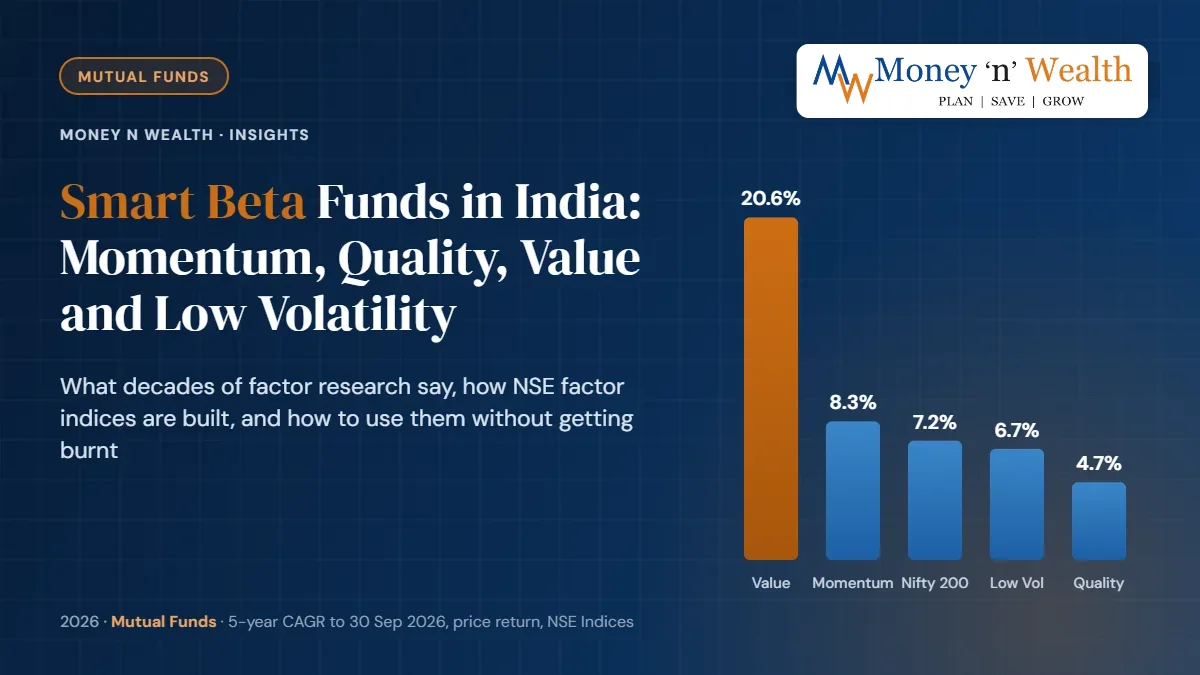
Last updated: 13 October 2026 Quick answer: Smart beta or factor funds are index funds or ETFs that track rule-based indices picking stocks by a trait such as momentum, quality, value or low volatility, instead of by market cap alone. Research from Fama-French and AQR shows these factors earned long-run premiums, but each can lag for years. In India they work best as a 10–30% satellite next to a broad index core. Key takeaways Dispersion: 5-year CAGR to Sep 2026 ranged from 20.56% (Nifty200 Value 30) to 4.67% (Nifty200 Quality 30); Nifty 200 did 7.16%. Indian evidence: IIM Ahmedabad data show momentum earned 10.65% a year and value 6.61% as long-short premia (1994–2025). Rules: factor index funds and ETFs must hold at least 95% in index stocks, like any passive fund. Rebalancing: semi-annual for momentum, quality and value; quarterly for Nifty100 Low Volatility 30. Main risk: long periods of underperformance that tempt investors to quit at the wrong time. In 2021 the hottest pitch in passive investing was "momentum". By 2023, value and PSU-heavy portfolios were leading. Through 2025 and 2026, many factor indices fell along with the broader market. An investor who chased last year's winning factor each time would have bought high and sold low, the very mistake factor investing is supposed to avoid. India now has dozens of factor index funds and ETFs. This guide explains what smart beta means, what the global and Indian evidence says, how NSE builds its factor indices, how each factor behaves across market phases, and a checklist for using them. It does not recommend any scheme. What is smart beta, and how is it different from a normal index fund? A normal index fund weights stocks by free-float market capitalisation. The biggest companies get the biggest weights, whatever their price, quality or recent trend. Smart beta is a rules-based index that selects or weights stocks by a factor : a measurable characteristic that research links to long-run returns or lower risk. It sits between passive and active investing. Like an index fund, it follows published rules with no manager discretion. Like an active fund, it deliberately deviates from the market. In India these products are launched as index funds or ETFs, so they follow the same SEBI rule: at least 95% of assets in the index's securities, as reaffirmed in SEBI's 26 February 2026 circular on scheme categorisation. Factor What it buys Example NSE index Rebalancing Momentum Stocks with the strongest volatility-adjusted 6 and 12-month price returns Nifty200 Momentum 30 Semi-annual (June, December) Quality High ROE, low debt-equity, stable EPS growth over 5 years Nifty200 Quality 30 Semi-annual Value High earnings yield, book-to-price, sales-to-price and dividend yield Nifty200 Value 30 Semi-annual (June, December) Low volatility Stocks with the lowest one-year standard deviation of daily returns Nifty100 Low Volatility 30 Quarterly Alpha Stocks with the highest Jensen's alpha versus the market Nifty Alpha 50, Nifty200 Alpha 30 Per index methodology Multi-factor Blends of the above, e.g. momentum + quality + value + low vol Nifty500 Multifactor MQVLv 50 Per index methodology NSE Indices lists over 30 strategy indices built on these factors and their combinations, across large, mid and small-cap universes. Check the methodology document of any index before investing, because small rule differences change behaviour a lot. What does the research say about factor investing? Fama-French: size and value Eugene Fama and Kenneth French's three-factor model (1993) showed that, beyond market risk, small companies and cheap "value" stocks (high book-to-market) explained a large part of US stock returns. Their 2015 five-factor model added profitability and investment, which map closely to what Indian indices call "quality". Kenneth French still publishes these factor returns monthly in his data library at Dartmouth (https://mba.tuck.dartmouth.edu/pages/faculty/ken.french/data_library.html) . Momentum and AQR's global evidence Narasimhan Jegadeesh and Sheridan Titman documented momentum in 1993: recent winners kept outperforming recent losers over the next 3 to 12 months. Mark Carhart added momentum as a fourth factor in 1997. AQR researchers Asness, Moskowitz and Pedersen's "Value and Momentum Everywhere" (https://www.aqr.com/Insights/Research/Journal-Article/Value-and-Momentum-Everywhere) (Journal of Finance, 2013) found both premia across eight markets and asset classes. Crucially, value and momentum were negatively correlated, so combining them smoothed returns. Low volatility and quality Theory says riskier stocks should earn more. In practice, Frazzini and Pedersen's "Betting Against Beta" (https://www.aqr.com/Insights/Research/Journal-Article/Betting-Against-Beta) (Journal of Financial Economics, 2014) found low-beta stocks delivered better risk-adjusted returns across 20 countries. Their explanation: investors who cannot borrow bid up high-beta stocks instead. Later AQR work on "quality minus junk" found that profitable, safe, well-run companies also earned a premium. The warning in the research Premia are not smooth. Kent Daniel and Tobias Moskowitz's "Momentum Crashes" (https://www.nber.org/papers/w20439) (NBER, 2014) showed momentum suffers rare but severe crashes, typically when markets rebound sharply after a high-volatility decline. Many factors also weakened after they were published and widely traded. Treat historical premia as evidence of a tilt worth having, not as a forecast. Do factors work in India? The evidence IIM Ahmedabad maintains the Indian Fama-French and Momentum Factors Data Library (https://faculty.iima.ac.in/~iffm/Indian-Fama-French-Momentum/) , based on work by Agarwalla, Jacob and Varma. Its December 2025 release shows annualised returns from January 1994 for long-short factor portfolios. Chart of Indian factor premia from IIM Ahmedabad data: momentum, value, market premium and size, 1994 to 2025 Two lessons stand out. Momentum has been the strongest Indian factor over three decades, and value has also paid. Size has been negative: small caps as a long-short factor did not earn a premium over this period. These are academic long-short portfolios before costs. A long-only factor fund captures only part of the premium and pays expenses and trading costs. How NSE factor indices have performed Here are 1-year and 5-year price returns from NSE Indices factsheets dated 30 September 2026. Smart beta factor index returns in India: value, momentum, low volatility and quality vs Nifty 200 over 1 and 5 years Index (price return) 1 year 5 years (CAGR) P/E Rebalancing Nifty 200 (benchmark) −4.15% 7.16% 20.45 Semi-annual Nifty200 Momentum 30 −1.09% 8.32% 23.21 Semi-annual Nifty200 Quality 30 −6.86% 4.67% 25.66 Semi-annual Nifty200 Value 30 6.30% 20.56% 8.86 Semi-annual Nifty100 Low Volatility 30 −5.70% 6.67% 23.71 Quarterly The five-year spread between best and worst factor is about 16 percentage points a year. Value led as cheaply priced cyclical stocks re-rated from deep discounts, while quality, which started this period at richer valuations, lagged. Factor indices with 20 years of back-history, from their April 2005 base dates, often look stronger; remember that much of that history was simulated before launch. How are smart beta indices built and rebalanced? Five steps showing how NSE builds smart beta factor indices such as Nifty200 Momentum 30 Rebalancing is where factor funds differ most from plain index funds. A Nifty 50 fund rarely changes holdings. The Nifty200 Momentum 30 can replace a large share of its 30 stocks at a single review, and sector weights swing with them. As of September 2026 its top sectors were capital goods (24%), financial services (21%) and metals and mining (19%). Higher turnover means higher hidden trading costs, which show up as tracking difference rather than in the expense ratio. Our guide to ETFs vs index funds (/insights/etf-vs-index-fund-india) explains how to read tracking difference and ETF liquidity, both important for niche factor products. How do momentum, quality and low-volatility funds behave in different markets? Comparison of how momentum, quality, low volatility and value factor funds behave in different market regimes Momentum rides trends. It tends to lead in long bull phases and to suffer when leadership flips suddenly, for example a sharp rebound after a crash, when last year's losers jump first. It is often the most volatile factor. Quality and low volatility are defensive. They usually fall less in corrections and lag in speculative rallies led by cyclical or loss-making companies. Low volatility indices typically have a beta below 1 against the Nifty 50. Value is cyclical. It shines in economic recoveries and when interest rates or commodity prices rise, and it can trail for years when growth stocks dominate. At a P/E of 8.86 in September 2026, the Nifty200 Value 30 is far cheaper than the Nifty 200's 20.45, but cheap can stay cheap. Because these cycles offset each other, some investors combine two factors with low correlation, such as momentum with low volatility or quality with value. Multi-factor indices do this in one product, at the cost of diluting each tilt. Are smart beta funds better than active funds? They compete for the same "satellite" slot. Factor funds are transparent, rules-based and usually cheaper than active funds. You know exactly what they will own after the next rebalance. But they cannot adapt: if a factor goes out of favour, the fund keeps buying it by design. Many active funds are, in effect, factor funds with higher fees. A "quality" active fund and a quality index fund may hold similar stocks. Comparing an active fund's portfolio with a factor index is a useful way to judge whether you are paying for genuine skill. Our fund shortlisting framework (/insights/how-to-shortlist-sip-funds-2026) and value, contra and focused funds guide (/insights/value-contra-focused-funds) help with that comparison. How to use factor funds in your portfolio: a checklist Build the core first. A broad index or diversified equity core should usually be 70–90% of equity. See index funds (/insights/index-funds) and flexi cap funds (/insights/flexi-cap-funds) . Pick factors you can stick with. Choose based on your temperament, not last year's winner. If a 30% fall would make you sell momentum, choose low volatility or quality. Size it as a satellite. 10–30% of equity in one or two factors is a common range. Check the index rules. Universe (Nifty 100, 200, 500 or midcap), number of stocks, weighting caps and rebalancing frequency. Compare tracking difference and liquidity. For ETFs, check traded volumes and the gap to iNAV. For index funds, check the 1-year and 3-year tracking difference. Commit to a horizon of 7+ years. Factor cycles can last three to five years. Rebalance your allocation annually. Trimming the winning factor and adding to the laggard turns rotation to your advantage. Tax treatment is the same as any equity index fund: 20% on gains within 12 months and 12.5% on long-term gains above ₹1.25 lakh a year. The fund's own rebalancing does not create tax for you; only your redemptions do. See capital gains tax on mutual funds in 2026 (/insights/capital-gains-tax-mutual-funds-2026) . Red flags Marketing that shows only a back-tested history from 2005 without live performance since launch. A new factor NFO launched just after that factor's best year. Our NFO evaluation guide (/insights/how-to-evaluate-nfo) covers this pattern. Small, illiquid ETFs on niche factor combinations with wide spreads. Using a factor fund as your entire equity portfolio. Related reading ETFs vs index funds: which suits a long-term investor? (/insights/etf-vs-index-fund-india) Index funds explained (/insights/index-funds) Sectoral and thematic funds: when they make sense (/insights/sectoral-thematic-funds-guide) Rolling returns, Sharpe ratio and standard deviation (/insights/rolling-returns-sharpe-ratio-explained) Five behavioural mistakes that cost investors most (/insights/behavioural-finance-investor-mistakes) Frequently Asked Questions What is a smart beta fund in India? A smart beta fund is an index fund or ETF that tracks a rules-based index selecting or weighting stocks by a factor such as momentum, quality, value, low volatility or alpha, instead of by market cap alone. It has no fund manager discretion, but it deliberately differs from the broad market. Examples of underlying indices include Nifty200 Momentum 30 and Nifty100 Low Volatility 30. Which factor has performed best in India? Over the long run, momentum. IIM Ahmedabad's factor data show a momentum premium of 10.65% a year from 1994 to 2025, against 6.61% for value. Over the five years to September 2026, though, the Nifty200 Value 30 index led with 20.56% a year. Leadership rotates, so past winners are not a reliable guide. How often are NSE factor indices rebalanced? Nifty200 Momentum 30, Nifty200 Quality 30 and Nifty200 Value 30 are reconstituted semi-annually, with momentum and value reviewed in June and December. Nifty100 Low Volatility 30 is rebalanced quarterly. Frequent rebalancing means higher turnover and trading costs inside the fund, which show up in tracking difference. Are momentum funds risky? Yes, relatively. Momentum portfolios concentrate in recent winners and can change many holdings at each review. Research by Daniel and Moskowitz shows momentum suffers occasional severe crashes, especially when markets rebound sharply after a fall. Momentum funds suit investors with a long horizon who can sit through deep drawdowns. How are factor index funds taxed? Exactly like other equity index funds. Units held over 12 months attract 12.5% tax on long-term gains above ₹1.25 lakh a year; units held for 12 months or less are taxed at 20%. Rebalancing inside the fund does not create tax for you. Only your own redemptions or switches do. How much of my portfolio should be in smart beta funds? There is no fixed rule, but many planners treat factor funds as a satellite: about 10–30% of equity, alongside a broad index or diversified core. The right share depends on your horizon, how well you understand the factor and whether you can tolerate years of underperformance without selling. Is a low volatility fund safe? No equity fund is safe. Low volatility funds usually fall less than the market in corrections because they hold stocks with steadier prices, but they still lose money in bear markets. In the year to September 2026, the Nifty100 Low Volatility 30 fell 5.70%, more than the Nifty 200's 4.15% decline. Sources: NSE Indices: strategy indices (https://www.niftyindices.com/indices/equity/strategy-indices) ; Nifty200 Momentum 30 factsheet (https://www.niftyindices.com/Factsheet/Factsheet_Nifty200_Momentum30.pdf) ; Nifty200 Quality 30 factsheet (https://www.niftyindices.com/Factsheet/Factsheet_NIFTY200_Quality30.pdf) ; Nifty200 Value 30 factsheet (https://www.niftyindices.com/Factsheet/Factsheet_Nifty200_Value30.pdf) ; Nifty100 Low Volatility 30 factsheet (https://www.niftyindices.com/Factsheet/Nifty100_LowVolatility30.pdf) ; Nifty 200 factsheet (https://www.niftyindices.com/Factsheet/ind_nifty_200.pdf) (all as of 30 Sep 2026); IIM Ahmedabad factor data library (https://faculty.iima.ac.in/~iffm/Indian-Fama-French-Momentum/) ; Kenneth French data library (https://mba.tuck.dartmouth.edu/pages/faculty/ken.french/data_library.html) ; AQR: Value and Momentum Everywhere (https://www.aqr.com/Insights/Research/Journal-Article/Value-and-Momentum-Everywhere) ; AQR: Betting Against Beta (https://www.aqr.com/Insights/Research/Journal-Article/Betting-Against-Beta) ; NBER: Momentum Crashes (https://www.nber.org/papers/w20439) ; SEBI circular on categorisation, 26 Feb 2026 (https://www.sebi.gov.in/sebi_data/attachdocs/feb-2026/1772079826878.pdf) . Wondering whether a factor tilt fits your portfolio? Factor funds help only if their behaviour suits your goals and temperament and complements what you already own. Talk to Money n Wealth (/contact) for a free portfolio review. This article is for general educational purposes only and does not constitute financial advice. Figures and examples are illustrative. Please consult a qualified financial adviser for guidance specific to your situation. Money n Wealth (Predics Fintech Services Pvt Ltd) is an AMFI-registered Mutual Fund Distributor (ARN-121995) and APMI-registered PMS Distributor (APRN07444); it is not a SEBI-registered investment adviser and may earn distribution commission on investments made through it.
Frequently Asked Questions
What is a smart beta fund in India?
A smart beta fund is an index fund or ETF that tracks a rules-based index selecting or weighting stocks by a factor such as momentum, quality, value, low volatility or alpha, instead of by market cap alone. It has no fund manager discretion, but it deliberately differs from the broad market. Examples of underlying indices include Nifty200 Momentum 30 and Nifty100 Low Volatility 30.
Which factor has performed best in India?
Over the long run, momentum. IIM Ahmedabad's factor data show a momentum premium of 10.65% a year from 1994 to 2025, against 6.61% for value. Over the five years to September 2026, though, the Nifty200 Value 30 index led with 20.56% a year. Leadership rotates, so past winners are not a reliable guide.
How often are NSE factor indices rebalanced?
Nifty200 Momentum 30, Nifty200 Quality 30 and Nifty200 Value 30 are reconstituted semi-annually, with momentum and value reviewed in June and December. Nifty100 Low Volatility 30 is rebalanced quarterly. Frequent rebalancing means higher turnover and trading costs inside the fund, which show up in tracking difference.
Are momentum funds risky?
Yes, relatively. Momentum portfolios concentrate in recent winners and can change many holdings at each review. Research by Daniel and Moskowitz shows momentum suffers occasional severe crashes, especially when markets rebound sharply after a fall. Momentum funds suit investors with a long horizon who can sit through deep drawdowns.
How are factor index funds taxed?
Exactly like other equity index funds. Units held over 12 months attract 12.5% tax on long-term gains above ₹1.25 lakh a year; units held for 12 months or less are taxed at 20%. Rebalancing inside the fund does not create tax for you. Only your own redemptions or switches do.
How much of my portfolio should be in smart beta funds?
There is no fixed rule, but many planners treat factor funds as a satellite: about 10–30% of equity, alongside a broad index or diversified core. The right share depends on your horizon, how well you understand the factor and whether you can tolerate years of underperformance without selling.
Is a low volatility fund safe?
No equity fund is safe. Low volatility funds usually fall less than the market in corrections because they hold stocks with steadier prices, but they still lose money in bear markets. In the year to September 2026, the Nifty100 Low Volatility 30 fell 5.70%, more than the Nifty 200's 4.15% decline.
Wondering whether a factor tilt fits your portfolio?
Factor funds help only if their behaviour suits your goals and temperament and complements what you already own. Talk to Money n Wealth for a free portfolio review.