Should You Stop Your SIP When Markets Fall? What 2008, 2020 and 2026 Show
Last updated: 13 October 2026
Quick answer: Usually, no. Stopping a SIP when the market falls means you stop buying exactly when units are cheapest. In past Indian crashes (2008, 2020, 2024–25), SIPs that kept running broke even long before the index regained its peak. Change course only for personal reasons: a goal within about three years, no emergency fund, or a fund that has genuinely failed.
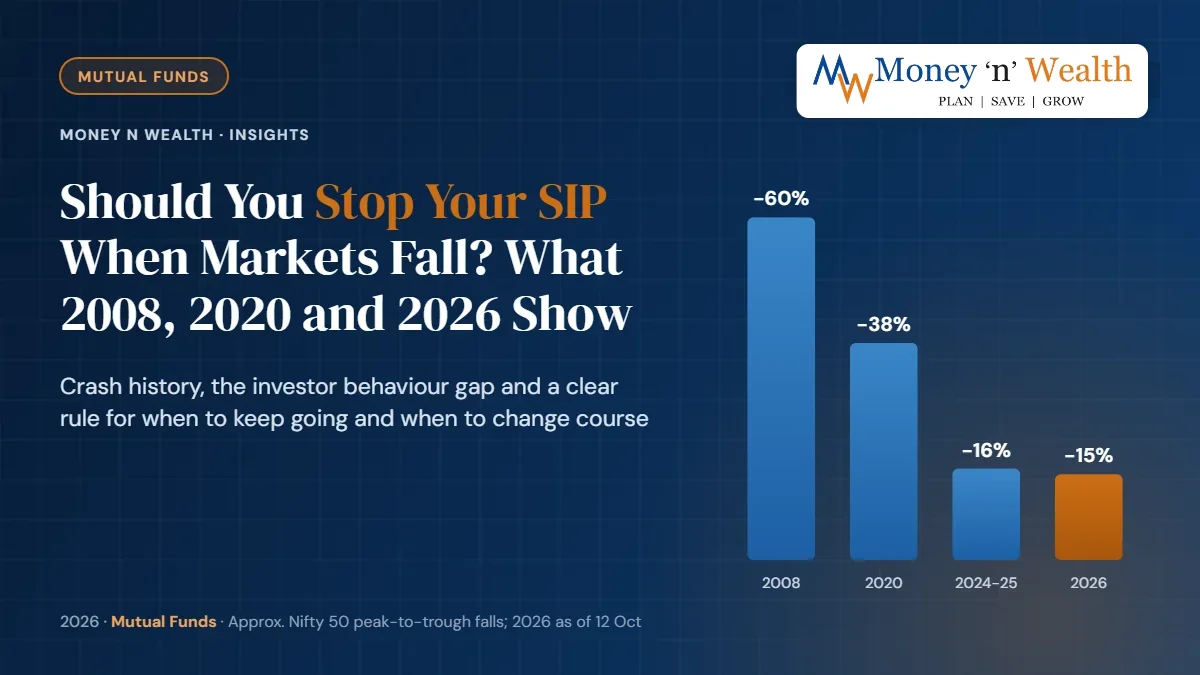
Last updated: 13 October 2026 Quick answer: Usually, no. Stopping a SIP when the market falls means you stop buying exactly when units are cheapest. In past Indian crashes (2008, 2020, 2024–25), SIPs that kept running broke even long before the index regained its peak. Change course only for personal reasons: a goal within about three years, no emergency fund, or a fund that has genuinely failed. Key takeaways Where we are: the Nifty 50 was about 15% below its 2 January 2026 record of 26,328.55 on 12 October 2026. 2008 lesson: a SIP started at the January 2008 peak was back in profit within 18 months, with the index still far below its high. Timing barely mattered: a Sensex TRI SIP started at the 2008 peak earned 12.96% a year to August 2025, against 13.05% for one started at the 2009 bottom. Behaviour gap: investors earned 1.2 percentage points a year less than their funds over 2016–2025 (Morningstar). Illustration: stopping for two years during a 40% fall cut a 5-year SIP's return from 13.8% to 6.3% a year. Open any SIP portfolio in October 2026 and the colour is probably red. The Nifty 50 hit a record close of 26,328.55 on 2 January 2026 and was near 22,363 on 12 October, a fall of roughly 15%. September's CPI inflation came in at 5.54% and the RBI raised the repo rate to 5.50% this month. Many investors are asking the same question: should I stop my SIP until things settle? This guide answers that with evidence rather than slogans. We look at what happened to SIPs through the 2008, 2020 and 2024–25 falls, what the global research on investor behaviour shows, what Indian SIP investors are actually doing, and the small number of situations in which stopping is the right call. Why a falling market helps a SIP investor A SIP buys a fixed rupee amount every month. When the NAV falls, the same ₹10,000 buys more units. At an NAV of ₹100 you get 100 units; at ₹60 you get about 167. When prices recover, every one of those extra units recovers with them. This is rupee-cost averaging. It does not guarantee a profit, and it does not beat investing a lumpsum at the bottom. But it means a SIP investor's average purchase cost falls during a decline. In our illustration later, the average cost over three years of a 40% fall and recovery works out to 78 against a starting price of 100. The SIP is in profit long before the market gets back to where it began. Stopping in a fall does the opposite. You keep all the units bought at high prices and skip the cheap ones. That is why the question "should I stop my SIP when markets fall?" usually has the opposite answer to the one fear suggests. What happened to SIPs in past market crashes? Indian equities have had several deep falls in the last two decades. The table below gives approximate peak-to-trough figures and what happened to SIP investors who kept going. Episode Approx. fall What happened to SIPs that continued Global financial crisis (Jan–Oct 2008) Nifty 50 about 60% A Nifty 100 TRI SIP started at the January 2008 peak broke even after 18 instalments, with ₹18,000 invested worth about ₹21,800 (PrimeInvestor) Covid crash (Jan–Mar 2020) Nifty 50 about 38%, to 7,610 on 23 March 2020 A Nifty 100 TRI SIP started in January 2018 was back in profit by about August 2020, five months after the low (PrimeInvestor) 2024–25 correction (Sep 2024–Mar 2025) Nifty 50 about 16%; Nifty Smallcap 250 about 28% By July 2026 the Smallcap 250 was within about 4% of its September 2024 high (Free Press Journal) 2026 fall (Jan–Oct 2026, ongoing) Nifty 50 about 15% so far Outcome not yet known Bar chart of Nifty 50 and Smallcap 250 falls in 2008, 2020, 2024-25 and 2026, context for whether to stop SIP when market falls The 2008 test: starting at the worst possible moment The most useful evidence comes from investors who started SIPs at a market peak. PrimeInvestor's analysis of the Nifty 100 TRI found that a SIP begun in January 2008, days before the crash, was in the green after 18 months. The XIRR at that point was about 30%, because the units bought near the bottom had risen sharply. The index itself was still well below its 2008 high. A WhiteOak Capital study of Sensex TRI data, reported by Business Standard in September 2025, makes the same point over the long run. A ₹10,000 monthly SIP started at the January 2008 peak was worth ₹75.23 lakh by 31 August 2025, an XIRR of 12.96%. One started at the March 2009 bottom earned 13.05%. Seventeen years later, the difference between the worst and best starting month was less than a tenth of a percentage point a year. Small caps fall harder and take longer The same research has a warning. In 2008, PrimeInvestor found smallcap indices fell further (about 69% for the Smallcap 250 TRI against 53% for the Nifty 100 TRI) and smallcap SIPs slipped back into losses during the 2011 correction. Its suggestion is to give large-cap SIPs at least seven years and small and mid caps closer to ten. If your small-cap fund (/insights/small-cap-funds) SIP has a three-year horizon, the problem is the fund choice, not the market. Illustration: continuing vs stopping during a 40% fall To isolate the effect of stopping, we built a simple, hypothetical index. It falls 40% in a straight line over 12 months, climbs back to its starting level over the next 24 months, then grows 12% a year for two more years. Three investors each set aside ₹10,000 a month for five years. Money not invested sits in a savings account at 3.5%. Investor Money set aside Value after 5 years Annualised return (XIRR) A: kept the SIP going throughout ₹6,00,000 ₹8,47,444 13.8% B: stopped at month 6 (index down 20%), restarted at month 30 (index back to 90) ₹6,00,000 ₹7,04,225 6.3% C: stopped at month 6 and never restarted ₹6,00,000 ₹6,67,303 4.2% Investor A's SIP was back above the money invested by month 21, when the index was still 25% below its starting level. By month 36, when the index had only returned to where it began, A's ₹3.6 lakh was worth ₹4.6 lakh. Investor B, who waited for "clarity", restarted after most of the recovery and ended about ₹1.43 lakh behind. This is a stylised example, not a forecast: real recoveries are messier and can take much longer, as 2008–2013 showed. Illustration comparing a SIP continued through a market fall with one stopped and restarted The behaviour gap: why investors earn less than their funds If continuing is so clearly better on paper, why do people stop? Because falls feel dangerous, and acting feels safer than waiting. Morningstar measures the cost of that instinct every year in its Mind the Gap study, comparing fund returns with the dollar-weighted returns investors actually earn. The 2026 edition, published on 6 August 2026, covers US mutual funds and ETFs for the ten years to December 2025. Funds returned 9.9% a year; the average invested dollar earned 8.7%. That gap of 1.2 percentage points is roughly 12% of the total return, lost purely to the timing of purchases and sales. The gap was about 0.4 points in the least volatile funds and above 2 points in the most volatile. Morningstar's own suggestion for narrowing it is regimented approaches such as regular investing and automatic rebalancing. The lesson for Indian investors is direct. The funds that tempt you to stop (small caps, sector funds, anything that has just dropped sharply) are the ones where stopping and restarting does the most damage. We explore the psychology further in five behavioural mistakes that cost investors most (/insights/behavioural-finance-investor-mistakes) . Morningstar Mind the Gap 2026 investor return gap statistics Are Indian SIP investors stopping now? AMFI publishes monthly SIP registrations and stoppages. The stoppage ratio (SIPs closed or matured divided by new SIPs registered) rose from about 51% in July 2024 to about 83% in December 2024 as markets corrected, according to AMFI data compiled by IIFL. The spike above 100% between January and April 2025 was largely an accounting clean-up of dormant legacy folios, not panic. In 2026 the picture is steadier. The ratio eased from about 101% in April to 81.1% in August 2026, when 66.39 lakh new SIPs were registered against 53.82 lakh closed or matured. Monthly SIP inflows reached ₹32,297 crore and contributing SIP accounts crossed 10 crore for the first time. Most Indian SIP investors, in other words, are staying the course. The risk is that a deeper fall changes that. AMFI SIP stoppage ratio April to August 2026 When should you stop or change your SIP in a falling market? Stopping is right when your circumstances change, not when the Nifty does. Legitimate reasons include: Your goal is close. Money needed within about three years should be moving from equity to debt anyway. Use an STP or redirect new SIPs to a debt or hybrid fund such as a balanced advantage fund (/insights/balanced-advantage) . You have no emergency fund. If a job loss would force you to redeem at the bottom, build six months of expenses first. Our emergency fund guide (/insights/emergency-fund-guide-india) explains where to keep it. Your income has fallen. Pause rather than cancel; see how SIP pause, skip and stop work (/insights/sip-pause-skip-stop-what-happens) . The fund has failed on its own terms. Lagging its benchmark and category over three to five years is a fund problem. Our SIP fund screening framework (/insights/how-to-shortlist-sip-funds-2026) helps you check. Your allocation is badly off. If equity has fallen from 60% to 50% of your portfolio, rebalancing towards equity is the disciplined move; if small caps dominate, redirecting new SIPs to diversified funds can make sense. What about "stop now, restart lower"? That plan requires two correct calls: when to stop and when to restart. Investor B in our illustration got the direction right and still lost about half the return, because recoveries tend to start before the news improves. The 2020 recovery was well under way within weeks of the 23 March low. Few people who stopped in March had restarted by June. What should you do instead? A falling market is a good time to review, not to react. Work through these checks in order. Checklist before you stop SIP when the market falls If you have surplus cash and a long horizon, a fall is also a chance to add. Deploying a lumpsum through a 6–12 month STP spreads the entry risk; our comparison of SIP vs lumpsum vs STP (/insights/sip-vs-lumpsum-vs-stp) explains when each works. For a broader playbook covering direct equity too, read what to do when the Nifty drops 10% or more (/insights/stock-market-fall-what-to-do) . And measure progress with XIRR rather than the red absolute number; our guide to XIRR vs CAGR vs absolute return (/insights/xirr-vs-cagr-vs-absolute-return) shows why. Related reading SIP pause, skip or stop: what happens to your investment (/insights/sip-pause-skip-stop-what-happens) Market fall playbook: what to do when the Nifty drops 10% or more (/insights/stock-market-fall-what-to-do) Five behavioural mistakes that cost investors most (/insights/behavioural-finance-investor-mistakes) RBI hikes the repo rate to 5.50%: what it means for you (/insights/rbi-repo-rate-hike-october-2026-emi-fd-debt-funds) SIP planning: the complete guide (/insights/sip-planning-guide-india) Frequently Asked Questions Should I stop my SIP when the market is falling? In most cases, no. A falling market lets your fixed monthly amount buy more units, lowering your average cost. Indian crash history shows SIPs that continued through 2008 and 2020 returned to profit well before the index regained its peak. Stop or reduce only if your goal is near, you lack an emergency fund, your income has dropped, or the fund itself has failed. Is it better to stop SIP and invest a lumpsum at the bottom? Only if you can identify the bottom, which nobody does reliably. The WhiteOak study of Sensex TRI found a SIP started at the 2008 peak earned 12.96% a year to August 2025 versus 13.05% for one started at the 2009 bottom. Continuing the SIP and adding spare cash through an STP during falls is a more dependable approach. How long does a SIP take to recover after a crash? It varies with the depth of the fall and how fast markets bounce. A Nifty 100 TRI SIP started at the January 2008 peak was in profit after about 18 months; one started in January 2018 recovered from the Covid crash by about August 2020. Small-cap SIPs typically take longer. Plan for at least seven years in large caps and ten in small caps. Should I increase my SIP when markets fall? If your emergency fund is in place, your goal is more than seven years away and your equity allocation has slipped below target, adding during a fall is sensible. You can raise the SIP, add a lumpsum, or use an STP from a liquid fund. Do not stretch your monthly budget so far that a later shock forces you to stop altogether. What is the SIP stoppage ratio? It is the number of SIPs closed or matured in a month divided by the new SIPs registered that month, reported by AMFI. A ratio below 100% means more SIPs are starting than ending. It was 81.1% in August 2026, down from about 101% in April 2026. The spike in early 2025 was largely a data clean-up of dormant folios. Are small-cap SIPs riskier to continue in a crash? Small caps fall further and recover more unevenly. The Nifty Smallcap 250 fell roughly 28% between September 2024 and March 2025, against about 16% for the Nifty 50. Continuing a small-cap SIP makes sense only with a ten-year horizon and a sensible portfolio weight. If the fall is keeping you awake, the allocation is probably too high. Will stopping my SIP protect my existing investment? No. Stopping a SIP only ends future purchases; the units you already own stay fully invested and move with the market. To reduce risk on existing money, you would have to redeem or switch, which can trigger exit load and capital gains tax. That is a decision to make against your goal date, not this month's headlines. Sources: PrimeInvestor: When will your SIPs break even? (https://primeinvestor.in/reports/when-will-your-sips-break-even/) ; Business Standard on WhiteOak Capital SIP timing study (https://www.business-standard.com/finance/personal-finance/does-timing-matter-investing-10-000-sip-peak-or-bottom-who-got-richer-125091200641_1.html) ; Morningstar, Mind the Gap 2026 (https://www.morningstar.com/en-us/business/insights/research/mind-the-gap) ; Business Standard on the March 2020 crash (https://www.business-standard.com/amp/article/markets/biggest-crash-ever-makes-india-worst-performing-market-in-the-world-120032301809_1.html) ; Business Standard on the 2025 smallcap low (https://www.business-standard.com/amp/markets/news/nifty-smallcap-up-13-from-recent-low-is-it-out-of-the-correction-zone-125032100237_1.html) ; Free Press Journal on index peaks, August 2026 (https://www.freepressjournal.in/business/nifty-still-8-below-record-high-as-midcap-smallcap-indices-lead-market-recovery) ; INDmoney on AMFI SIP data (https://www.indmoney.com/blog/mutual-funds/sip-stoppage-ratio-explained) ; IIFL on the 2025 stoppage spike (https://indiainfoline.com/blog/what-explains-the-sharp-spike-and-fall-in-sip-stoppage-ratio) ; AMFI monthly data (https://www.amfiindia.com/research-information/amfi-monthly) . The five-year illustration is a Money n Wealth calculation on a hypothetical index path. Worried about your SIPs in this fall? Whether to continue, rebalance or redirect depends on your goals and cash buffer, which a headline cannot see. Talk to Money n Wealth (/contact) for a free portfolio review. This article is for general educational purposes only and does not constitute financial advice. Figures and examples are illustrative. Please consult a qualified financial adviser for guidance specific to your situation. Money n Wealth (Predics Fintech Services Pvt Ltd) is an AMFI-registered Mutual Fund Distributor (ARN-121995) and APMI-registered PMS Distributor (APRN07444); it is not a SEBI-registered investment adviser and may earn distribution commission on investments made through it.
Frequently Asked Questions
Should I stop my SIP when the market is falling?
In most cases, no. A falling market lets your fixed monthly amount buy more units, lowering your average cost. Indian crash history shows SIPs that continued through 2008 and 2020 returned to profit well before the index regained its peak. Stop or reduce only if your goal is near, you lack an emergency fund, your income has dropped, or the fund itself has failed.
Is it better to stop SIP and invest a lumpsum at the bottom?
Only if you can identify the bottom, which nobody does reliably. The WhiteOak study of Sensex TRI found a SIP started at the 2008 peak earned 12.96% a year to August 2025 versus 13.05% for one started at the 2009 bottom. Continuing the SIP and adding spare cash through an STP during falls is a more dependable approach.
How long does a SIP take to recover after a crash?
It varies with the depth of the fall and how fast markets bounce. A Nifty 100 TRI SIP started at the January 2008 peak was in profit after about 18 months; one started in January 2018 recovered from the Covid crash by about August 2020. Small-cap SIPs typically take longer. Plan for at least seven years in large caps and ten in small caps.
Should I increase my SIP when markets fall?
If your emergency fund is in place, your goal is more than seven years away and your equity allocation has slipped below target, adding during a fall is sensible. You can raise the SIP, add a lumpsum, or use an STP from a liquid fund. Do not stretch your monthly budget so far that a later shock forces you to stop altogether.
What is the SIP stoppage ratio?
It is the number of SIPs closed or matured in a month divided by the new SIPs registered that month, reported by AMFI. A ratio below 100% means more SIPs are starting than ending. It was 81.1% in August 2026, down from about 101% in April 2026. The spike in early 2025 was largely a data clean-up of dormant folios.
Are small-cap SIPs riskier to continue in a crash?
Small caps fall further and recover more unevenly. The Nifty Smallcap 250 fell roughly 28% between September 2024 and March 2025, against about 16% for the Nifty 50. Continuing a small-cap SIP makes sense only with a ten-year horizon and a sensible portfolio weight. If the fall is keeping you awake, the allocation is probably too high.
Will stopping my SIP protect my existing investment?
No. Stopping a SIP only ends future purchases; the units you already own stay fully invested and move with the market. To reduce risk on existing money, you would have to redeem or switch, which can trigger exit load and capital gains tax. That is a decision to make against your goal date, not this month's headlines.
Worried about your SIPs in this fall?
Whether to continue, rebalance or redirect depends on your goals and cash buffer, which a headline cannot see. Talk to Money n Wealth for a free portfolio review.