Credit Risk Funds and Dynamic Bond Funds: The Risks to Know in 2026
Last updated: 13 October 2026
Quick answer: Credit risk funds must invest at least 65% in corporate bonds rated AA or below, so they earn more but can lose money suddenly when a borrower defaults. Dynamic bond funds (now called Dynamic Term Funds) can change duration freely, so returns depend on the manager's interest-rate calls. Both suit only experienced investors with long horizons, as a small slice of their debt allocation.
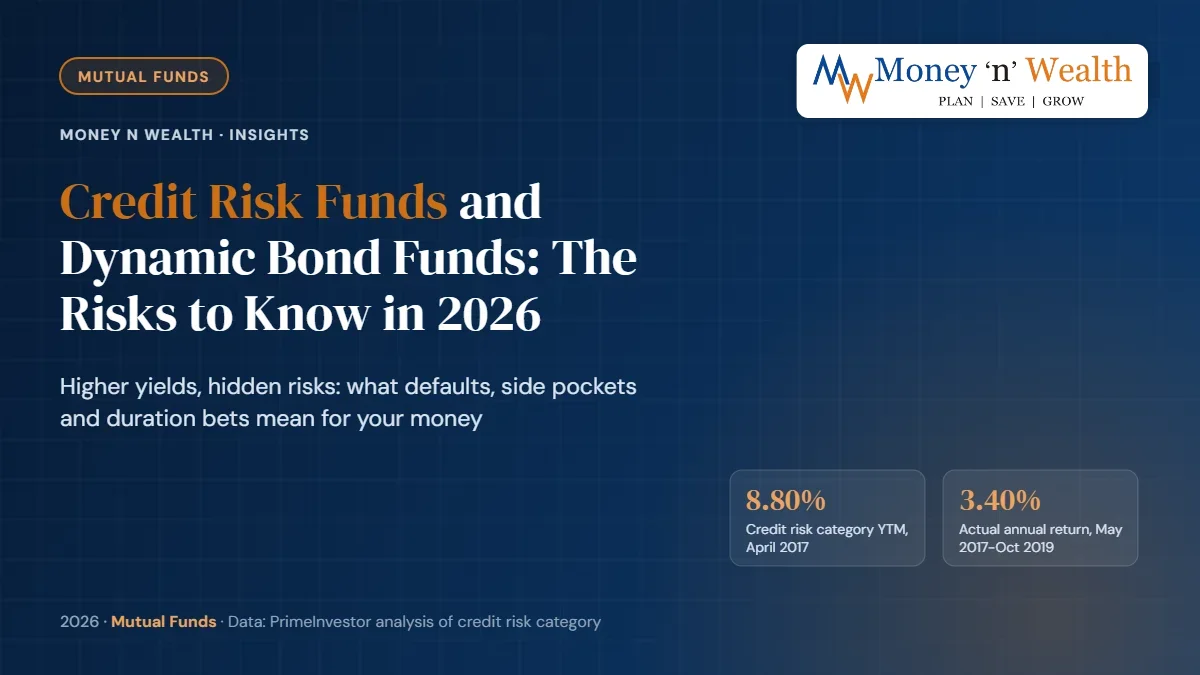
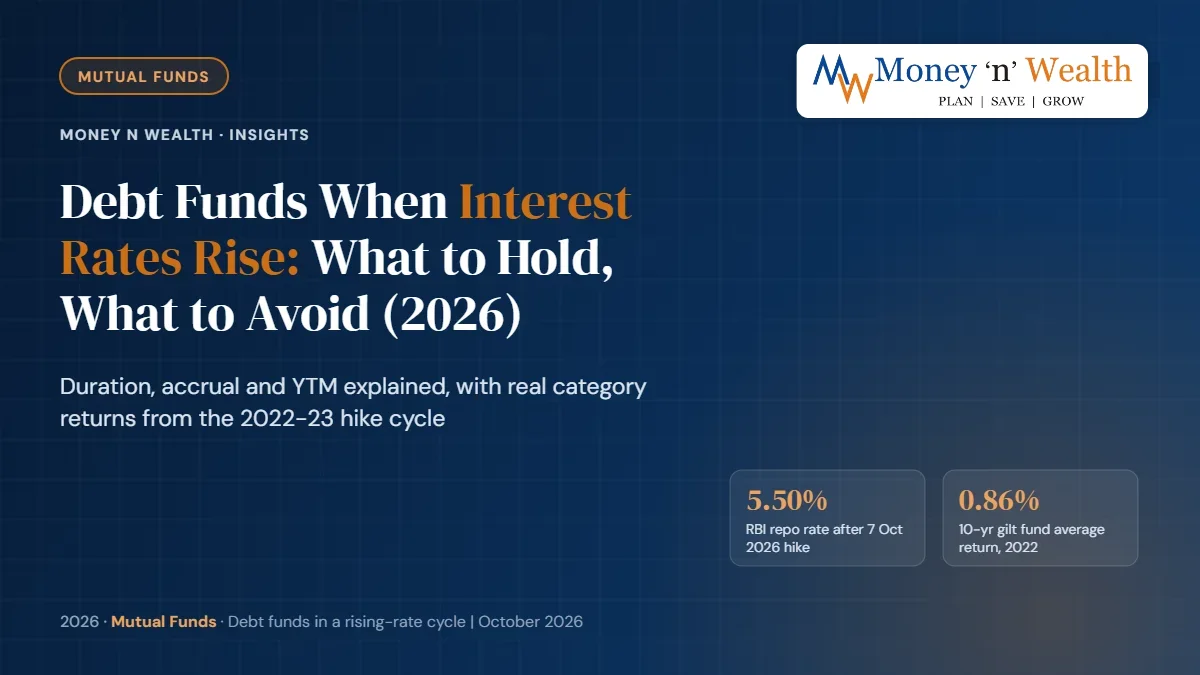
Last updated: 13 October 2026 Quick answer: Credit risk funds must invest at least 65% in corporate bonds rated AA or below, so they earn more but can lose money suddenly when a borrower defaults. Dynamic bond funds (now called Dynamic Term Funds) can change duration freely, so returns depend on the manager's interest-rate calls. Both suit only experienced investors with long horizons, as a small slice of their debt allocation. Key takeaways SEBI rule: credit risk funds hold 65%+ in bonds rated AA and below (excluding AA+); dynamic term funds invest across any duration. Yield is not return: credit risk funds showed an 8.80% average YTM in April 2017 but returned 3.40% a year to October 2019. Recent returns look good: about 7.98% over one year and 8.99% a year over three years to July 2026, in a benign credit environment. Safety valve: side-pocketing, allowed by SEBI since December 2018, isolates defaulted bonds from the rest of the fund. Who should avoid: anyone needing money within three years or using debt funds as an emergency reserve. Over the year to July 2026, credit risk funds were the best-performing debt category in India, earning about 8% while liquid funds earned about 6%. On a screen that sorts debt funds by return, they rise straight to the top. That is precisely why they need a warning label. Between 2018 and 2020, the same category went through defaults at IL&FS and other borrowers, frozen portfolios and, in April 2020, the wind-up of six Franklin Templeton debt schemes. Investors who bought them as "FD plus" learnt that the extra 2% came with very different risks. This guide explains what credit risk funds and dynamic bond funds are allowed to do under SEBI's rules, what the 2018-2020 episodes taught, how side-pocketing protects you, and a clear checklist of who should avoid these funds altogether. What is a credit risk fund? A credit risk fund is an open-ended debt mutual fund that must invest at least 65% of its assets in corporate bonds rated AA or below, excluding AA+. SEBI's circular of 26 February 2026 restated this definition and wrote the AA+ exclusion explicitly into the category description. In plain terms, the fund deliberately lends to companies that are not top-rated, because they pay higher interest. That extra interest over a government bond of the same maturity is called the credit spread . The fund's bet is that the spread it collects will exceed the losses from the few borrowers that get downgraded or default. Why a higher YTM does not mean a higher return A fund's yield to maturity (YTM) shows what its current bonds would earn if every borrower paid in full and on time. For a credit risk fund, that "if" carries a lot of weight. When a borrower defaults, the fund writes down that bond, often sharply, and the NAV drops overnight. PrimeInvestor's analysis of the category makes the point vividly. In April 2017, credit risk funds had an average YTM of 8.80% and an average expense ratio of 1.60%, implying a return of about 7.2%. Their actual annualised return from May 2017 to October 2019 was 3.40%. Chart showing credit risk funds promised 8.8% YTM but delivered 3.4% a year between 2017 and 2019 What went wrong in 2018-2020? In September 2018, Infrastructure Leasing & Financial Services (IL&FS), a large infrastructure lender that was highly rated until shortly before, began defaulting on its debt. Its bonds were held by many mutual funds. The default triggered a wider loss of confidence in lower-rated corporate debt and in several non-bank lenders. Credit risk funds were hit twice. First, by write-downs on bonds that defaulted or were downgraded. Second, by liquidity: as investors rushed to redeem, funds had to sell their most saleable, highest-quality bonds, leaving the remaining investors holding a larger share of the weakest paper. The Franklin Templeton wind-up of April 2020 In April 2020, as COVID-19 lockdowns froze India's corporate bond market, Franklin Templeton Mutual Fund decided to wind up six of its debt schemes, which held a large share of lower-rated and less liquid bonds. Redemptions were suspended, and investors had to wait while the portfolios were sold off and money was returned in instalments. The case went to court and investors received their money over a period of years rather than days. The episode changed how Indians view "safe" debt funds. It showed that a debt fund can stop redemptions entirely if its holdings cannot be sold, which no FD investor ever faces for a DICGC-insured deposit up to ₹5 lakh. What SEBI changed afterwards Side-pocketing (December 2018): funds may separate defaulted or downgraded paper into a segregated portfolio, so new investors cannot buy in cheaply and existing investors get any recovery. Liquidity buffers (from 2020-21): many debt categories must hold at least 10% in liquid assets such as government securities, treasury bills and cash equivalents. Potential Risk Class matrix (2021): each debt fund discloses the maximum interest-rate and credit risk it can take, on a grid shown in the factsheet. Corporate Debt Market Development Fund (2023): a backstop facility meant to buy investment-grade corporate bonds from mutual funds in times of market stress. Four-step explanation of side-pocketing in credit risk funds How do credit risk funds perform now? In a calm credit environment, credit risk funds do what they are designed to do: collect the spread. Over the year to late July 2026 the category returned 7.98%, and over three years 8.99% a year, the highest of any debt category in DSIJ's data. Lower defaults, better corporate balance sheets and earlier recoveries have all helped. Period Credit risk funds Liquid funds Corporate bond funds Calendar 2022 (average, direct plans) 4.73% (range 0.94% to 10.12%) 4.85% 3.72% 1 year to July 2026 7.98% 6.19% Not reported 3 years to July 2026 (a year) 8.99% Not reported 7.04% May 2017 to Oct 2019 (a year) 3.40% Not reported Not reported 2022: Arthgyaan from AMFI data. 2026: DSIJ category data, August 2026. 2017-2019: PrimeInvestor. Past returns do not predict future returns. Read the recent numbers with care. The unusually high returns of individual schemes, such as the 10.12% top performer of 2022, largely reflect recoveries of money on bonds written down years earlier. That is a one-off, not a repeatable source of return. And a few calm years say little about how the category will behave in the next credit squeeze. Chart comparing the range of 2022 returns of credit risk funds and dynamic bond funds against corporate bond and liquid funds What is a dynamic bond fund? A dynamic bond fund is a debt fund that can invest across any duration. SEBI's February 2026 circular renamed the category Dynamic Term Fund , and existing schemes had six months to update their names, so you may see both labels in 2026. Unlike short term or long term funds, which must keep duration within a set band, a dynamic fund's manager can hold a portfolio of a few months' duration one year and ten years the next. The idea is to lengthen duration when rates are expected to fall and shorten it when they are expected to rise. The main risk is the manager's rate call Dynamic bond funds usually hold high-quality paper, so credit risk is often modest. Their main risk is interest-rate risk combined with timing risk : if the manager is on the wrong side of a rate move, the fund can lag even a plain short term fund. Rate forecasts are hard to get right; the RBI's October 2026 hike came after many forecasters expected rates to stay on hold through 2026. The evidence shows a wide spread of outcomes. In 2022, dynamic bond funds ranged from 0.53% to 10.78%, around an average of 3.76%. In the January-March 2026 quarter, as yields rose, the category lost 1.01% on average, more than corporate bond funds but less than gilt funds. PrimeInvestor's rolling data to October 2019 found one-year dynamic bond returns ranging from 0.34% to 15.44%. Feature Credit risk fund Dynamic term (dynamic bond) fund SEBI mandate 65%+ in bonds rated AA and below (excl. AA+) Any duration; no fixed band Main risk Default and downgrade; liquidity Wrong interest-rate calls Typical credit quality Mostly AA and A Varies; often G-secs and AAA, check the factsheet How losses happen Sudden, large NAV drop on a single default Gradual or sharp NAV falls when yields rise Exit load Many schemes charge one; check the SID Varies by scheme Suggested minimum horizon 3-5 years or more 5 years or more Tax (units bought from 1 April 2023) Gains taxed at your slab rate, whatever the holding period Who should avoid credit risk and dynamic bond funds? For most retail investors, the honest answer is that neither fund is necessary. Debt funds are usually there to provide stability and liquidity, and both categories trade some of that away for extra return. Before you consider either, the core of your debt allocation should already sit in liquid, money market, short term, corporate bond or banking & PSU funds (/insights/gilt-corporate-bond-banking-psu-funds) . Checklist of who should avoid credit risk funds and dynamic bond funds and who might consider them Red flags in a credit risk fund portfolio YTM far above peers. A gap of 1-2 percentage points over similar funds usually means riskier borrowers, not skill. Concentration. More than a few percent of assets in one lower-rated issuer or one business group. Unrated, unlisted or structured paper. Check the holdings list for unusual instruments or "loan against shares" style structures. Shrinking assets. Steady outflows can leave remaining investors with the least liquid bonds. An existing segregated portfolio. Not a reason to panic, but a sign of past credit stress worth understanding. The fund's factsheet shows the rating break-up, top holdings and Potential Risk Class. Our guide to reading a mutual fund factsheet (/insights/how-to-read-mutual-fund-factsheet) walks through each section. What about the rate hike of October 2026? The RBI raised the repo rate by 25 basis points to 5.50% on 7 October 2026 and moved to a "calibrated tightening" stance. For credit risk funds, a rising-rate cycle tends to raise borrowing costs for weaker companies and can widen credit spreads, which hurts prices of lower-rated bonds. For dynamic bond funds, the outcome depends on how much duration the manager was holding. The October hike is not a reason in itself to sell. It is a good reason to check whether a fund's risk still fits your horizon. Our guide to debt funds in a rising-rate cycle (/insights/debt-funds-rising-interest-rates-2026) covers what to hold for each time frame, and the RBI rate hike explainer (/insights/rbi-repo-rate-hike-october-2026-emi-fd-debt-funds) covers loans and deposits. How are credit risk and dynamic bond funds taxed? Both are debt funds. Gains on units bought on or after 1 April 2023 are added to your income and taxed at your slab rate, regardless of how long you hold them. Units bought before that date and held more than 24 months are taxed at 12.5% as long-term gains, without indexation, for transfers from 23 July 2024. A loss on a written-down bond reduces your NAV and therefore your taxable gain on redemption. For the full rules across categories see our capital gains tax guide for mutual funds (/insights/capital-gains-tax-mutual-funds-2026) . A global view: "high yield" carries the same trade-off everywhere Credit risk funds are India's closest equivalent to the high-yield or "junk" bond funds common in the US and Europe. The trade-off is universal: higher spreads in good years, sharp losses when defaults cluster, usually in recessions and liquidity crises. Indian credit risk funds mostly hold AA and A rated paper on India's domestic rating scale, which is not directly comparable with international ratings, and India's corporate bond market is far less liquid. That makes the liquidity risk seen in 2020 at least as important as the default risk. Related reading How to choose a debt mutual fund: 3 checks (/insights/how-to-choose-debt-mutual-fund-three-checks) Gilt vs corporate bond vs banking & PSU funds (/insights/gilt-corporate-bond-banking-psu-funds) FD vs debt mutual funds after tax (/insights/fixed-deposit-vs-debt-mutual-funds-which-gives-better-post-tax-returns-now) Bonds 101: G-secs, corporate and tax-free bonds (/insights/bonds-101-india) 7 signs your mutual fund portfolio needs a review (/insights/signs-your-mutual-fund-portfolio-needs-a-review) Mutual funds at Money n Wealth (/products/mutual-funds) Frequently Asked Questions Are credit risk funds safe? They are not safe in the way an FD or a liquid fund is. They must hold at least 65% in bonds rated AA or below, so a single default can cut the NAV sharply overnight. Recent returns have been strong, but between May 2017 and October 2019 the category earned just 3.40% a year despite an 8.80% starting yield. What is side-pocketing in mutual funds? Side-pocketing, or creating a segregated portfolio, lets a fund move a defaulted or downgraded bond into a separate portfolio. Existing investors get units in both the main and segregated portfolios. The main fund continues to trade normally, and any money later recovered from the bad bond is paid only to those who held units when the side pocket was created. What happened to Franklin Templeton's debt funds? In April 2020, Franklin Templeton Mutual Fund wound up six debt schemes after the COVID-19 lockdown froze trading in lower-rated corporate bonds and redemptions surged. Redemptions were suspended, and investors were repaid in instalments over the following years as the portfolios were sold. The episode led to tighter liquidity and risk-disclosure rules for debt funds. Is a dynamic bond fund good when interest rates rise? It depends on the manager. A dynamic bond fund that cut its duration before rates rose will hold up well; one holding long duration will fall, as the category's average loss of 1.01% in the January-March 2026 quarter shows. Because you rely on the manager's timing, check the fund's current duration in the factsheet before investing. What is the new name for dynamic bond funds? SEBI's circular of 26 February 2026 renamed the category "Dynamic Term Fund" and required scheme names to match their category. Existing schemes had six months to update their names, so statements and apps may show either name during 2026. The mandate, investing across durations, is unchanged. How long should I hold a credit risk fund? If you invest at all, plan for at least three to five years. That gives the higher yield time to absorb occasional write-downs, and avoids any exit load on early redemption. Even then, limit it to a small portion of your debt allocation. Do credit risk funds beat FDs after tax? Sometimes, but not reliably. Both are taxed at your slab rate for new investments, though fund tax is deferred until you redeem. A credit risk fund may earn 1-2% more in a good period, but can lose principal in a default, while bank deposits are insured by DICGC up to ₹5 lakh per depositor per bank. Sources: SEBI circular on categorisation and rationalisation of mutual fund schemes, 26 February 2026 (https://www.sebi.gov.in/sebi_data/attachdocs/feb-2026/1772079826878.pdf) ; AMFI: SEBI categorisation of schemes (https://amfiindia.com/investor-corner/knowledge-center/SEBI-categorization-of-mutual-fund-schemes.html) ; PrimeInvestor: what returns to expect from debt funds (Dec 2019) (https://primeinvestor.in/reports/what-returns-should-you-expect-from-your-debt-funds/) ; DSIJ: debt funds and the RBI effect (Aug 2026) (https://insights.dsij.in/appmindshare/debt-funds-risk-reward-and-the-rbi-effect-58828) ; Arthgyaan: 2022 category returns from AMFI data (https://arthgyaan.com/blog/the-worst-mutual-funds-of-2022.html) ; Upstox on the 2026 debt fund renaming (https://upstox.com/news/personal-finance/mutual-funds/new-debt-mutual-fund-classification-rules-2026-what-changes-for-investors/article-190012/) ; Kuvera on SEBI debt classifications and liquidity rules (https://kuvera.in/blog/what-are-the-types-of-debt-funds-in-india-sebi-and-other-classifications/) . Holding a credit risk or dynamic bond fund you are unsure about? A quick look at its ratings, concentration and duration against your goals can tell you whether it still belongs. Talk to Money n Wealth (/contact) for a free portfolio review. This article is for general educational purposes only and does not constitute financial advice. Figures and examples are illustrative. Please consult a qualified financial adviser for guidance specific to your situation. Money n Wealth (Predics Fintech Services Pvt Ltd) is an AMFI-registered Mutual Fund Distributor (ARN-121995) and APMI-registered PMS Distributor (APRN07444); it is not a SEBI-registered investment adviser and may earn distribution commission on investments made through it.
Frequently Asked Questions
Are credit risk funds safe?
They are not safe in the way an FD or a liquid fund is. They must hold at least 65% in bonds rated AA or below, so a single default can cut the NAV sharply overnight. Recent returns have been strong, but between May 2017 and October 2019 the category earned just 3.40% a year despite an 8.80% starting yield.
What is side-pocketing in mutual funds?
Side-pocketing, or creating a segregated portfolio, lets a fund move a defaulted or downgraded bond into a separate portfolio. Existing investors get units in both the main and segregated portfolios. The main fund continues to trade normally, and any money later recovered from the bad bond is paid only to those who held units when the side pocket was created.
What happened to Franklin Templeton's debt funds?
In April 2020, Franklin Templeton Mutual Fund wound up six debt schemes after the COVID-19 lockdown froze trading in lower-rated corporate bonds and redemptions surged. Redemptions were suspended, and investors were repaid in instalments over the following years as the portfolios were sold. The episode led to tighter liquidity and risk-disclosure rules for debt funds.
Is a dynamic bond fund good when interest rates rise?
It depends on the manager. A dynamic bond fund that cut its duration before rates rose will hold up well; one holding long duration will fall, as the category's average loss of 1.01% in the January-March 2026 quarter shows. Because you rely on the manager's timing, check the fund's current duration in the factsheet before investing.
What is the new name for dynamic bond funds?
SEBI's circular of 26 February 2026 renamed the category "Dynamic Term Fund" and required scheme names to match their category. Existing schemes had six months to update their names, so statements and apps may show either name during 2026. The mandate, investing across durations, is unchanged.
How long should I hold a credit risk fund?
If you invest at all, plan for at least three to five years. That gives the higher yield time to absorb occasional write-downs, and avoids any exit load on early redemption. Even then, limit it to a small portion of your debt allocation.
Do credit risk funds beat FDs after tax?
Sometimes, but not reliably. Both are taxed at your slab rate for new investments, though fund tax is deferred until you redeem. A credit risk fund may earn 1-2% more in a good period, but can lose principal in a default, while bank deposits are insured by DICGC up to ₹5 lakh per depositor per bank.
Holding a credit risk or dynamic bond fund you are unsure about?
A quick look at its ratings, concentration and duration against your goals can tell you whether it still belongs. Talk to Money n Wealth for a free portfolio review.