Debt Funds When Interest Rates Rise: What to Hold, What to Avoid (2026)
Last updated: 13 October 2026
Quick answer: When interest rates rise, debt funds with long duration (gilt, long-term, dynamic) fall in price first, while liquid, money market and short-term funds barely move and start earning higher yields almost immediately. Hold funds whose duration matches when you need the money. Higher yields mean better future returns, so long-horizon investors usually gain by staying put.
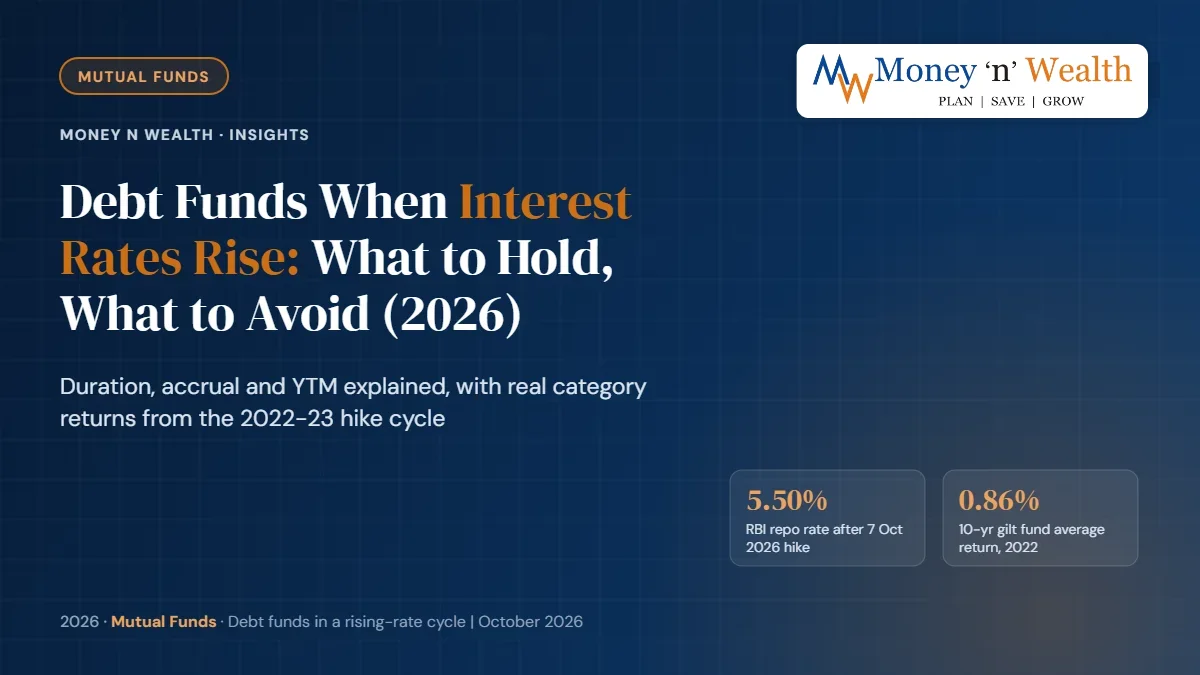
Last updated: 13 October 2026 Quick answer: When interest rates rise, debt funds with long duration (gilt, long-term, dynamic) fall in price first, while liquid, money market and short-term funds barely move and start earning higher yields almost immediately. Hold funds whose duration matches when you need the money. Higher yields mean better future returns, so long-horizon investors usually gain by staying put. Key takeaways Where we are: the RBI raised the repo rate to 5.50% on 7 October 2026, its first hike since February 2023. The rule: price change is roughly minus duration times the change in yield. A 7-year duration fund loses about 3.5% if yields rise 0.50%. The 2022 lesson: after 250 bps of hikes, liquid funds averaged 4.85% in 2022 while 10-year gilt funds averaged 0.86%. The payback: longer-duration categories averaged above 7.2% in 2023 and most gilt funds earned over 9% in 2024. Tax: debt fund gains on units bought from 1 April 2023 are taxed at your slab rate, whatever the holding period. In March 2022, Indian investors pulled more than ₹1.14 lakh crore out of debt mutual funds in a single month. By December, net outflows for the year had reached ₹2.3 lakh crore, and debt fund assets had shrunk by over 11%, according to AMFI data reported by PTI. The trigger was simple: the RBI had started raising rates, and bond prices were falling. Many of those investors sold at exactly the wrong time. The yields that hurt them in 2022 became the returns that rewarded patient holders in 2023 and 2024. Now, with the RBI raising the repo rate by 25 basis points to 5.50% on 7 October 2026, the same question is back: what should you do with your debt funds when interest rates rise? This guide explains the three numbers that decide how a debt fund behaves (duration, yield to maturity and credit quality), shows what each category actually returned in the last hike cycle, and gives a horizon-based framework for deciding what to hold, what to trim and where to put new money. Why do debt funds fall when interest rates rise? A debt fund is a mutual fund that lends money to governments, banks and companies by buying their bonds and money market instruments. It earns the interest those bonds pay, and its NAV also moves with their market price. Bond prices and yields move in opposite directions. Suppose a fund holds a bond paying 7% a year. If new bonds start paying 7.5%, nobody will pay full price for the 7% bond, so its price falls until its effective yield matches the market. The longer that bond has left to maturity, the longer you are stuck with the lower coupon, and the bigger the price cut. That is why a rising-rate cycle hits debt funds unevenly. A liquid fund holding 60-day paper hardly notices. A gilt fund holding 30-year government bonds can see its NAV drop in a few days. Duration: the one number that predicts the damage Modified duration tells you how much a fund's NAV will move for a 1 percentage point change in yields. The working rule is: Approximate price change = −modified duration × change in yield A fund with a modified duration of 7 years loses about 7% if yields rise by 1 percentage point, or about 1.75% for a 0.25% rise. A liquid fund with a duration of about one month loses a few hundredths of a percent. Every debt fund factsheet now discloses modified duration and Macaulay duration (the weighted time to get your money back). SEBI's February 2026 categorisation circular requires Macaulay duration to be reported at the portfolio level. Illustrative chart of debt fund price impact when interest rates rise by 0.50% for different modified durations Accrual and YTM: the part that makes you whole The price fall is only half the story. When yields rise, the fund also reinvests coupons and maturing bonds at the new, higher rates. That steady interest income is called accrual , and the fund's portfolio yield to maturity (YTM) tells you roughly what it is earning before costs. A useful rule of thumb: if your holding period is roughly equal to the fund's Macaulay duration, the price loss from a rate rise and the extra income from reinvesting at higher yields roughly cancel out. Your return ends up close to the YTM you started with. Investors get hurt when they hold a long-duration fund for a short-term need, then sell during the dip. What happened to debt funds in the 2022-23 rate hike cycle? The best guide to the present is the most recent hike cycle. Between May 2022 and February 2023, the RBI raised the repo rate by 250 basis points, from 4.00% to 6.50%, in six steps. Here is how the main categories did in calendar 2022, the year of the steepest hikes. Bar chart of debt fund returns in 2022 when interest rates rose: liquid funds 4.85%, gilt funds 2.98%, 10-year constant duration gilt 0.86% The pattern is exactly what duration predicts. Short-maturity categories (overnight, liquid, money market, ultra short) clustered between 4.6% and 4.9%, because they could reinvest quickly at rising rates. Gilt funds averaged about 3%, long-duration funds about 2.3%, and 10-year constant duration gilt funds less than 1%. Two cautions on the data. First, these are simple averages of direct plans; individual funds varied a lot. Dynamic bond funds ranged from about 0.5% to over 10% in 2022, depending on the manager's duration calls and one-off recoveries. Second, a few outliers (one short duration fund returned over 27% in 2022) reflect recoveries of money from earlier defaults, so do not read high averages in those categories as a sign that credit risk pays in a hike cycle. What happened after the hikes stopped? The investors who held on were paid. With yields elevated, longer-horizon categories (floater, long-duration, gilt and dynamic bond) averaged over 7.2% in the year to December 2023, according to Value Research data reported by Business Standard. In 2024, as yields fell, most gilt and dynamic bond funds returned over 9% and long-duration funds over 10%. Category 2022 (hiking) 2023 (pause) 2024 (yields falling) Liquid 4.7-4.9% n/a 7.11% Gilt 2.2-3.0% Above 7.2% (group average) 8.78% (most funds above 9%) Long duration About 2.3% Above 7.2% (group average) 10.77% 10-yr constant duration gilt 0.75-0.86% n/a n/a Ranges reflect different data providers (AMFI-based direct plan averages and DSIJ category averages). 2023 figure is Value Research's average for the longer-horizon group (floater, long duration, gilt, dynamic bond). n/a = not separately reported in the sources used. The lesson is not that long-duration funds are bad. It is that they are a poor home for money you need within a year or two, and a reasonable one for money you can leave alone through a full rate cycle. Which debt funds are hit hardest when rates rise? You do not need to go back to 2022 to see duration at work. Bond yields rose during the January-March 2026 quarter, and the categories fell in almost perfect order of their duration. Bar chart showing debt fund category returns in the March 2026 quarter: liquid funds gained 0.47% while long duration funds lost 2.93% Long-duration funds lost about 2.9% in three months; liquid funds gained about 0.5%. Banking and PSU and corporate bond funds, which typically run two to four years of duration, lost less than half a percent. Note the comparison with equity: flexi-cap funds lost about 11% in the same quarter, so even the worst debt category held up far better. Where each category sits after the October 2026 hike SEBI's circular of 26 February 2026 renamed several debt categories to make them easier to understand, with existing schemes given six months to comply. You may see both old and new names on statements this year. Category (old name) Duration or mandate Rate-rise sensitivity Suits money needed in Overnight, Liquid 1-day / up to 91-day maturity Very low Days to months Money Market; Ultra Short Term (Ultra Short Duration) Up to 1 year / 3-6 months Macaulay Low 3-12 months Ultra Short to Short Term (Low Duration) 6-12 months Macaulay Low 6-18 months Short Term (Short Duration); Banking and PSU Debt; Corporate Bond 1-3 years Macaulay / 80% in specified issuers Moderate 1-3 years Floating Interest Rates Fund (Floater) 65%+ in floating-rate instruments Low to moderate 1-3 years Medium Term; Medium to Long Term 3-4 / 4-7 years Macaulay Moderate to high 4-7 years Gilt; 10-yr Constant Maturity Gilt; Long Term Across maturities / 10 years / above 7 years High 7 years or more Dynamic Term (Dynamic Bond) Any duration, manager's call Varies widely 5 years or more For a deeper look at the government and high-quality corporate categories, see our guide to gilt, corporate bond and banking and PSU funds (/insights/gilt-corporate-bond-banking-psu-funds) . For the riskier end, read credit risk and dynamic bond funds: risks to know (/insights/credit-risk-dynamic-bond-funds) . What should you hold in debt funds in 2026? Start with when you need the money, not with what the RBI might do next. Nobody reliably forecasts rate cycles; the October hike surprised many who expected rates to stay at 5.25% through 2026. Matching duration to your horizon works whichever way rates move. Money needed within a year Emergency funds, tax payments, school fees and down payments belong in overnight, liquid (/insights/overnight-liquid-funds) , money market or ultra short (/insights/ultra-short-funds) funds. This is where a hike is good news: these funds roll over their holdings within weeks, so their yields rise with the repo rate. Our emergency fund guide (/insights/emergency-fund-guide-india) covers how much to keep and where. Money needed in one to three years Short term, banking and PSU, and corporate bond funds are the core here. Expect a small dip after each hike, followed by higher accrual. Floater funds, which hold bonds whose coupons reset with market rates, are built for this phase of the cycle, although some use swaps and their behaviour varies. For investors in higher tax brackets with this horizon, arbitrage funds (/insights/arbitrage-funds) , which are taxed as equity, are also worth comparing. Money needed in five years or more Here the rate hike is an opportunity rather than a threat. Higher starting yields raise the return you can lock in. Gilt and long-duration funds will be volatile if the RBI hikes again in December, so add money in stages over a few months rather than all at once. Target maturity funds (index funds that hold bonds maturing in a fixed year) offer a middle path: if you hold to maturity, your return is close to the YTM at entry, minus costs. If you want the certainty of holding individual bonds instead, RBI Retail Direct (/insights/rbi-retail-direct-buy-government-bonds) lets you buy government securities directly. A worked example: ₹10 lakh in a gilt fund vs a short-term fund Imagine two investors each put ₹10 lakh into debt funds on the day of the hike. Assume (for illustration only) both funds have a portfolio YTM of 7.2% and an expense ratio of 0.4%, and that yields rise a further 0.50% over the next month. Illustrative Gilt fund (modified duration 7) Short term fund (modified duration 2) Immediate price impact of +0.50% −3.5% (−₹35,000) −1.0% (−₹10,000) Rough 1-year return (6.8% net carry − price impact) About 3.3% (₹33,000) About 5.8% (₹58,000) New yield going forward About 7.7% before costs About 7.7% before costs Who ends up ahead? Over 1 year, the short-term fund. Over 7 years or more, the two converge, and if yields later fall, the gilt fund gains much more. The simplification ignores the extra accrual during the year and assumes a parallel move in yields, but the direction is right. Duration is a bet on time as much as on rates. What not to do with debt funds after a rate hike Do not redeem in panic. In 2022 investors withdrew ₹2.3 lakh crore from debt funds, much of it from short duration and corporate bond funds, just before yields peaked. Do not chase the highest YTM. A YTM well above category peers usually means lower-rated bonds. That is credit risk, not a smarter manager. Do not forget the tax cost of switching. Every switch is a redemption and a taxable event. Do not put short-term money in dynamic bond funds. Their duration can change sharply at the manager's discretion. How are debt funds taxed in 2026? For debt fund units bought on or after 1 April 2023, gains are added to your income and taxed at your slab rate, whatever the holding period. There is no indexation and no long-term rate. This rule was introduced by the Finance Act 2023 and continues under the Income-tax Act, 2025 that took effect on 1 April 2026. Units bought before 1 April 2023 and held for more than 24 months are taxed as long-term capital gains at 12.5% without indexation (for transfers from 23 July 2024). This makes old units valuable: think twice before switching them, as the replacement units will be taxed at slab rates. Because debt funds are taxed only when you redeem, they can still beat FDs after tax for investors who hold for several years: you defer the tax, while FD interest is taxed every year. Our comparison of FD vs debt mutual funds after tax (/insights/fixed-deposit-vs-debt-mutual-funds-which-gives-better-post-tax-returns-now) works through the numbers, and the capital gains tax guide for mutual funds (/insights/capital-gains-tax-mutual-funds-2026) covers every category. The global lesson from 2022: duration risk is real everywhere India's 2022 experience was mild by global standards. In the UK, after the government's fiscal statement of 23 September 2022, the 30-year gilt yield rose about 130 basis points in three trading days, a move the Bank of England described as three times larger than any comparable historical move. Leveraged pension (LDI) funds faced margin calls, and the Bank bought £19.3 billion of gilts to stabilise the market. Indian retail debt funds do not use that kind of leverage, and SEBI's caps on duration bands, liquidity rules and the Potential Risk Class matrix (introduced in 2021) make each fund's risk more visible. But the underlying maths is identical: the longer the duration, the more a sudden change in yields hurts, and the more a later fall helps. Five-step checklist for reviewing debt funds when interest rates rise in 2026 If you are also weighing deposits, our analysis of whether to lock in FDs now or wait for December (/insights/lock-in-fd-now-or-wait-rate-hike-2026) covers laddering. For the full picture of what the October policy means for loans and savings, read our RBI rate hike explainer (/insights/rbi-repo-rate-hike-october-2026-emi-fd-debt-funds) . Related reading How to choose a debt mutual fund: 3 checks (/insights/how-to-choose-debt-mutual-fund-three-checks) Long duration funds explained (/insights/long-duration-funds) How to read a mutual fund factsheet (YTM, duration) (/insights/how-to-read-mutual-fund-factsheet) Bonds 101: G-secs, corporate and tax-free bonds (/insights/bonds-101-india) Conservative hybrid funds (/insights/conservative-hybrid) Mutual funds at Money n Wealth (/products/mutual-funds) Frequently Asked Questions Are debt funds a good investment when interest rates are rising? Short-maturity debt funds such as liquid, money market and ultra short funds benefit from rising rates because they reinvest quickly at higher yields. Long-duration funds suffer temporary price falls but lock in higher yields for the future. Whether debt funds suit you depends on matching the fund's duration to when you need the money, not on the rate direction. Should I sell my gilt fund after the RBI rate hike? Only if you need the money within the next two or three years. A gilt fund's price falls when yields rise, but its higher yield then works in your favour. If your horizon is seven years or more, selling usually locks in the loss and creates a tax bill. If your horizon is short, moving to a shorter-duration category makes sense. Which debt fund is best when interest rates rise? No single fund is best for everyone. As a category framework: overnight, liquid and money market funds for money needed within a year; short term, banking and PSU, corporate bond or floater funds for one to three years; and gilt or target maturity funds for long horizons, added in stages. Compare YTM, duration, credit quality and expense ratio within the right category. How much can a debt fund lose when rates rise by 0.25%? Multiply the fund's modified duration by 0.25. A liquid fund with a duration of 0.1 years moves by about 0.03%; a corporate bond fund with a duration of 3 years drops about 0.75%; a long-duration fund with a duration of 10 years drops about 2.5%. The fund's monthly factsheet shows its modified duration. What is the difference between YTM and the return I will get? Yield to maturity is the annual return the fund's current portfolio would earn if every bond were held to maturity and yields stayed unchanged. Your actual return also depends on price changes, the expense ratio, credit events and the manager's trades. Over a holding period close to the fund's Macaulay duration, YTM minus expenses is a reasonable estimate. Are floater funds better than FDs in a rising-rate cycle? Floater funds hold instruments whose coupons reset with market rates, so their income rises as rates rise, while an FD's rate is fixed once booked. However, floater funds are not guaranteed, their NAV can still move, and gains are taxed at your slab rate on redemption. FDs offer certainty and DICGC cover up to ₹5 lakh per bank. When will the RBI decide on rates next? The next Monetary Policy Committee meeting is scheduled for 2-4 December 2026. The RBI changed its stance to calibrated tightening in October, so a further hike or a pause are both possible. Investors with long-duration debt funds should expect volatility around that date. Sources: SEBI circular on categorisation of mutual fund schemes, 26 February 2026 (https://www.sebi.gov.in/sebi_data/attachdocs/feb-2026/1772079826878.pdf) ; AMFI: SEBI categorisation of schemes (https://amfiindia.com/investor-corner/knowledge-center/SEBI-categorization-of-mutual-fund-schemes.html) ; PTI/Outlook Business on 2022 debt fund outflows (AMFI data) (https://www.outlookbusiness.com/news/debt-mutual-funds-log-rs-2-3-lakh-crore-outflow-in-2022-on-rate-hike-cycle-news-253116) ; Arthgyaan: 2022 category returns from AMFI data (https://arthgyaan.com/blog/the-worst-mutual-funds-of-2022.html) ; DSIJ: debt funds and the RBI effect (https://insights.dsij.in/appmindshare/debt-funds-risk-reward-and-the-rbi-effect-58828) ; Business Standard on 2023 debt fund returns (https://www.business-standard.com/amp/markets/news/longer-horizon-debt-funds-bounce-back-in-2023-as-bond-yields-soften-123122100934_1.html) ; Business Standard on 2024 debt fund returns (https://www.business-standard.com/amp/markets/mutual-fund/after-a-stellar-2024-debt-mfs-set-for-best-annual-performance-in-4-years-124122001103_1.html) ; Business Today on the February 2023 hike (https://www.businesstoday.in/latest/economy/story/rbi-raises-repo-rate-by-25-basis-points-to-65-from-625-369446-2023-02-08) ; Bank of England: 2022 gilt market case study (https://www.bankofengland.co.uk/quarterly-bulletin/2023/2023/financial-stability-buy-sell-tools-a-gilt-market-case-study) . Worked examples are Money n Wealth calculations. Is your debt fund portfolio matched to your goals? The right mix depends on your horizons, tax bracket and existing units bought before April 2023. Talk to Money n Wealth (/contact) for a free portfolio review. This article is for general educational purposes only and does not constitute financial advice. Figures and examples are illustrative. Please consult a qualified financial adviser for guidance specific to your situation. Money n Wealth (Predics Fintech Services Pvt Ltd) is an AMFI-registered Mutual Fund Distributor (ARN-121995) and APMI-registered PMS Distributor (APRN07444); it is not a SEBI-registered investment adviser and may earn distribution commission on investments made through it.
Frequently Asked Questions
Are debt funds a good investment when interest rates are rising?
Short-maturity debt funds such as liquid, money market and ultra short funds benefit from rising rates because they reinvest quickly at higher yields. Long-duration funds suffer temporary price falls but lock in higher yields for the future. Whether debt funds suit you depends on matching the fund's duration to when you need the money, not on the rate direction.
Should I sell my gilt fund after the RBI rate hike?
Only if you need the money within the next two or three years. A gilt fund's price falls when yields rise, but its higher yield then works in your favour. If your horizon is seven years or more, selling usually locks in the loss and creates a tax bill. If your horizon is short, moving to a shorter-duration category makes sense.
Which debt fund is best when interest rates rise?
No single fund is best for everyone. As a category framework: overnight, liquid and money market funds for money needed within a year; short term, banking and PSU, corporate bond or floater funds for one to three years; and gilt or target maturity funds for long horizons, added in stages. Compare YTM, duration, credit quality and expense ratio within the right category.
How much can a debt fund lose when rates rise by 0.25%?
Multiply the fund's modified duration by 0.25. A liquid fund with a duration of 0.1 years moves by about 0.03%; a corporate bond fund with a duration of 3 years drops about 0.75%; a long-duration fund with a duration of 10 years drops about 2.5%. The fund's monthly factsheet shows its modified duration.
What is the difference between YTM and the return I will get?
Yield to maturity is the annual return the fund's current portfolio would earn if every bond were held to maturity and yields stayed unchanged. Your actual return also depends on price changes, the expense ratio, credit events and the manager's trades. Over a holding period close to the fund's Macaulay duration, YTM minus expenses is a reasonable estimate.
Are floater funds better than FDs in a rising-rate cycle?
Floater funds hold instruments whose coupons reset with market rates, so their income rises as rates rise, while an FD's rate is fixed once booked. However, floater funds are not guaranteed, their NAV can still move, and gains are taxed at your slab rate on redemption. FDs offer certainty and DICGC cover up to ₹5 lakh per bank.
When will the RBI decide on rates next?
The next Monetary Policy Committee meeting is scheduled for 2-4 December 2026. The RBI changed its stance to calibrated tightening in October, so a further hike or a pause are both possible. Investors with long-duration debt funds should expect volatility around that date.
Is your debt fund portfolio matched to your goals?
The right mix depends on your horizons, tax bracket and existing units bought before April 2023. Talk to Money n Wealth for a free portfolio review.