Education Loan Guide 2026: India and Abroad, Collateral, Tax, TCS
Last updated: 13 October 2026
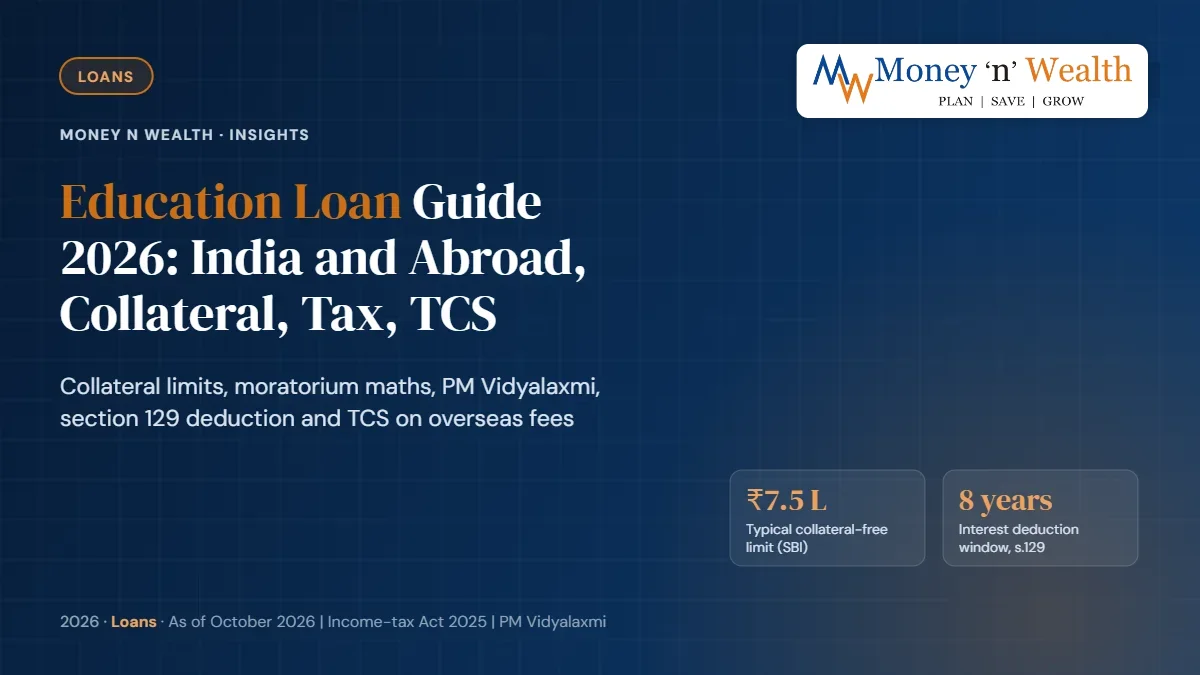
Quick answer: An education loan in India usually needs no collateral up to ₹7.5 lakh, with a parent as co-borrower. Larger loans, common for study abroad, need property or deposits as security unless the college qualifies for collateral-free schemes such as PM Vidyalaxmi. Repayment starts after the course plus a moratorium of six to twelve months. Interest is deductible for eight years under section 129 (old 80E), old regime only.
Last updated: 13 October 2026 Quick answer: An education loan in India usually needs no collateral up to ₹7.5 lakh, with a parent as co-borrower. Larger loans, common for study abroad, need property or deposits as security unless the college qualifies for collateral-free schemes such as PM Vidyalaxmi. Repayment starts after the course plus a moratorium of six to twelve months. Interest is deductible for eight years under section 129 (old 80E), old regime only. Key takeaways Collateral: none up to ₹7.5 lakh at SBI; tangible security above that, with exceptions for premier institutes. Tax: full interest deductible for up to 8 tax years under section 129 of the Income-tax Act, 2025, no upper limit, old regime only. Moratorium: interest still runs. Paying it during study saved ₹5.2 lakh in our ₹40 lakh example. PM Vidyalaxmi: collateral-free, guarantor-free loans for students at 860 NIRF-ranked institutions, with 3% interest subvention for family income up to ₹8 lakh. TCS: nil on fees paid from an education loan; 2% above ₹10 lakh a year if self-funded, from 1 April 2026. A Pune family planning a two-year master's in the US is looking at ₹50 lakh to ₹80 lakh, all in. Very few households can write that cheque without touching retirement savings. An education loan bridges the gap, but the way it is structured, from who signs as borrower to what happens during the moratorium, can swing the total cost by several lakh rupees. This guide explains, as of October 2026, how an education loan works for study in India and abroad: collateral thresholds, margin money, the moratorium and how interest builds up, the PM Vidyalaxmi scheme, the interest deduction under the new Income-tax Act, and TCS on overseas fee remittances. A worked rupee example shows the decisions that matter most. What is an education loan, and what does it cover? An education loan is a loan to pay for a course of study after school, repaid mainly from the student's future income, with a parent or guardian usually signing as co-borrower. Banks and some non-banking finance companies (NBFCs) offer them for courses in India and abroad. Most bank schemes cover far more than tuition. SBI's Student Loan Scheme, for example, includes college and hostel fees, exam, library and lab fees, books and a computer (capped at 20% of tuition), refundable deposits (capped at 10%), travel for study abroad, and other course costs such as project work. Living costs abroad are typically financed for overseas loans. Loan size depends on the course and the institution. SBI lends up to ₹50 lakh for most courses at top-100 NIRF institutions and up to ₹75 lakh for medicine there, with case-by-case limits up to ₹1 crore. Its Global Ed-Vantage scheme for foreign universities runs from above ₹7.5 lakh to ₹3 crore. Do you need collateral for an education loan? For smaller loans, no. For large overseas loans, usually yes. The common dividing line is ₹7.5 lakh, which is also the ceiling for the government's credit guarantee support on education loans. Loan amount Security (SBI example) Margin (your contribution) Processing fee Up to ₹4 lakh Parent or guardian as co-borrower only Nil Nil ₹4 lakh to ₹7.5 lakh Co-borrower; no collateral or third-party guarantee 5% (India), 15% (abroad) Nil ₹7.5 lakh to ₹20 lakh Co-borrower plus tangible collateral 5% / 15% Nil to ₹10 lakh; ₹5,000 + GST from ₹10 lakh to ₹20 lakh Above ₹20 lakh Co-borrower plus tangible collateral 5% / 15% 0.5%, capped at ₹25,000 + GST (Global Ed-Vantage: 0.5%, ₹10,000 to ₹50,000 + GST) There are important exceptions. SBI offers collateral-free overseas loans up to ₹50 lakh for select premier foreign institutions. Many Indian institutes of national importance have tie-ups for larger unsecured loans. NBFCs that specialise in study-abroad lending often lend without property security for well-ranked universities, usually at higher rates than banks. Education loan collateral rules compared: up to ₹7.5 lakh, above ₹7.5 lakh, and PM Vidyalaxmi scheme What counts as collateral? Banks accept residential property, fixed deposits, LIC policies with surrender value, government securities and similar assets. Property is valued by the bank's panel valuer and a lien or mortgage is created. If parents plan to use the family flat as security, check early whether the title papers, society NOC and share certificate are in order. Delays here are the most common reason overseas loans miss visa deadlines. How does the education loan moratorium work? The moratorium, or repayment holiday, is the period during which you do not pay EMIs. It covers the course plus a grace period after it: 12 months under SBI's Student Loan Scheme and six months under its Global Ed-Vantage scheme. After that, the loan is repaid over up to 15 years. The catch is that interest does not stop. Banks typically charge simple interest during the course and moratorium and add it to the principal when repayment starts. The EMI is then fixed on the larger amount. If you pay the interest as it falls due, the EMI is based on the original principal alone. Worked example: capitalise or pay as you go? Riya from Kothrud takes a ₹40 lakh loan for a two-year US master's. It is disbursed in two ₹20 lakh tranches a year apart. We assume 10.5% a year (illustrative; actual rates are linked to each bank's benchmark and rose after the October 2026 repo rate hike (/insights/rbi-repo-rate-hike-october-2026-emi-fd-debt-funds) ), a six-month moratorium after the course and a 10-year repayment. Interest during study and moratorium: ₹5.25 lakh on the first tranche (2.5 years) plus ₹3.15 lakh on the second (1.5 years) = ₹8.4 lakh. Option A, capitalise: principal becomes ₹48.4 lakh; EMI ₹65,309 for 120 months; total interest about ₹38.4 lakh. Option B, parents pay interest during study: they pay ₹8.4 lakh over 3.5 years; EMI ₹53,974 on ₹40 lakh; total interest about ₹33.2 lakh. Option B saves about ₹5.2 lakh and cuts Riya's starting EMI by over ₹11,000 a month, which matters when she is on a first salary and paying rent abroad. Stretching Option A to 15 years drops the EMI to ₹53,501 but raises total interest sharply. Use our EMI calculator guide (/insights/emi-calculator-guide-reduce-loan-interest) or the EMI calculator (/tools) to run your own numbers. Education loan moratorium interest: capitalising versus paying interest during the course How much tax can you save on an education loan? From 1 April 2026, the old section 80E lives on as section 129 of the Income-tax Act, 2025 , titled "Deduction in respect of interest on loan taken for higher education". The rules carry over almost unchanged: Who can claim: only an individual, for a loan taken for his or her own higher education or that of a spouse, children or a student for whom he or she is legal guardian. Which lenders: banks, other financial institutions notified by the government (several education NBFCs are notified) and approved charitable institutions. Loans from relatives, employers or most foreign lenders do not qualify. What is deductible: the full interest paid in the year, with no rupee cap. Principal repayment gets no deduction. How long: the tax year in which you start paying interest and the next seven, so eight tax years at most. Which regime: like other Chapter VIII deductions, it is available only if you choose the old regime. The default new regime under section 202 does not allow it. Two practical points decide whether the deduction is worth anything. First, the person claiming must be a borrower and must pay the interest out of income taxable in India. If Riya works in the US after graduating, she may have little Indian taxable income, so a parent co-borrower in the old regime who actually pays the EMIs is better placed to claim. Second, the clock starts in the year interest is first paid. In Riya's Option A, interest over the first eight repayment years is about ₹28.4 lakh. At a 31.2% marginal rate (30% plus cess), the deduction is worth roughly ₹8.9 lakh to someone in the old regime, but nothing in the new regime. Compare the two regimes for your household in our tax planning guide (/insights/tax-planning-guide-india) ; the section renumbering is explained in our guide to the Income-tax Act 2025 changes (/insights/income-tax-act-2025-changes-individuals) . What is PM Vidyalaxmi, and who qualifies? PM Vidyalaxmi is a central scheme, approved by the Union Cabinet on 6 November 2024, that gives collateral-free and guarantor-free education loans to students admitted to Quality Higher Education Institutions (QHEIs). QHEIs are chosen by NIRF ranking: government and private institutions in the top 100 overall or by category or domain, state government institutions ranked 101 to 200, and all central government institutions. The list started with 860 institutions and is updated each year. Credit guarantee: the government guarantees 75% of defaults on loans up to ₹7.5 lakh, which encourages banks to lend without security. Interest subvention: 3% a year during the moratorium on loans up to ₹10 lakh, for students with family income up to ₹8 lakh who do not get other government scholarships or subvention, for up to 1 lakh students a year. Lower-income families: students with family income up to ₹4.5 lakh in approved technical or professional courses get full interest subvention during the moratorium on loans up to ₹10 lakh under the separate PM-USP CSIS scheme. One application: a unified PM-Vidyalaxmi portal lets students apply to multiple banks with a single form. The scheme has an outlay of ₹3,600 crore for 2024-25 to 2030-31. It is aimed at study in India. For overseas study, the bank's regular study-abroad scheme applies. How does TCS work on education loan and overseas fee remittances? Paying a foreign university is a remittance under the RBI's Liberalised Remittance Scheme (LRS). The bank collects tax at source (TCS) under section 394 of the Income-tax Act, 2025. The Finance Act 2026 cut the rate for education and medical remittances from 5% to 2%, from 1 April 2026. How the remittance is funded Up to ₹10 lakh a year Above ₹10 lakh a year Education loan from a bank or notified financial institution Nil Nil Own funds, for education Nil 2% Own funds, for medical treatment Nil 2% Other LRS purposes (investments, gifts) Nil 20% Suppose parents pay ₹30 lakh of fees from savings in one year. TCS is 2% of ₹20 lakh, or ₹40,000. It is not an extra tax: it shows in the remitter's Form 26AS/AIS and is adjusted against tax due or refunded when the return is filed. It does, however, lock up cash for months. Paying directly from the loan account avoids it entirely. Our explainer on LRS and TCS (/insights/lrs-tcs-overseas-investing-india) covers the wider rules. TCS on education loan and self-funded overseas fee remittances in 2026 Education loan vs savings: how much should you borrow? The best education plan uses savings built over years, and a loan only for the gap. Parents who start early, through equity mutual fund SIPs or the Sukanya Samriddhi Yojana (/insights/sukanya-samriddhi-yojana-guide) for a daughter, need to borrow less. Our child education planning guide (/insights/child-education-planning-guide-india) and study-abroad planning guide (/insights/study-abroad-education-planning-india) show how to size that corpus. That said, a modest loan is not a failure. It gives the student a stake in the outcome, builds a credit history and protects the parents' retirement savings, which no lender will fund later. A sensible rule of thumb is to keep the expected EMI below about 15% to 20% of the student's realistic starting take-home pay, in the currency they will earn. If the corpus is only three to five years away, protect it as explained in our guide on de-risking an education corpus (/insights/education-planning-3-to-5-years) . Bank vs NBFC vs international lender Factor Public and private banks Education NBFCs Foreign lenders (US-based) Collateral Usually above ₹7.5 lakh Often unsecured for ranked universities Usually none; based on university and course Interest cost Generally lowest; linked to benchmark Higher than banks Varies; in foreign currency Section 129 deduction Yes Only if lender is notified Generally no TCS exemption on remittance Yes Only if notified Not applicable (paid abroad) Speed Slower, paperwork-heavy Faster Fast, online How to apply for an education loan, step by step Build the budget. List tuition, living costs, health insurance, travel and visa costs for the whole course. Convert at a cautious exchange rate and add 10%. Fix the family contribution. Decide how much comes from savings, keeping the emergency fund (/insights/emergency-fund-guide-india) and retirement money untouched. Check eligibility routes. If the institution is a QHEI, apply on the PM-Vidyalaxmi portal. For abroad, approach two or three banks and one NBFC. Get the paperwork ready. Admission letter, fee schedule, academic records, KYC of student and co-borrower, income proof and, for secured loans, property papers. Compare sanction letters. Look at the rate benchmark and spread, margin, collateral, processing fee, moratorium length, prepayment charges and whether a term insurance cover is bundled. Structure for tax. Make sure the person who will pay the interest from Indian taxable income is a borrower. Plan the moratorium. Set up a standing instruction to pay simple interest during the course if cash flow allows. Step-by-step checklist for taking an education loan for India or abroad Protect the loan and the family If the student dies or is disabled, the co-borrower still owes the bank. A simple term insurance policy on the student, sized to the loan, removes that risk; see our term cover guide (/insights/term-insurance-advisor-pune) . Repaying on time also builds the student's credit score (/insights/credit-score-cibil-check-improve) , which will matter for a first home loan. Once the student is earning, the choice between prepaying and investing follows the same logic as in our prepay-or-invest guide (/insights/prepay-home-loan-or-invest) . Related reading Planning for a child to study abroad (/insights/study-abroad-education-planning-india) Child education planning in India (/insights/child-education-planning-guide-india) LRS, TCS and overseas remittances (/insights/lrs-tcs-overseas-investing-india) EMI calculator guide: cut total loan interest (/insights/emi-calculator-guide-reduce-loan-interest) Income-tax Act 2025: what changed for individuals (/insights/income-tax-act-2025-changes-individuals) Loan solutions at Money n Wealth (/products/loans) Frequently Asked Questions What is the maximum education loan without collateral in India? At most banks, including SBI, education loans up to ₹7.5 lakh need no collateral or third-party guarantee, only a parent or guardian as co-borrower. Students admitted to the 860-odd QHEIs under PM Vidyalaxmi can get collateral-free, guarantor-free loans, and some banks and NBFCs lend larger unsecured amounts for premier Indian and foreign institutions. Terms vary, so compare lenders. What is section 80E called in the new Income-tax Act? Section 80E of the 1961 Act has been replaced by section 129 of the Income-tax Act, 2025, effective 1 April 2026. It allows an individual to deduct the full interest paid on a loan for higher education of self, spouse, children or a ward, from a bank or notified institution, for up to eight tax years. It is available only under the old tax regime. Can parents claim the education loan interest deduction? Yes, if the parent is a borrower or co-borrower on the loan and pays the interest out of income taxable in India. The loan must be for the higher education of their child, spouse or a student they are legal guardian of. Both parents cannot claim the same interest twice. The claimant must be in the old tax regime for that tax year. Is interest charged during the moratorium period? Yes. Banks typically charge simple interest during the course and the moratorium and add it to the principal when EMIs begin, which raises the EMI. Paying this interest as it falls due keeps the EMI based on the original loan. In our ₹40 lakh example at 10.5%, paying it during study saved about ₹5.2 lakh of total interest. Is there TCS on fees paid from an education loan? No. Under section 394 of the Income-tax Act, 2025, no TCS is collected on an overseas education remittance funded by a loan from a bank or notified financial institution. Self-funded education remittances attract 2% TCS on the amount above ₹10 lakh in a financial year from 1 April 2026, which can be claimed back in the remitter's tax return. How long is the repayment period for an education loan? Repayment starts after the course plus a grace period, six to twelve months at SBI depending on the scheme, and can run up to 15 years. Shorter tenures cost far less in total interest. Most banks allow prepayment, and floating-rate loans to individuals generally carry no foreclosure charge, but confirm this in the sanction letter. Does PM Vidyalaxmi cover study abroad? No. PM Vidyalaxmi covers students admitted to Quality Higher Education Institutions in India, selected through NIRF rankings and central government status. For foreign universities, use a bank's study-abroad scheme, such as SBI Global Ed-Vantage, or a specialist education lender, and check whether the lender qualifies for the section 129 deduction and TCS exemption. Sources: Income Tax Department, section 129, Income-tax Act 2025 (https://www.incometaxindia.gov.in/w/section-129-94) ; Income Tax Department, section 394 (TCS) (https://www.incometaxindia.gov.in/w/section-394-6) ; PMIndia, Cabinet approves PM Vidyalaxmi (6 Nov 2024) (https://www.pmindia.gov.in/en/news_updates/cabinet-approves-pm-vidyalaxmi-scheme-to-provide-financial-support-to-meritorious-students-so-that-financial-constraints-do-not-prevent-any-youth-of-india-from-pursuing-quality-higher-education/) ; SBI Student Loan Scheme (https://sbi.bank.in/web/personal-banking/loans/education-loans/student-loan-scheme) ; SBI Global Ed-Vantage Scheme (https://sbi.bank.in/web/personal-banking/loans/education-loans/global-ed-vantage-scheme) . Worked examples are Money n Wealth calculations. Planning to fund a degree in India or abroad? The right mix of savings, loan structure and tax regime can save your family several lakh rupees. Talk to Money n Wealth (/contact) for a free portfolio review. This article is for general educational purposes only and does not constitute financial advice. Figures and examples are illustrative. Please consult a qualified financial adviser for guidance specific to your situation. Money n Wealth (Predics Fintech Services Pvt Ltd) is an AMFI-registered Mutual Fund Distributor (ARN-121995) and APMI-registered PMS Distributor (APRN07444); it is not a SEBI-registered investment adviser and may earn distribution commission on investments made through it.
Frequently Asked Questions
What is the maximum education loan without collateral in India?
At most banks, including SBI, education loans up to ₹7.5 lakh need no collateral or third-party guarantee, only a parent or guardian as co-borrower. Students admitted to the 860-odd QHEIs under PM Vidyalaxmi can get collateral-free, guarantor-free loans, and some banks and NBFCs lend larger unsecured amounts for premier Indian and foreign institutions. Terms vary, so compare lenders.
What is section 80E called in the new Income-tax Act?
Section 80E of the 1961 Act has been replaced by section 129 of the Income-tax Act, 2025, effective 1 April 2026. It allows an individual to deduct the full interest paid on a loan for higher education of self, spouse, children or a ward, from a bank or notified institution, for up to eight tax years. It is available only under the old tax regime.
Can parents claim the education loan interest deduction?
Yes, if the parent is a borrower or co-borrower on the loan and pays the interest out of income taxable in India. The loan must be for the higher education of their child, spouse or a student they are legal guardian of. Both parents cannot claim the same interest twice. The claimant must be in the old tax regime for that tax year.
Is interest charged during the moratorium period?
Yes. Banks typically charge simple interest during the course and the moratorium and add it to the principal when EMIs begin, which raises the EMI. Paying this interest as it falls due keeps the EMI based on the original loan. In our ₹40 lakh example at 10.5%, paying it during study saved about ₹5.2 lakh of total interest.
Is there TCS on fees paid from an education loan?
No. Under section 394 of the Income-tax Act, 2025, no TCS is collected on an overseas education remittance funded by a loan from a bank or notified financial institution. Self-funded education remittances attract 2% TCS on the amount above ₹10 lakh in a financial year from 1 April 2026, which can be claimed back in the remitter's tax return.
How long is the repayment period for an education loan?
Repayment starts after the course plus a grace period, six to twelve months at SBI depending on the scheme, and can run up to 15 years. Shorter tenures cost far less in total interest. Most banks allow prepayment, and floating-rate loans to individuals generally carry no foreclosure charge, but confirm this in the sanction letter.
Does PM Vidyalaxmi cover study abroad?
No. PM Vidyalaxmi covers students admitted to Quality Higher Education Institutions in India, selected through NIRF rankings and central government status. For foreign universities, use a bank's study-abroad scheme, such as SBI Global Ed-Vantage, or a specialist education lender, and check whether the lender qualifies for the section 129 deduction and TCS exemption.
Planning to fund a degree in India or abroad?
The right mix of savings, loan structure and tax regime can save your family several lakh rupees. Talk to Money n Wealth for a free portfolio review.