Claim Settlement Ratio Explained: How to Read IRDAI Data in 2026
Last updated: 13 October 2026
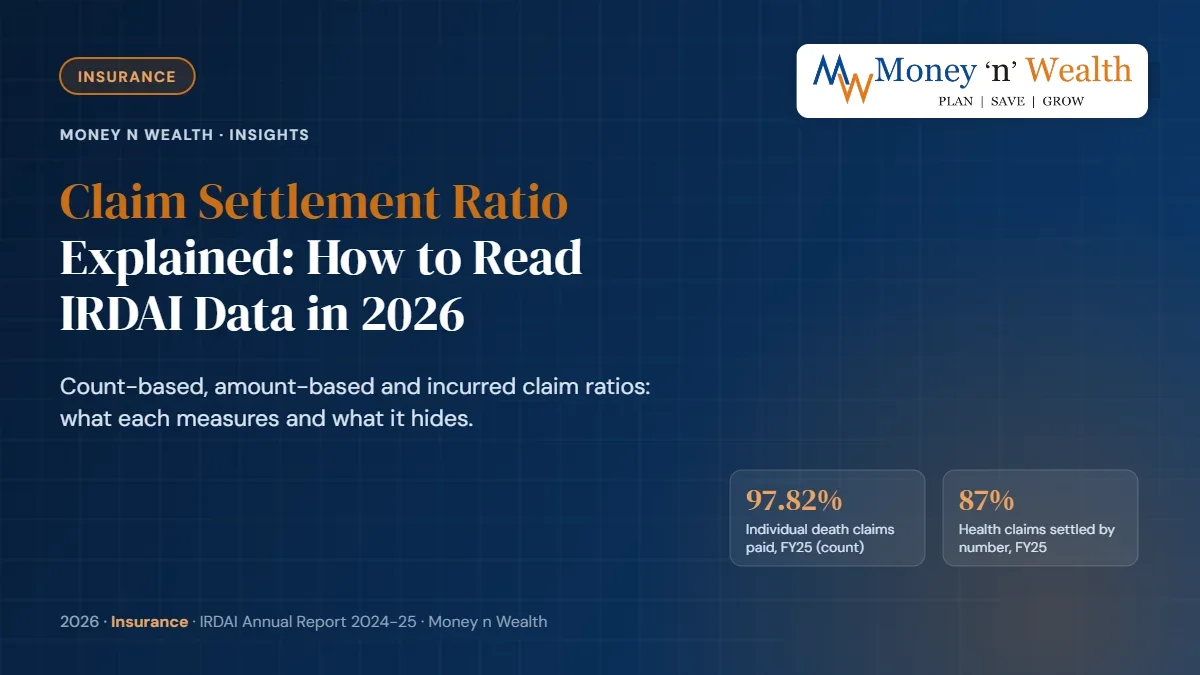
Quick answer: A claim settlement ratio (CSR) is the share of claims an insurer paid out of the claims it decided in a year. In 2024-25, Indian life insurers paid 97.82% of individual death claims by number, per IRDAI. Count-based CSR treats a ₹10 lakh and a ₹2 crore claim alike, so also check the amount-based ratio. In health insurance, the incurred claim ratio measures cost, not fairness.
Last updated: 13 October 2026 Quick answer: A claim settlement ratio (CSR) is the share of claims an insurer paid out of the claims it decided in a year. In 2024-25, Indian life insurers paid 97.82% of individual death claims by number, per IRDAI. Count-based CSR treats a ₹10 lakh and a ₹2 crore claim alike, so also check the amount-based ratio. In health insurance, the incurred claim ratio measures cost, not fairness. Key takeaways Life, FY25: 97.82% of individual death claims settled by number (IRDAI Annual Report 2024-25). Health, FY25: about 3.26 crore claims, ₹94,248 crore paid; roughly 87% settled, 8% repudiated, 5% pending. Count vs amount: a gap of more than 2–3 points means rejections cluster in bigger claims. Health ICR: standalone health insurers ran at 68.06% in FY25; it is a cost ratio, not a payout score. Your control: full disclosure at proposal stage matters more than a one-point CSR difference. Almost every term insurance advert in India leads with a claim settlement ratio of 98% or 99%. When nearly every insurer sits in a narrow band, the headline number stops helping you choose. Worse, it can hide the one thing a family cares about: will a large claim be paid in full and on time? This guide explains how the claim settlement ratio is calculated, where the official data comes from, why the amount-based ratio and the health incurred claim ratio tell different stories, and a practical way to use all three. Figures are from the IRDAI Annual Report 2024-25 (dated 30 December 2025), the latest available as of October 2026. What is a claim settlement ratio? A claim settlement ratio is the percentage of claims an insurer paid out of all claims it disposed of during a financial year. Disposed claims are those paid plus those repudiated (rejected). Claims still pending at year end are usually shown separately. For life insurance, the figure most quoted is the individual death claim settlement ratio by number . If an insurer received decisions on 10,000 death claims and paid 9,800, its count-based CSR is 98%. In health insurance, IRDAI reports how many claims were settled, repudiated and left pending across the industry. Insurers also publish their own claims data in quarterly public disclosures on their websites. The health ratio most people quote, though, is a different measure entirely: the incurred claim ratio. Comparison of claim settlement ratio by count, claim settlement ratio by amount and incurred claim ratio What did IRDAI's latest annual report show? IRDAI's Annual Report for 2024-25 is the most recent full-year regulator data. The headline numbers, as reported by the financial press and checked across sources, are below. Measure (FY 2024-25) Figure What it tells you Individual death claims settled, by number (life) 97.82% Roughly 2 in 100 individual death claims were not paid Health claims handled (general and health insurers) About 3.26 crore A record number of claims Health claim amount paid ₹94,248 crore Up from ₹83,493 crore in FY24 Average health claim paid ₹28,910 Down from ₹31,086 in FY24 Health claims settled / repudiated / pending (by number) ~87% / ~8% / ~5% Improved from ~83% / ~11% / ~6% in FY24 Share of health claim amount paid cashless 66.35% Two-thirds of rupees paid went directly to hospitals Incurred claim ratio, standalone health insurers 68.06% ₹68 of claims cost for every ₹100 of premium earned Health ICR, public sector general insurers (combined) 99.84% Claims almost equal to premium earned Two cautions. First, IRDAI's annual report gives industry totals and segment data; insurer-wise tables appear in the report annexures and in IRDAI's Handbook on Indian Insurance Statistics , which follows later. Second, definitions vary slightly between the two documents, so a ratio quoted from the handbook may not match the annual report exactly. Bar chart of health insurance claim settlement, repudiation and pending ratios in India, FY24 vs FY25 Count-based vs amount-based claim settlement ratio: why the gap matters The count-based CSR gives each claim one vote. A ₹15 lakh claim on an old endowment policy weighs the same as a ₹2 crore term claim. If an insurer pays thousands of small claims promptly but disputes a few large ones, its count-based ratio can still look excellent. The amount-based claim settlement ratio divides the rupees paid by the rupees claimed. It is the better guide for anyone buying a large term cover. Insurers are not required to advertise it, but IRDAI's handbook tables carry it. A worked example Suppose an insurer decides 1,000 death claims. It pays 980 claims averaging ₹20 lakh each, which is ₹196 crore. It rejects 20 claims averaging ₹1 crore each, which is ₹20 crore. Count-based CSR: 980 ÷ 1,000 = 98.0% Amount-based CSR: ₹196 crore ÷ ₹216 crore = 90.7% The headline would say 98%. A family holding a ₹1 crore policy with this insurer faces a very different picture. Illustrative bar chart showing a 98% claim settlement ratio by count but 90.7% by amount What the real data shows The gap is not hypothetical. In IRDAI's 2023-24 handbook data, LIC settled 96.42% of individual death claims within 30 days by number but 95.23% by amount, as reported by Angel One. One large private insurer settled 97.09% by number but only 91.16% by amount within 30 days. An analysis of IRDAI handbook data for 2024-25, reported by Insurance Business , put the industry at about 98.3% by count and 97.2% by amount. Analysts it quoted treat a gap above three points as a sign that rejections cluster at higher values. That is a useful rule of thumb, not a regulatory threshold. What is the incurred claim ratio in health insurance? The incurred claim ratio (ICR) is net claims incurred divided by net premium earned, for a year. It is the main ratio published for health insurers, and it is often mistaken for a settlement ratio. ICR answers a business question: how much of each premium rupee went to claims? It does not tell you what share of claims was paid. An insurer with an ICR of 65% may still pay 95% of its claims; it may simply have priced its policies well or grown fast with young customers. ICR range Common reading What to check next Below 50% Very profitable; may signal tight claim practices or rapid growth Repudiation share, complaints, waiting-period exclusions About 60%–90% Often seen as a comfortable range by analysts Trend over three years; settlement speed Above 100% Claims exceed premium earned (underwriting loss) Risk of steep premium increases at renewal As per FY25 data reported by Business Standard , standalone health insurers had a combined ICR of 68.06%, while the four public sector general insurers ran at 99.84% in health. Private general insurers spread widely, from under 60% to above 100%. None of these numbers alone makes an insurer good or bad for you. Health claim settlement ratio: where to find it For a health insurer's actual payout behaviour, look for claims paid, repudiated and pending by number, and the claims paid within prescribed timelines. These appear in each insurer's quarterly public disclosures and in IRDAI's annual data. Also read the policy's sub-limits, co-payment and room-rent clauses; partial deductions do not show up as rejections. For the mechanics of filing, see our guide on cashless and reimbursement health insurance claims (/insights/health-insurance-claim-cashless-reimbursement) . Why do life insurance claims get rejected? Most individual death claim rejections fall into a few buckets: Non-disclosure: an undeclared illness, smoking or alcohol habit, or existing policies with other insurers. Income misrepresentation: inflated income to qualify for a larger cover. Lapsed policy: premium not paid within the grace period. Exclusions: for example, suicide within the first 12 months under the policy terms. Fraud: forged documents or misrepresented identity. Section 45 of the Insurance Act, 1938 limits an insurer's ability to question a policy once three years have passed from the date of issue or revival. After three years, a claim cannot be rejected on grounds of misstatement or non-disclosure. Within three years, the insurer can repudiate on fraud or material non-disclosure, but must give reasons in writing. This is why early-duration claims are investigated more closely. It is also why a perfect proposal form is your best claim insurance. How fast must insurers settle claims in 2026? IRDAI's Master Circular on Protection of Policyholders' Interests, issued 5 September 2024, sets the current service standards: Claim type Timeline Death claim, no investigation needed Within 15 days of intimation, once documents are complete Death claim, investigation needed Within 45 days of intimation, including investigation Health cashless pre-authorisation Within 1 hour of request Health cashless final authorisation at discharge Within 3 hours Health reimbursement claim Within 15 days of receiving the last document Delay penalty (life claims) Interest at bank rate plus 2% from intimation The older handbook speed data was compiled against a 30-day standard. Because the bar is now tighter, look for an insurer's share of claims settled within 30 days as a minimum, and expect it to rise. How should you use claim settlement ratio when buying a policy? Treat CSR as a filter, not a ranking. A difference between 98.6% and 99.1% in one year tells you very little. A consistent pattern over several years, and a narrow count-to-amount gap, tells you more. Five-step checklist for reading claim settlement ratio data before buying insurance Take three to five years of data. One year can be distorted by a few large claims or a change in claim volumes. Check the amount-based ratio for big covers. If you are buying ₹50 lakh or more, the amount ratio is more relevant to you. Look at volumes. A 100% ratio on 300 claims is less informative than 98.5% on 30,000 claims. Look at speed and pending claims. A high pending share at year end means slow processing. Compare complaints. Insurers disclose grievances; Bima Bharosa, IRDAI's grievance portal, logs them too. Then weigh product and service. Premium, policy wording, riders, servicing in your city and digital claim support matter as much. Money n Wealth distributes Tata AIA and Tata AIG policies, so we deliberately do not rank insurers here. The checklist above works for any insurer, including the ones we represent. Our insurance planning guide (/insights/insurance-planning-guide-india) covers how much cover to buy first. What can you do to make sure your own claim is paid? Insurer averages matter less than your file. Most avoidable rejections start at the proposal stage. Fill the proposal yourself. Check every answer an agent or website pre-fills. Declare smoking, alcohol, past surgeries and existing policies. Keep income proof consistent. The income you declare should match your ITR and salary slips. Register nominees and tell them. Keep policy numbers in one place. Our guide to consolidating scattered policies (/insights/consolidate-scattered-investments-and-policies) helps. Consider an MWPA policy so proceeds go to your spouse and children beyond the reach of creditors. See term insurance for homemakers and women (/insights/term-insurance-for-homemakers-women) for how this works. Keep the policy in force. Use auto-debit and note the grace period. If a claim is wrongly rejected, escalate to the insurer's grievance officer, then to Bima Bharosa, and then to the Insurance Ombudsman, which handles complaints up to ₹50 lakh without a fee. Does claim settlement ratio matter for NRIs and homemakers? Yes, and the stakes can be higher. NRI claims often involve overseas death certificates and documentation, so speed data matters more. Read life and health insurance for NRIs (/insights/insurance-for-nris-india) for the paperwork. For homemakers, covers are usually smaller and capped by the spouse's cover; the amount-based gap is less of a concern than getting eligibility right. Related reading Term insurance: how much cover you need (/insights/term-insurance-advisor-pune) How to file a cashless or reimbursement health claim (/insights/health-insurance-claim-cashless-reimbursement) Porting your health insurance: rules and pitfalls (/insights/health-insurance-portability-rules) Super top-up health plans (/insights/super-top-up-health-insurance) Health insurance for parents and senior citizens (/insights/health-insurance-for-parents-senior-citizens) Frequently Asked Questions What is a good claim settlement ratio for term insurance? Most life insurers report 97% to 99.5% by number, and the industry figure for individual death claims was 97.82% in 2024-25. Look for a ratio consistently in that band for three to five years, a large enough claim volume, and an amount-based ratio within two or three points of the count-based ratio. Small year-to-year differences are not meaningful. Where can I find the official claim settlement ratio? The authoritative sources are IRDAI's Annual Report and its Handbook on Indian Insurance Statistics, both on irdai.gov.in. Each insurer also publishes claims data in its quarterly public disclosures on its own website. Figures in adverts and comparison sites should be traced back to one of these, with the year stated. Is incurred claim ratio the same as claim settlement ratio? No. Incurred claim ratio is claims incurred divided by premium earned, a measure of cost and pricing. Claim settlement ratio is the share of claims paid. A health insurer with a 60% ICR can still pay most claims, and one with 100% ICR may be losing money. Use ICR to spot pricing stress, not to judge fairness. What is an amount-based claim settlement ratio? It is the total rupee value of claims paid divided by the total value of claims decided. Because large claims weigh more, it shows whether an insurer pays big claims as reliably as small ones. It is especially relevant for term covers of ₹50 lakh or more, where a few rejected large claims can pull the ratio down sharply. Can an insurer reject a claim after three years? Under Section 45 of the Insurance Act, 1938, a life policy cannot be questioned on any ground, including misstatement or non-disclosure, after three years from the date of issue or revival. Policy exclusions and lapse still apply. Within three years, rejection on fraud or material non-disclosure is allowed, with written reasons. How long does a life insurance death claim take in 2026? Under IRDAI's September 2024 master circular, claims not needing investigation must be settled within 15 days of intimation once documents are complete. Claims needing investigation must be settled within 45 days. If the insurer delays, it must pay interest at bank rate plus 2% from the date of intimation. Should I choose an insurer only on claim settlement ratio? No. Use it to filter out insurers with persistently weak or volatile records. Then compare premium, policy wording, riders, servicing, complaint data and the amount-based ratio. Your own disclosure at proposal stage has a bigger effect on your claim than a fraction of a percentage point in CSR. Sources: Outlook Money on IRDAI Annual Report 2024-25 (https://www.outlookmoney.com/personal-finance/irdai-2024-25-annual-report-health-premiums-cross-rs-127-lakh-crore-mark) ; Business Standard, incurred claim ratios FY25 (https://www.business-standard.com/finance/personal-finance/paying-claims-or-pushing-back-what-irdai-data-reveals-about-insurers-126010100580_1.html) ; IndiaMedToday, health claims FY25 (https://indiamedtoday.com/record-health-insurance-claims-settled-in-fy25-average-payout-per-claim-declines/) ; Ditto summary of IRDAI Annual Report 2024-25 (https://www.joinditto.in/articles/general/irdai-annual-report/) ; Insurance Business, count vs amount CSR (https://www.insurancebusinessmag.com/asia/news/life-insurance/what-indias-claims-settlement-ratio-doesnt-tell-brokers-586054.aspx) ; Angel One, IRDAI handbook 2023-24 data (https://oga-prod.angelone.in/news/economy/life-insurance-claim-settlement-ratios-2025-how-insurers-performed-this-year) ; Mondaq, IRDAI master circular timelines (https://www.mondaq.com/india/insurance-laws-and-products/1536672/irdai39s-update-on-turnaround-times-for-insurance-companies) . Worked examples are Money n Wealth calculations. Not sure your existing policies would pay out smoothly? A review of your proposal disclosures, nominees and cover can prevent the most common claim problems. Talk to Money n Wealth (/contact) for an insurance review. This article is for general educational purposes only and does not constitute financial advice. Figures and examples are illustrative. Please consult a qualified financial adviser for guidance specific to your situation. Money n Wealth (Predics Fintech Services Pvt Ltd) is an AMFI-registered Mutual Fund Distributor (ARN-121995) and APMI-registered PMS Distributor (APRN07444); it is not a SEBI-registered investment adviser and may earn distribution commission on investments made through it. Insurance is the subject matter of solicitation.
Frequently Asked Questions
What is a good claim settlement ratio for term insurance?
Most life insurers report 97% to 99.5% by number, and the industry figure for individual death claims was 97.82% in 2024-25. Look for a ratio consistently in that band for three to five years, a large enough claim volume, and an amount-based ratio within two or three points of the count-based ratio. Small year-to-year differences are not meaningful.
Where can I find the official claim settlement ratio?
The authoritative sources are IRDAI's Annual Report and its Handbook on Indian Insurance Statistics, both on irdai.gov.in. Each insurer also publishes claims data in its quarterly public disclosures on its own website. Figures in adverts and comparison sites should be traced back to one of these, with the year stated.
Is incurred claim ratio the same as claim settlement ratio?
No. Incurred claim ratio is claims incurred divided by premium earned, a measure of cost and pricing. Claim settlement ratio is the share of claims paid. A health insurer with a 60% ICR can still pay most claims, and one with 100% ICR may be losing money. Use ICR to spot pricing stress, not to judge fairness.
What is an amount-based claim settlement ratio?
It is the total rupee value of claims paid divided by the total value of claims decided. Because large claims weigh more, it shows whether an insurer pays big claims as reliably as small ones. It is especially relevant for term covers of ₹50 lakh or more, where a few rejected large claims can pull the ratio down sharply.
Can an insurer reject a claim after three years?
Under Section 45 of the Insurance Act, 1938, a life policy cannot be questioned on any ground, including misstatement or non-disclosure, after three years from the date of issue or revival. Policy exclusions and lapse still apply. Within three years, rejection on fraud or material non-disclosure is allowed, with written reasons.
How long does a life insurance death claim take in 2026?
Under IRDAI's September 2024 master circular, claims not needing investigation must be settled within 15 days of intimation once documents are complete. Claims needing investigation must be settled within 45 days. If the insurer delays, it must pay interest at bank rate plus 2% from the date of intimation.
Should I choose an insurer only on claim settlement ratio?
No. Use it to filter out insurers with persistently weak or volatile records. Then compare premium, policy wording, riders, servicing, complaint data and the amount-based ratio. Your own disclosure at proposal stage has a bigger effect on your claim than a fraction of a percentage point in CSR.
Not sure your existing policies would pay out smoothly?
A review of your proposal disclosures, nominees and cover can prevent the most common claim problems. Talk to Money n Wealth for an insurance review.