What Is a Specialised Investment Fund (SIF)? The 2026 Guide
Last updated: 13 October 2026
Quick answer: A Specialised Investment Fund (SIF) is a SEBI-regulated product, run by a mutual fund house under a separate brand, that can use long-short strategies a normal mutual fund cannot. It needs a minimum of ₹10 lakh per investor, may hold unhedged short positions of up to 25% of assets through derivatives, and is taxed largely like a mutual fund.
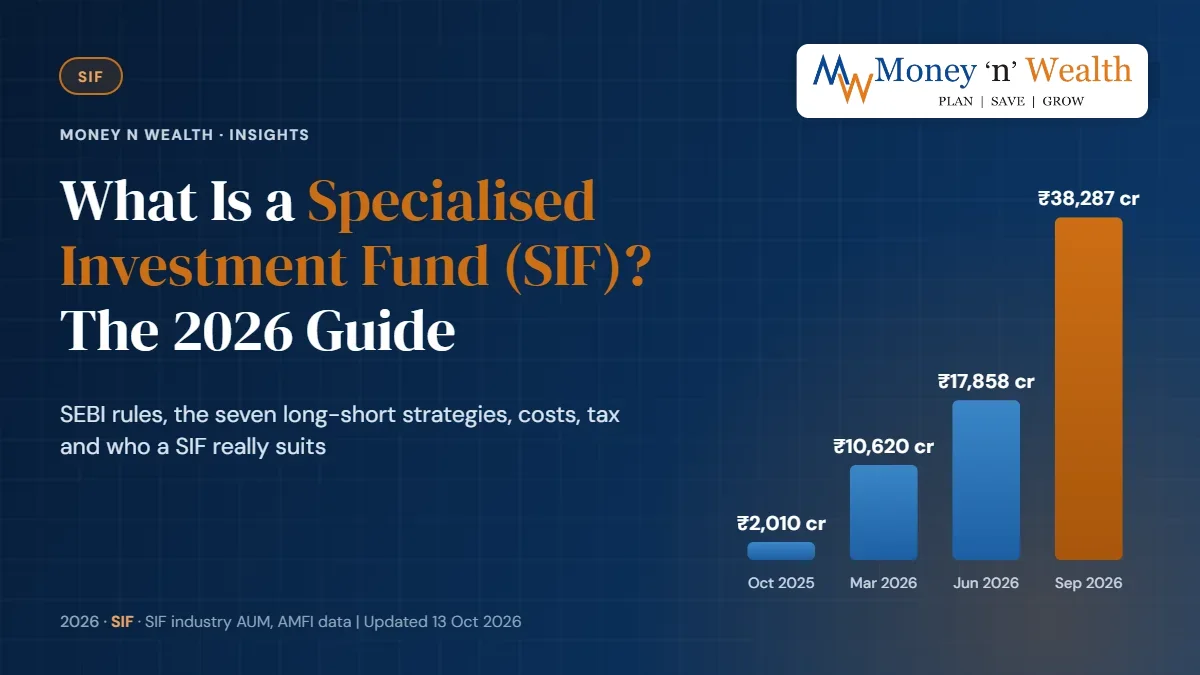
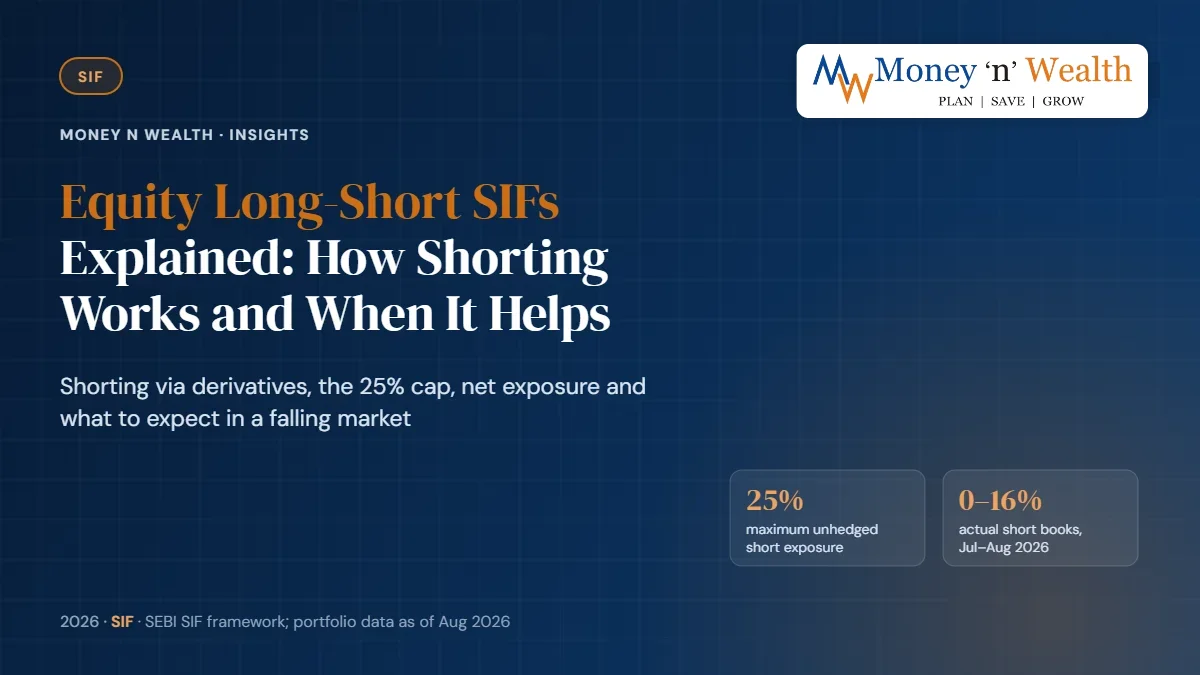
Last updated: 13 October 2026 Quick answer: A Specialised Investment Fund (SIF) is a SEBI-regulated product, run by a mutual fund house under a separate brand, that can use long-short strategies a normal mutual fund cannot. It needs a minimum of ₹10 lakh per investor, may hold unhedged short positions of up to 25% of assets through derivatives, and is taxed largely like a mutual fund. Key takeaways Rulebook: SEBI circular of 27 February 2025, effective 1 April 2025; first SIF launched September 2025. Ticket size: ₹10 lakh minimum at PAN level across one AMC’s SIF strategies. Shorting: unhedged short exposure capped at 25% of net assets, via exchange-traded derivatives only. Growth: industry AUM reached ₹38,287 crore by September 2026, up from ₹2,010 crore in October 2025. Most popular: hybrid long-short strategies hold roughly two-thirds of SIF assets. Fit: a satellite for experienced investors, not a replacement for core mutual funds. Until 2025, an Indian investor who wanted a fund manager to bet against a stock, not just buy it, needed ₹50 lakh for a PMS or ₹1 crore for a Category III AIF. The Specialised Investment Fund, or SIF, changed that. With ₹10 lakh you can now buy a regulated long-short strategy from a mutual fund house you already know. The response has been fast. In twelve months, SIFs went from zero to more than ₹38,000 crore of assets and over 1.25 lakh folios. That speed is a reason to understand the product properly before investing. This guide explains what a SIF is, the exact SEBI rules, the seven strategy types, costs, tax, the global precedents, and a frank view of who should and should not use one. What is a Specialised Investment Fund (SIF)? A Specialised Investment Fund is a pooled investment product offered by a SEBI-approved mutual fund house, under a brand distinct from its mutual funds, that may run strategies with limited short selling and wider use of derivatives. SEBI spells it "Specialized"; you will see both spellings. Each SIF scheme is called an "investment strategy" rather than a scheme. Think of a SIF as a mutual fund with a longer leash. It keeps the mutual-fund chassis: the same trust structure, daily NAV for open-ended strategies, custodians, SEBI inspection and mutual-fund-style taxation. What it adds is the ability to profit from falling prices on part of the portfolio, plus more flexible asset allocation. SEBI created the category to fill the gap between mutual funds (₹500 SIPs, tightly restricted) and PMS or AIFs (₹50 lakh to ₹1 crore minimums, lighter product rules). The legal base came through amendments to the Mutual Funds Regulations in December 2024. The operating rules arrived in the SEBI circular on the regulatory framework for SIFs (https://www.sebi.gov.in/legal/circulars/feb-2025/regulatory-framework-for-specialized-investment-funds-sif-_92299.html) dated 27 February 2025, effective 1 April 2025. The framework now sits within the SEBI (Mutual Funds) Regulations, 2026, in force since 1 April 2026. Key specialised investment fund SIF rules: ₹10 lakh minimum, 25% short cap, seven strategies, 15-day notice, risk band 1 to 5 What are the SEBI rules for SIFs? Who can launch a SIF? Not every fund house qualifies. An AMC needs either a sound track record (at least three years in operation with average AUM of ₹10,000 crore or more over the preceding three years) or an alternate route: a Chief Investment Officer with at least 10 years of fund management experience and ₹5,000 crore average AUM managed, plus an additional fund manager with three years’ experience and ₹500 crore managed. In both routes, the AMC must not have faced specified SEBI enforcement action in the last three years. The ₹10 lakh minimum investment The minimum is ₹10 lakh per investor, counted at PAN level across all SIF strategies of one AMC. Your ordinary mutual fund holdings with that AMC do not count. Accredited investors are exempt. SIP, SWP and STP are allowed, provided you stay above the threshold. A worked example shows how it bites. Say you invest ₹12 lakh in one SIF. You cannot withdraw ₹3 lakh, because that would take you to ₹9 lakh, an "active breach". You could withdraw up to ₹2 lakh, or exit fully. If markets push your holding down to ₹9 lakh, that "passive breach" is not a violation, but any further redemption must be of the entire balance. The 25% short-exposure cap A SIF may take unhedged short positions of up to 25% of net assets through exchange-traded derivatives. This is in addition to derivatives used for hedging and rebalancing. There is no physical short selling of borrowed shares and no leverage: gross exposure across all instruments cannot exceed 100% of net assets. Equity single-company exposure stays capped at 10% of assets, as in mutual funds. For a ₹100 crore equity long-short strategy, that means at most ₹25 crore of net short bets. If the manager is short ₹15 crore of Nifty futures and the index falls 10%, the short gains about ₹1.5 crore, cushioning losses on the long book (illustrative, before costs). Redemption, notice period and listing SIFs can be open-ended, closed-ended or interval. Redemption frequency varies by strategy (see table below) and an AMC may impose a notice period of up to 15 working days, with redemption at the NAV at the end of that notice. Closed-ended and interval strategies must be listed on a stock exchange. Branding, risk band and disclosures Each SIF must carry its own brand name and logo, which is why you see names like Magnum, qSIF, Altiva, iSIF or Titanium. The parent mutual fund’s name can appear for five years from launch approval, in a font no larger than the SIF brand, as "brought to you by". AMCs must run a separate website or dedicated page for the SIF. Instead of the familiar riskometer, SIFs show a risk band from 1 (lowest) to 5 (highest), reviewed monthly. Offer documents, called the ISID, must include a scenario analysis of how the strategy may behave. What are the seven SIF strategy types? SEBI permits seven strategies, and each AMC may offer only one strategy per category. The table summarises the circular’s core rules. SIF strategy Core allocation rule Short exposure Redemption (max frequency) Equity Long-Short At least 80% in equity Unhedged short up to 25% Daily or less frequent Equity Ex-Top 100 Long-Short At least 65% in stocks outside the top 100 by market cap Up to 25%, in non-large-cap stocks Daily or less frequent Sector Rotation Long-Short At least 80% in up to four sectors Up to 25%, sector level Daily or less frequent Debt Long-Short Debt across durations Via exchange-traded debt derivatives Weekly or less frequent Sectoral Debt Long-Short Debt across at least two sectors, max 75% in one Up to 25% Weekly or less frequent Active Asset Allocator Long-Short Dynamic mix of equity, debt, REITs/InvITs, commodity derivatives Up to 25% Twice a week or less frequent Hybrid Long-Short At least 25% equity and at least 25% debt Up to 25% Twice a week or less frequent As of October 2026, no fund house has launched a debt or sectoral debt long-short SIF. The live strategies fall into the other five categories. Why hybrid long-short SIFs dominate Most early SIFs are conservative. A typical hybrid long-short strategy holds 65–75% in equity, much of it hedged through arbitrage and covered calls, 25–35% in debt, and a small unhedged short book. SBI’s Magnum Hybrid Long Short Fund, launched in October 2025, is an example: twice-weekly redemptions and a NIFTY 50 Hybrid Composite Debt 50:50 benchmark, as described in Business Standard’s launch coverage (https://www.business-standard.com/amp/finance/personal-finance/sbi-mf-rolls-out-magnum-hybrid-long-short-fund-nfo-opens-october-1-125092500126_1.html) . Investors use these as a "fixed income plus" option. Our explainer on hybrid long-short SIFs (/insights/hybrid-long-short-sif-explained) covers the mechanics, and the companion piece on equity long-short SIFs (/insights/equity-long-short-sif-explained) explains how shorting works in practice. Horizontal bar chart of SIF AUM by strategy category in August 2026, led by hybrid long-short SIFs at ₹19,670 crore How fast are SIFs growing in 2026? India’s first SIF, quant’s qSIF Equity Long-Short Fund, ran its NFO from 17 September to 1 October 2025 and raised about ₹300 crore from over 1,900 investors, Cafemutual reported (https://cafemutual.com/news/industry/35954-indias-first-sif-raises-nearly-rs300-crore) . By end-October 2025, AMFI data showed ₹2,010 crore of SIF assets in 10,212 folios. Growth then compounded. SIF AUM crossed ₹10,000 crore in March 2026 and ₹13,500 crore by May 2026, with more than 56,000 folios. August 2026 closed at ₹31,175 crore and about 1.25 lakh folios. September 2026 net inflows were ₹7,578 crore, taking AUM to ₹38,287 crore, of which ₹26,413 crore was in hybrid strategies, according to AMFI data reported by Outlook Money (https://www.outlookmoney.com/invest/equity-oriented-sif-inflows-fall-september-2026-amfi-data) . Bar chart of specialised investment fund SIF AUM in India rising from ₹2,010 crore in October 2025 to ₹38,287 crore in September 2026 By August 2026, more than 30 strategies were live from around 17 fund houses, including SBI, ICICI Prudential, Kotak, Tata, Edelweiss, Bandhan, Mirae Asset, HSBC, Aditya Birla Sun Life, 360 ONE and quant. For a running list, see our SIF launches and AUM tracker (/insights/sif-launches-aum-tracker-2026) . Note that the average folio is well above the minimum: roughly ₹36 lakh in hybrid strategies and ₹15 lakh in equity-oriented ones in August 2026. Early buyers are mostly affluent investors. How is a SIF different from a mutual fund, PMS or AIF? In short: a SIF has mutual-fund-style regulation and tax with some hedge-fund-style tools. A mutual fund can use derivatives only for hedging and rebalancing. A PMS holds stocks in your own demat account, and every trade is taxed in your hands. A Category III AIF can use leverage and is generally taxed at the fund level. Our full comparison, SIF vs mutual fund vs PMS vs AIF (/insights/sif-vs-mutual-fund-vs-pms-vs-aif) , sets these out side by side. Background reading: our PMS guide (/insights/pms-india) and Category III AIF guide (/insights/category-iii-aif-guide) . How are SIFs taxed and what do they cost? Tax SIFs are set up under mutual fund trusts, so the fund itself pays no tax and you are taxed when you redeem. The rate depends on each strategy’s equity character, as for mutual funds. Where domestic equity (including hedged positions) is at least 65%, equity rules apply: 20% short-term capital gains tax within 12 months and 12.5% long-term tax above ₹1.25 lakh a year after 12 months. Some hybrid strategies keep equity below 65% and are taxed under hybrid or debt rules instead, with a 24-month holding period or slab rates. Check the tax section of each ISID rather than assuming. Our article on SIF taxation in 2026 (/insights/sif-taxation-india) works through examples, and capital gains tax on mutual funds (/insights/capital-gains-tax-mutual-funds-2026) covers the base rules. Costs SEBI applied the mutual-fund expense structure to SIFs, so total expense ratios fall within mutual-fund-style caps rather than PMS-style fixed and performance fees. There is no performance fee. A Cafemutual analysis of AMFI data in April 2026 found the gap between regular and direct plan expense ratios averaged about 1.3% across SIFs. Exit loads are common in the first weeks or months. As with any fund, ask for both the regular and direct plan expense ratio before investing. How do other countries bring hedge-fund strategies to retail investors? India is not the first market to do this, and the global record is useful for setting expectations. Europe (UCITS): UCITS funds are barred from uncovered short sales under Article 89 of the UCITS Directive (https://www.esma.europa.eu/publications-and-data/interactive-single-rulebook/ucits/article-89) . Managers create "synthetic" shorts through derivatives within exposure and liquidity limits, much like SIFs. Alternative UCITS long-short funds became a large category after 2008. United States (40-Act funds): "Liquid alternative" mutual funds use long-short and other hedge-fund strategies. Since the SEC adopted Rule 18f-4 in October 2020, funds using derivatives substantially must cap risk through value-at-risk limits, as Ropes & Gray summarises (https://www.ropesgray.com/en/newsroom/alerts/2020/11/SEC-Adopts-Rule-18f-4-Concerning-Registered-Funds-Use-of-Derivatives) . Canada: "Alternative mutual funds" opened to retail investors on 3 January 2019, with short selling up to 50% of NAV and aggregate leverage up to 300%, far looser than India’s 25% and no-leverage rule. The lesson is caution about returns. A Dimensional study (https://www.dimensional.com/gb-en/insights/liquid-alternatives-panacea-or-just-a-pain) of US liquid-alternative funds from June 2006 to June 2022 found they trailed global stocks by 4.2 percentage points a year and global bonds by 1.7 points, with an average expense ratio of 1.6%. Long-short is a tool for a smoother ride, not a reliable source of extra return. India’s tighter limits reduce the risk of blow-ups but also limit what shorting can add. Who should consider a SIF, and who should not? A SIF can make sense if most of these are true: Your investable portfolio is large enough that ₹10 lakh is a modest slice, typically 10–15% or less. Your core mutual fund, retirement and emergency allocations are already in place. You understand derivatives and shorting at a basic level, and accept that a strategy can lag in strong bull markets. You can live with fixed redemption days and a possible notice period. You want a lower-volatility equity or hybrid option and are weighing it against arbitrage funds (/insights/arbitrage-funds) or balanced advantage funds (/insights/balanced-advantage) . A SIF is probably not for you if you are stretching to reach ₹10 lakh, need the money within two to three years, or are buying because a new product is getting attention. Most strategies have barely a year of history, which says little about how they behave in a deep bear market. Our SIF suitability checklist (/insights/is-sif-right-for-you-checklist) walks through the questions to ask. Five steps to invest in a specialised investment fund SIF in India How do you invest in a SIF? Confirm your KYC is valid and you can commit ₹10 lakh to one AMC’s SIF strategies. Choose a channel: an AMFI-registered distributor holding the NISM Series V-D SIF certification (or a grandfathered Series XIII holder), or the SIF’s own website for direct plans. AMFI’s SIF investor page (https://www.amfiindia.com/sif/sif-online-center/investonlineinsif) links to several SIF sites. Read the ISID and KIM: strategy, short limits, scenario analysis, redemption days, notice period, exit load and tax character. Invest by lump sum, or SIP once the threshold is met. Review against the benchmark and your goal at least yearly. Distributor rules tightened in July 2026, when SEBI introduced the NISM Series V-D certification for SIF distribution, Cafemutual reported (https://cafemutual.com/news/sif-corner/38300-existing-sif-distributors-need-not-appear-for-the-new-sif-exam-again-sebi) . You can check any distributor’s ARN using our guide on verifying an ARN or SEBI registration (/insights/how-to-verify-arn-sebi-irdai-registration) . Money n Wealth is a certified SIF distributor; see our SIF page (/products/sif) or, if you are in Pune, SIF distribution in Pune (/sif-distributor-pune) . Related reading SIF vs Mutual Fund vs PMS vs AIF: Where SIF Fits (/insights/sif-vs-mutual-fund-vs-pms-vs-aif) SIF Taxation in 2026: How Gains Are Taxed (/insights/sif-taxation-india) Hybrid Long-Short SIFs Explained (/insights/hybrid-long-short-sif-explained) Is a SIF Right for You? A Suitability Checklist (/insights/is-sif-right-for-you-checklist) PMS vs Mutual Funds above ₹1 crore (/insights/pms-vs-mutual-funds-1-crore-investors) Frequently Asked Questions What is the minimum investment in a SIF? The minimum is ₹10 lakh per investor, measured at PAN level across all SIF strategies of the same fund house. Your regular mutual fund investments with that AMC do not count towards it. Accredited investors are exempt. Once you meet the threshold, you can add through SIP or lump sum, but partial withdrawals that take you below ₹10 lakh are not allowed. Is a SIF the same as a mutual fund? Not quite. A SIF is offered by a mutual fund house under the same trust and SEBI oversight, and is taxed like a mutual fund. But it has a separate brand, a ₹10 lakh minimum, a 1-to-5 risk band, and can take unhedged short positions of up to 25% of assets through derivatives. Ordinary mutual funds can use derivatives only for hedging and rebalancing. Can a SIF lose more than I invest? No. SIFs cannot use leverage: total gross exposure, including derivatives, is capped at 100% of net assets, and short positions are limited to 25%. Your maximum loss is your investment. That said, the value can fall, sometimes sharply, and a short position can lose money if the market rises. SIFs carry market, derivative and liquidity risks. How quickly can I redeem a SIF? It depends on the strategy. Equity strategies may offer daily redemption, hybrid and asset-allocator strategies at most twice a week, and debt strategies at most weekly. AMCs can add a notice period of up to 15 working days. For example, SBI’s Magnum Hybrid Long Short Fund redeems twice a week. Always check the redemption days and exit load in the ISID. Are SIF gains taxed like equity mutual funds? Only if the strategy maintains at least 65% in domestic equity, including hedged positions. Then short-term gains are taxed at 20% and long-term gains above ₹1.25 lakh at 12.5% after 12 months. Strategies with lower equity are taxed under hybrid or debt rules. The fund’s ISID states its expected tax character. Which SIF strategy is most popular in India? Hybrid long-short. In August 2026 it held about ₹19,670 crore, roughly 63% of industry SIF assets, and in September 2026 hybrid strategies drew about 68% of net inflows. Equity ex-top 100 long-short has been the fastest-growing equity category. No debt long-short SIF had launched as of October 2026. Who regulates SIFs and what is the governing circular? SEBI. The framework was set by SEBI circular SEBI/HO/IMD/IMD-PoD-1/P/CIR/2025/26 dated 27 February 2025, effective 1 April 2025, building on December 2024 amendments to the mutual fund regulations. SIF rules now form part of the SEBI (Mutual Funds) Regulations, 2026. SEBI added compliance-reporting formats for SIFs in January 2026. Sources: SEBI SIF circular, 27 Feb 2025 (https://www.sebi.gov.in/legal/circulars/feb-2025/regulatory-framework-for-specialized-investment-funds-sif-_92299.html) ; AMFI SIF investor corner (https://www.amfiindia.com/sif/sif-online-center/investonlineinsif) ; Outlook Money (AMFI Sep 2026 data) (https://www.outlookmoney.com/invest/equity-oriented-sif-inflows-fall-september-2026-amfi-data) ; Cafemutual (https://cafemutual.com/news/industry/35954-indias-first-sif-raises-nearly-rs300-crore) ; Business Standard (https://www.business-standard.com/amp/finance/personal-finance/sbi-mf-rolls-out-magnum-hybrid-long-short-fund-nfo-opens-october-1-125092500126_1.html) ; ESMA UCITS rulebook (https://www.esma.europa.eu/publications-and-data/interactive-single-rulebook/ucits/article-89) ; Dimensional (https://www.dimensional.com/gb-en/insights/liquid-alternatives-panacea-or-just-a-pain) . Worked examples are Money n Wealth calculations. Wondering whether a SIF belongs in your portfolio? Whether a SIF suits you depends on your existing allocation, liquidity needs and tax position, so it helps to look at the whole picture. Talk to Money n Wealth (/contact) for a free portfolio review. This article is for general educational purposes only and does not constitute financial advice. Figures and examples are illustrative. Please consult a qualified financial adviser for guidance specific to your situation. Money n Wealth (Predics Fintech Services Pvt Ltd) is an AMFI-registered Mutual Fund Distributor (ARN-121995) and APMI-registered PMS Distributor (APRN07444); it is not a SEBI-registered investment adviser and may earn distribution commission on investments made through it.
Frequently Asked Questions
What is the minimum investment in a SIF?
The minimum is ₹10 lakh per investor, measured at PAN level across all SIF strategies of the same fund house. Your regular mutual fund investments with that AMC do not count towards it. Accredited investors are exempt. Once you meet the threshold, you can add through SIP or lump sum, but partial withdrawals that take you below ₹10 lakh are not allowed.
Is a SIF the same as a mutual fund?
Not quite. A SIF is offered by a mutual fund house under the same trust and SEBI oversight, and is taxed like a mutual fund. But it has a separate brand, a ₹10 lakh minimum, a 1-to-5 risk band, and can take unhedged short positions of up to 25% of assets through derivatives. Ordinary mutual funds can use derivatives only for hedging and rebalancing.
Can a SIF lose more than I invest?
No. SIFs cannot use leverage: total gross exposure, including derivatives, is capped at 100% of net assets, and short positions are limited to 25%. Your maximum loss is your investment. That said, the value can fall, sometimes sharply, and a short position can lose money if the market rises. SIFs carry market, derivative and liquidity risks.
How quickly can I redeem a SIF?
It depends on the strategy. Equity strategies may offer daily redemption, hybrid and asset-allocator strategies at most twice a week, and debt strategies at most weekly. AMCs can add a notice period of up to 15 working days. For example, SBI’s Magnum Hybrid Long Short Fund redeems twice a week. Always check the redemption days and exit load in the ISID.
Are SIF gains taxed like equity mutual funds?
Only if the strategy maintains at least 65% in domestic equity, including hedged positions. Then short-term gains are taxed at 20% and long-term gains above ₹1.25 lakh at 12.5% after 12 months. Strategies with lower equity are taxed under hybrid or debt rules. The fund’s ISID states its expected tax character.
Which SIF strategy is most popular in India?
Hybrid long-short. In August 2026 it held about ₹19,670 crore, roughly 63% of industry SIF assets, and in September 2026 hybrid strategies drew about 68% of net inflows. Equity ex-top 100 long-short has been the fastest-growing equity category. No debt long-short SIF had launched as of October 2026.
Who regulates SIFs and what is the governing circular?
SEBI. The framework was set by SEBI circular SEBI/HO/IMD/IMD-PoD-1/P/CIR/2025/26 dated 27 February 2025, effective 1 April 2025, building on December 2024 amendments to the mutual fund regulations. SIF rules now form part of the SEBI (Mutual Funds) Regulations, 2026. SEBI added compliance-reporting formats for SIFs in January 2026.
Wondering whether a SIF belongs in your portfolio?
Whether a SIF suits you depends on your existing allocation, liquidity needs and tax position, so it helps to look at the whole picture. Talk to Money n Wealth for a free portfolio review.