Planning for a Child to Study Abroad: Tuition, Currency Risk, LRS and the Education Corpus Indian Parents Often Underestimate
Parents often estimate an overseas education goal by converting today's university fee into rupees. That misses two moving parts: the university can raise fees and the rupee can move against the destination currency. Living costs, housing, insurance, travel and visa expenses add another layer.
Treat the goal in the currency in which it will ultimately be spent, then translate it into a rupee funding plan.
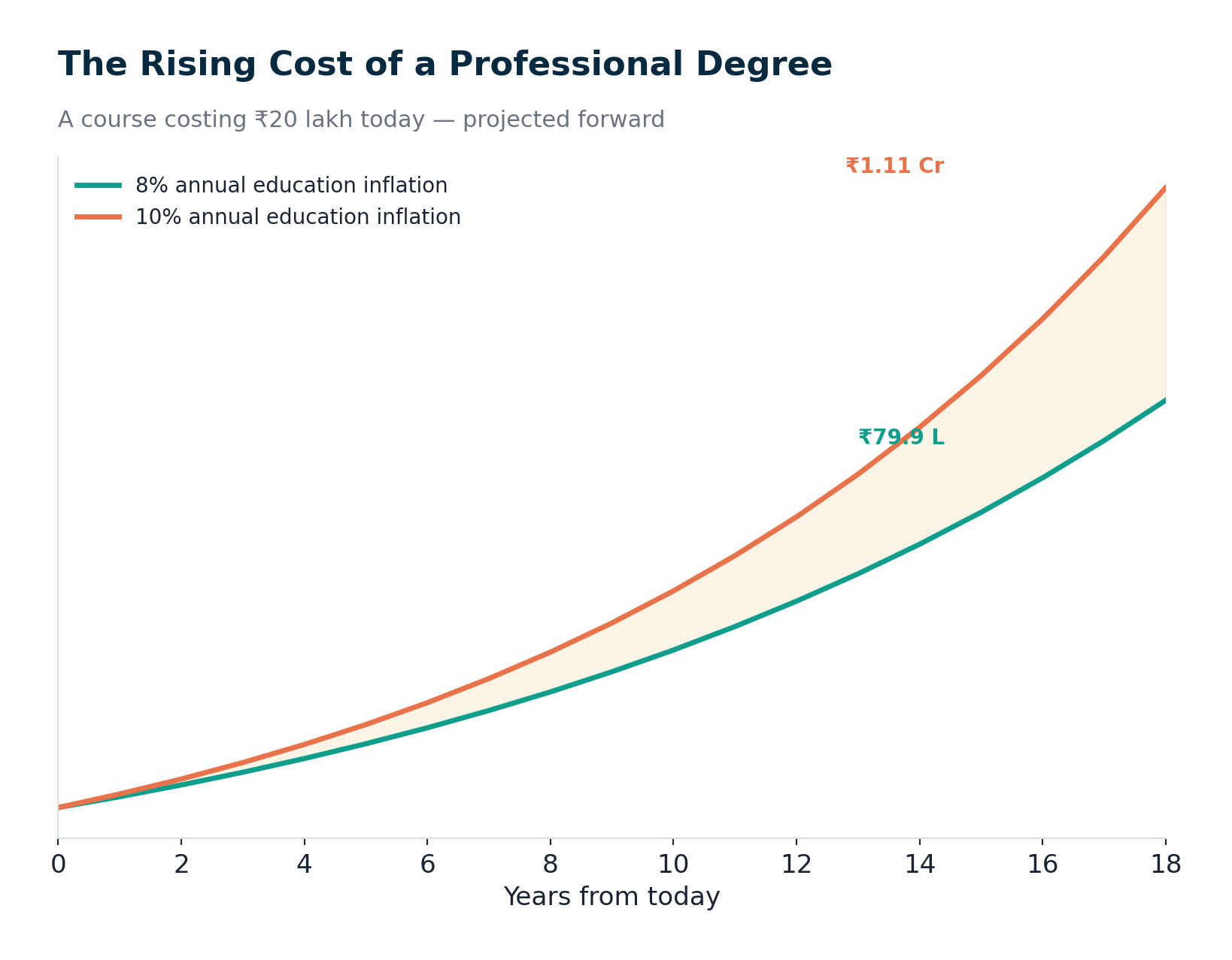
Important: Tax, FEMA, small-savings and cross-border rules can change. Figures and eligibility rules should be rechecked against current official provisions at publication and transaction time. An overseas degree is a foreign-currency liability Parents often estimate an overseas education goal by converting today's university fee into rupees. That misses two moving parts: the university can raise fees and the rupee can move against the destination currency. Living costs, housing, insurance, travel and visa expenses add another layer. Treat the goal in the currency in which it will ultimately be spent, then translate it into a rupee funding plan. Build the full cost, not just tuition Create separate estimates for tuition, accommodation, food, local transport, insurance, books/technology, visa fees, travel and an emergency buffer. Add one-time costs such as deposits and relocation. A scholarship should be treated as upside until it is confirmed. Building the plan around an uncertain scholarship can leave a large funding gap late in the process. Education inflation and exchange rates University fees can rise independently of India's CPI. At the same time, a weaker rupee increases the domestic cost of the same dollar, pound or euro fee. Because neither variable is predictable, use conservative scenarios rather than one-point forecasts. Stress-test at least a base cost and a higher-cost scenario. The objective is to know how much additional monthly saving would be required if assumptions worsen. Should part of the portfolio be global? If the future liability is in dollars or another foreign currency, holding some appropriately diversified foreign assets can create a partial currency match. But it also introduces market risk and overseas tax/reporting complexity. This is not a reason to put the entire education corpus into US stocks. The allocation should reflect the time horizon and be progressively de-risked before fees are due. LRS and remittance planning Overseas tuition and investment remittances can fall within the LRS framework, subject to applicable purpose-specific rules. Parents should check the current LRS/TCS treatment, bank documentation and timing before fee deadlines. Do not discover remittance paperwork a week before the university's payment date. Run a small operational checklist months in advance. Education loan versus liquidating investments An education loan can preserve family liquidity and may be appropriate even when parents have investments, but borrowing has interest and repayment implications. Compare the cost of debt with the risk of selling long-term assets or draining retirement savings. Parents should protect their own retirement security before committing every available asset to education. The five-year de-risking runway When the goal is far away, the portfolio may tolerate more growth-asset volatility. As admission approaches, move the first-year requirement toward lower-volatility, liquid assets. Continue de-risking later-year fees on a planned schedule. The objective is to avoid a situation where a market crash or currency spike forces a last-minute compromise on the child's admission. Frequently Asked Questions How do I estimate a foreign university cost 10 years away? Project tuition and living costs with conservative inflation assumptions and test adverse currency scenarios. Should I save entirely in dollars? Not necessarily. Currency matching can help, but investment route, risk, tax and time horizon all matter. Can LRS be used for education payments? Permitted remittances include specified education purposes, subject to current RBI and tax rules. Should parents use retirement money for education? Generally, protect retirement first; education has financing options that retirement does not. Related Reading Child Education Planning in India (/insights/child-education-planning-guide-india) Children's Funds (/insights/childrens-funds) SIP Planning Guide (/insights/sip-planning-guide-india) Disclaimer: This article is for general educational purposes only and is not personalised investment, tax, legal or regulatory advice. Rules, rates and product terms change. Readers should verify current provisions and obtain professional advice appropriate to their circumstances before acting.