Stock Market Fall: What to Do When the Nifty Drops 10% or More
Last updated: 13 October 2026
Quick answer: In a stock market fall, first secure your emergency fund and any money needed within three years. Then keep SIPs running, rebalance to your target asset mix and harvest tax losses. Avoid panic selling, leverage and tips. Indian markets have recovered from every major fall so far: about three years after 2008 and under a year after 2020, though timing is never guaranteed.
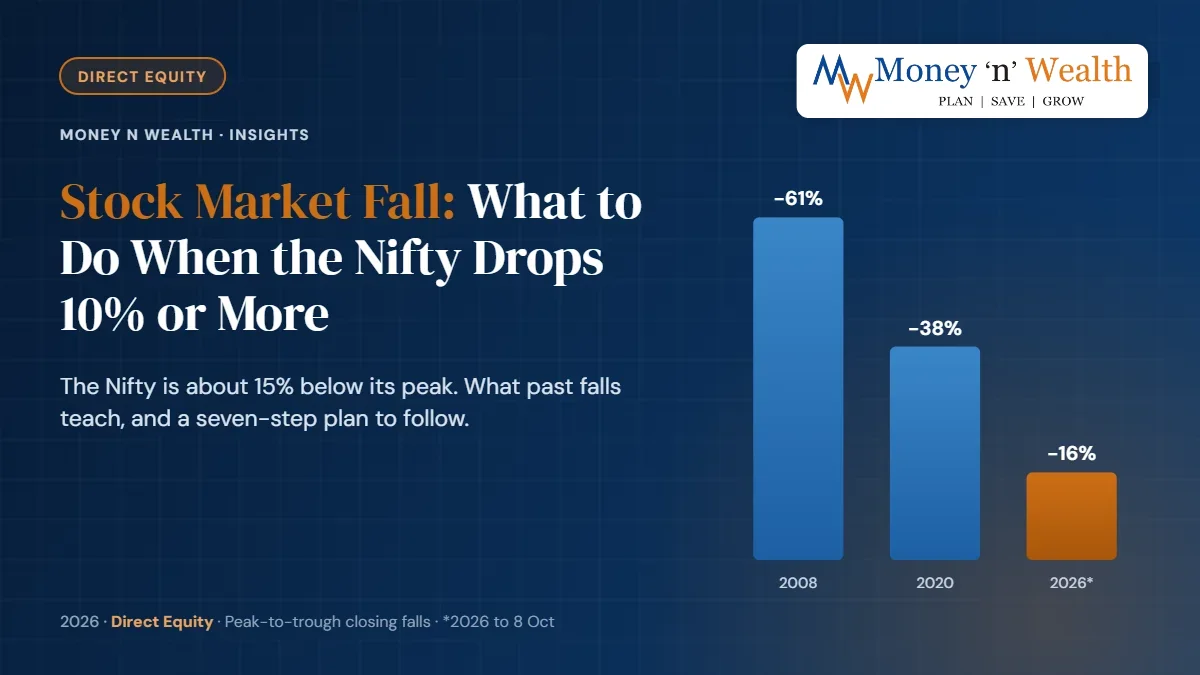
Last updated: 13 October 2026 Quick answer: In a stock market fall, first secure your emergency fund and any money needed within three years. Then keep SIPs running, rebalance to your target asset mix and harvest tax losses. Avoid panic selling, leverage and tips. Indian markets have recovered from every major fall so far: about three years after 2008 and under a year after 2020, though timing is never guaranteed. Key takeaways Where we are: Nifty 50 closed at 22,363.35 on 12 October 2026, about 15% below its 26,328.55 record of 2 January 2026. History: The Sensex fell 61% in 2008–09 and regained its peak by November 2010; it fell 38% in 2020 and hit new highs before the end of 2020. Maths: a 15% fall needs a 17.6% rise to recover; a 50% fall needs 100%. Behaviour costs: Morningstar found US fund investors earned 1.2 points a year less than their funds over 10 years to 2025. Rule over nerve: rebalancing a 60:40 portfolio after a 20% equity fall means moving about 4.8% of the original portfolio into equity. On 8 October 2026, the day after the RBI raised the repo rate to 5.50%, the Nifty 50 fell 1.6% to close at 22,231.80, its lowest close of the year. With crude oil above $100 a barrel, foreign investors selling and the rupee weak, the index was 15.6% below its January record. If your portfolio statement is making you uneasy, you are not alone. A stock market fall is a decline of 10% or more from a recent peak, called a correction; a fall of 20% or more is usually called a bear market. This guide covers what history says about Indian and global market falls, the recovery maths, and a practical seven-step playbook for SIP investors, direct equity investors and retirees. How bad is the 2026 stock market fall? As of 12 October 2026, the Nifty 50 was about 15% below its record close and roughly 14% lower for the calendar year. The Sensex closed at 71,924.68 that day. In Samvat terms, the Nifty is down about 13.5% since last Diwali (see our Muhurat trading 2026 guide (/insights/muhurat-trading-2026) ). The causes reported by the financial press are familiar ones: an oil shock tied to West Asia tensions, persistent foreign portfolio outflows, rising bond yields and a weaker rupee. The RBI's first rate hike since February 2023 added to the pressure; our repo rate hike explainer (/insights/rbi-repo-rate-hike-october-2026-emi-fd-debt-funds) covers its effect on loans and deposits. Two points put this in perspective. First, this fall has been a slow grind over nine months rather than a crash. Second, several Indian market falls since 2008 went deeper and still recovered. How often does the stock market fall 10% or more? More often than most investors expect. Falls of 10% or more are a normal part of owning equities, in India and abroad. One analysis shared on Zerodha's TradingQnA forum counted 10 Nifty falls of 15% or more in rupee terms since 2003. Wright Research's study of Indian drawdowns since 1990 classified 12 falls of 15% or more. The US, with the longest data history, tells the same story. The S&P 500 fell 19.7% in late 2018, 34% in February–March 2020 and 27.6% in 2022, and dropped sharply again in early 2025 before setting a new record on 27 June 2025. Horizontal bar chart comparing stock market falls: Sensex 2008 and 2020, S&P 500 2018, 2020 and 2022, and the 2026 Nifty fall The current fall is real but, so far, mid-sized by historical standards. What history says about recoveries Episode Peak (close) Trough (close) Fall Back to peak Sensex, global financial crisis 20,873 (8 Jan 2008) 8,160 (9 Mar 2009) −61% Nov 2010 (about 34 months from peak) Sensex, Covid-19 crash About 42,000 (Jan 2020) 25,981 (23 Mar 2020) −38% Late 2020 (within 9 months of trough) Nifty 50, 2024–25 correction 26,216 (26 Sep 2024) Early 2025 Over 12% within four months Nov 2025 (about 14 months from peak) Nifty 50, 2026 26,328.55 (2 Jan 2026) 22,231.80 so far (8 Oct 2026) −15.6% so far Ongoing Sources: BSE and NSE data as reported by Wikipedia, Navbharat Live, DD India and Outlook Business. "Back to peak" means the first new closing high. Wright Research's regime analysis is a useful rule of thumb. Mild drawdowns of 15–30% took about four months to bottom and eight months to recover on average. Moderate falls of 30–50% averaged 23 months to recover, and severe falls above 50% averaged 42 months. These are averages, not promises. Why does a big fall need a bigger recovery? Percentages are not symmetric. If ₹100 falls 50% to ₹50, it must double (+100%) to return to ₹100. That is why limiting the damage from deep falls matters so much, and why asset allocation, not stock picking, does most of the protective work. Bar chart showing the gain needed to recover from a stock market fall of 10% to 60% A 15% fall needs about a 17.6% rise to recover; deep falls are much harder to climb back from. The good news for long-term investors: the current fall needs a rise of about 17.6% to reach the old peak. For SIP investors, the recovery arrives sooner, because units bought below the peak cost less. What should you do when the market falls? The seven-step playbook The order matters. Protect your liquidity and near-term needs first, then think about opportunity. Check your emergency fund. Keep 6–12 months of expenses in savings, sweep FDs or liquid funds. If your job is in a sector under pressure, aim for the upper end. Our emergency fund guide (/insights/emergency-fund-guide-india) explains how much and where. Ring-fence goals due within three years. A child's admission fee or a house down payment due in 2027 should not depend on the Nifty. Move it gradually to debt if it is still in equity. Keep SIPs running. A pause at the bottom is the costliest SIP mistake. See should you stop your SIP when markets fall? (/insights/should-you-stop-sip-when-markets-fall) Rebalance to your target mix. Use new money first, then switches, when equity drifts 5 percentage points or more from target. Deploy lumpsums in stages. If you have spare cash, an STP over 6–12 months spreads timing risk. Our guide to SIP vs lumpsum vs STP (/insights/sip-vs-lumpsum-vs-stp) compares the options. Harvest tax losses. Book losses where you would hold the money elsewhere anyway; they can offset gains this year or be carried forward. Avoid leverage, tips and "averaging down" into weak stocks. Borrowing to buy or trading F&O to recover losses turns a temporary fall into a permanent one. Playbook steps for what to do in a stock market fall Should you keep investing in SIPs during a market fall? For a long-term goal, yes. A falling market is when a SIP works hardest. If a fund's NAV falls from ₹100 to ₹85, a ₹10,000 SIP buys about 117.6 units instead of 100. Those cheaper units lift returns when prices recover. The exception is a goal that is now near. If you need the money within two to three years, redirect new SIP instalments to debt rather than stopping them. You can use our SIP and goal calculators (/tools) to check whether your plan is still on track. How does rebalancing help in a stock market fall? Rebalancing turns "buy low" from a slogan into a rule. Suppose your plan is 60% equity and 40% debt on ₹10 lakh. Equity falls 20%, so the portfolio becomes ₹8.8 lakh with equity at only 54.5%. Worked example of rebalancing a 60:40 portfolio after a 20% stock market fall Rebalancing makes you buy equity when it is cheaper, by rule rather than by nerve. To restore 60:40, you move about ₹48,000 from debt to equity. You buy after a fall without forecasting the bottom. In a rising market the same rule trims equity. Balanced advantage funds apply a version of this automatically; see our note on balanced advantage funds (/insights/balanced-advantage) . Before switching between funds, check exit loads and capital gains tax. Redirecting fresh SIPs or bonuses is often cheaper than selling. Should you sell stocks during a market crash? Sell for a reason, not because of a falling price. Good reasons include a business whose story has broken (debt problems, governance issues, permanently lower earnings), a position that has grown too large for comfort, or a goal that now needs cash. "It has fallen 20%" alone is not a reason. The cost of selling in fear is measurable. Morningstar's 2026 Mind the Gap (https://www.morningstar.com/lp/mind-the-gap) study found US fund investors earned 8.7% a year over the 10 years to December 2025, versus 9.9% for the funds themselves, largely because of poorly timed buying and selling. That 1.2-point gap compounds into a large sum over decades. Use the fall for tax-loss harvesting If you hold stocks or funds at a loss, booking it can reduce tax. Short-term capital losses can be set off against both short-term and long-term gains; long-term losses only against long-term gains. Unused losses can be carried forward for eight years if you file your return on time. Listed equity gains are taxed at 20% (short term) and 12.5% above ₹1.25 lakh a year (long term). Our tax harvesting guide (/insights/capital-gains-tax-shares-tax-harvesting) explains the steps. What should retirees and near-retirees do in a market fall? Retirees face sequence risk: withdrawing from equity while it is down locks in losses that never recover. The answer is a bucket structure. Keep two to three years of expenses in safe assets, so you never sell equity in a slump. If you draw a monthly SWP from an equity fund, consider funding the next 12–24 months from your debt bucket while markets are weak. Our retirement income strategy guide (/insights/retirement-income-strategy-india) and five-years-to-retirement checklist (/insights/five-years-to-retirement-checklist) show how to set up the buckets. Market fall checklist for IT professionals and business owners Market falls often coincide with layoffs and slower business. Two extra checks help. Concentration in employer stock: RSUs or ESOPs in one company add job risk to market risk. Consider selling vested shares in a planned way; see ESOP and RSU taxation (/insights/esop-rsu-taxation-india) . Borrowing against investments: a loan against mutual funds can face margin calls when NAVs fall. Keep the loan well below the limit; our comparison of personal loans, LAMF and gold loans (/insights/personal-loan-vs-lamf-vs-gold-loan) covers the risks. The behavioural side: why falls feel worse than they are Daniel Kahneman and Amos Tversky's prospect theory found that losses hurt roughly twice as much as equal gains please. Add a 24-hour news cycle and a portfolio app that shows red every morning, and selling feels like relief. Three habits help. Check your portfolio monthly, not daily. Write down your asset allocation and the conditions under which you would change it. And talk to someone before acting. Our article on the five behavioural mistakes that cost investors most (/insights/behavioural-finance-investor-mistakes) goes deeper. Related reading Should you stop your SIP when markets fall? (/insights/should-you-stop-sip-when-markets-fall) Emergency fund: how much and where (/insights/emergency-fund-guide-india) How to choose mutual funds: a portfolio-first framework (/insights/how-to-choose-mutual-funds-portfolio-framework) Laid off? A 90-day money plan for IT professionals (/insights/laid-off-money-plan-it-professionals) RBI hikes repo rate to 5.50%: what it means for you (/insights/rbi-repo-rate-hike-october-2026-emi-fd-debt-funds) Frequently Asked Questions Why is the stock market falling in 2026? Reports point to several pressures: crude oil above $100 a barrel amid West Asia tensions, heavy foreign portfolio selling, rising bond yields, a weaker rupee and the RBI's 25 bps repo hike to 5.50% on 7 October 2026. As of 12 October 2026 the Nifty 50 was about 15% below its record close of 2 January 2026. How long does the Indian market take to recover from a fall? It has varied widely. The Sensex took about 34 months to regain its January 2008 peak after a 61% fall. After the 38% Covid crash in 2020, it reached new highs within nine months of the trough. The Nifty regained its September 2024 peak in November 2025, about 14 months later. Past recoveries do not guarantee future ones. Should I stop my SIP when the market falls? Not for long-term goals. Falling prices let each instalment buy more units, which lifts returns when markets recover. Stopping at the bottom locks in the worst of both worlds. If a goal is within two to three years, redirect new instalments to a debt fund instead of stopping investing altogether. Is a market fall a good time to invest a lumpsum? Lower prices improve long-term expected returns, but nobody knows where the bottom is. A practical approach is to invest in stages through an STP over 6–12 months, staying within your target asset allocation. Keep your emergency fund and near-term goal money out of equity, however attractive prices look. What is the difference between a correction and a bear market? A correction is a fall of 10% or more from a recent peak. A bear market is a fall of 20% or more. As of mid-October 2026, the Nifty 50's decline of about 15% from its peak is a correction. Both are normal: the S&P 500 had bear markets in 2020 and 2022, and India saw deep falls in 2008 and 2020. Should I move my money to FDs until the market recovers? Moving everything to FDs turns a paper loss into a real one and risks missing the rebound, which often comes suddenly. FDs suit emergency money and near-term goals. Long-term money is better held in the asset mix you planned, rebalanced periodically. After the rate hike, FD rates are rising, which can help your debt allocation. Can I use losses from the fall to save tax? Yes. Booking capital losses lets you offset gains this year. Short-term losses can offset both short- and long-term gains; long-term losses offset only long-term gains. Unused losses carry forward for eight years if you file your return on time. Reinvest the proceeds if the investment still suits you. Sources: Outlook Business, Nifty 2026 low (https://www.outlookbusiness.com/markets/nifty-hits-2026-low-what-triggered-the-market-bloodbath) ; Business Standard market close, 12 October 2026 (https://www.business-standard.com/amp/markets/news/stock-market-live-october-12-bse-sensex-today-nifty50-gift-nifty-crude-oil-prices-q2-results-today-126101200057_1.html) ; NIFTY 50 records (https://en.wikipedia.org/wiki/NIFTY_50) ; BSE SENSEX history (https://en.wikipedia.org/wiki/BSE_SENSEX) ; List of stock market crashes and bear markets (https://en.wikipedia.org/wiki/List_of_stock_market_crashes_and_bear_markets) ; Wright Research on Indian corrections (https://www.wrightresearch.in/blog/what-history-tells-us-about-indian-stock-market-corrections/) ; Morningstar Mind the Gap (https://www.morningstar.com/lp/mind-the-gap) . Worked examples are Money n Wealth calculations. Unsure whether to stay put, rebalance or reduce risk? The right move depends on your goals, timelines and cash needs, not on the index level. Talk to Money n Wealth (/contact) for a free portfolio review. This article is for general educational purposes only and does not constitute financial advice. Figures and examples are illustrative. Please consult a qualified financial adviser for guidance specific to your situation. Money n Wealth (Predics Fintech Services Pvt Ltd) is an AMFI-registered Mutual Fund Distributor (ARN-121995) and APMI-registered PMS Distributor (APRN07444); it is not a SEBI-registered investment adviser and may earn distribution commission on investments made through it.
Frequently Asked Questions
Why is the stock market falling in 2026?
Reports point to several pressures: crude oil above $100 a barrel amid West Asia tensions, heavy foreign portfolio selling, rising bond yields, a weaker rupee and the RBI's 25 bps repo hike to 5.50% on 7 October 2026. As of 12 October 2026 the Nifty 50 was about 15% below its record close of 2 January 2026.
How long does the Indian market take to recover from a fall?
It has varied widely. The Sensex took about 34 months to regain its January 2008 peak after a 61% fall. After the 38% Covid crash in 2020, it reached new highs within nine months of the trough. The Nifty regained its September 2024 peak in November 2025, about 14 months later. Past recoveries do not guarantee future ones.
Should I stop my SIP when the market falls?
Not for long-term goals. Falling prices let each instalment buy more units, which lifts returns when markets recover. Stopping at the bottom locks in the worst of both worlds. If a goal is within two to three years, redirect new instalments to a debt fund instead of stopping investing altogether.
Is a market fall a good time to invest a lumpsum?
Lower prices improve long-term expected returns, but nobody knows where the bottom is. A practical approach is to invest in stages through an STP over 6–12 months, staying within your target asset allocation. Keep your emergency fund and near-term goal money out of equity, however attractive prices look.
What is the difference between a correction and a bear market?
A correction is a fall of 10% or more from a recent peak. A bear market is a fall of 20% or more. As of mid-October 2026, the Nifty 50's decline of about 15% from its peak is a correction. Both are normal: the S&P 500 had bear markets in 2020 and 2022, and India saw deep falls in 2008 and 2020.
Should I move my money to FDs until the market recovers?
Moving everything to FDs turns a paper loss into a real one and risks missing the rebound, which often comes suddenly. FDs suit emergency money and near-term goals. Long-term money is better held in the asset mix you planned, rebalanced periodically. After the rate hike, FD rates are rising, which can help your debt allocation.
Can I use losses from the fall to save tax?
Yes. Booking capital losses lets you offset gains this year. Short-term losses can offset both short- and long-term gains; long-term losses offset only long-term gains. Unused losses carry forward for eight years if you file your return on time. Reinvest the proceeds if the investment still suits you.
Unsure whether to stay put, rebalance or reduce risk?
The right move depends on your goals, timelines and cash needs, not on the index level. Talk to Money n Wealth for a free portfolio review.