What Will ₹1 Crore Be Worth in 20 Years? Inflation Explained (2026)
Last updated: 13 October 2026
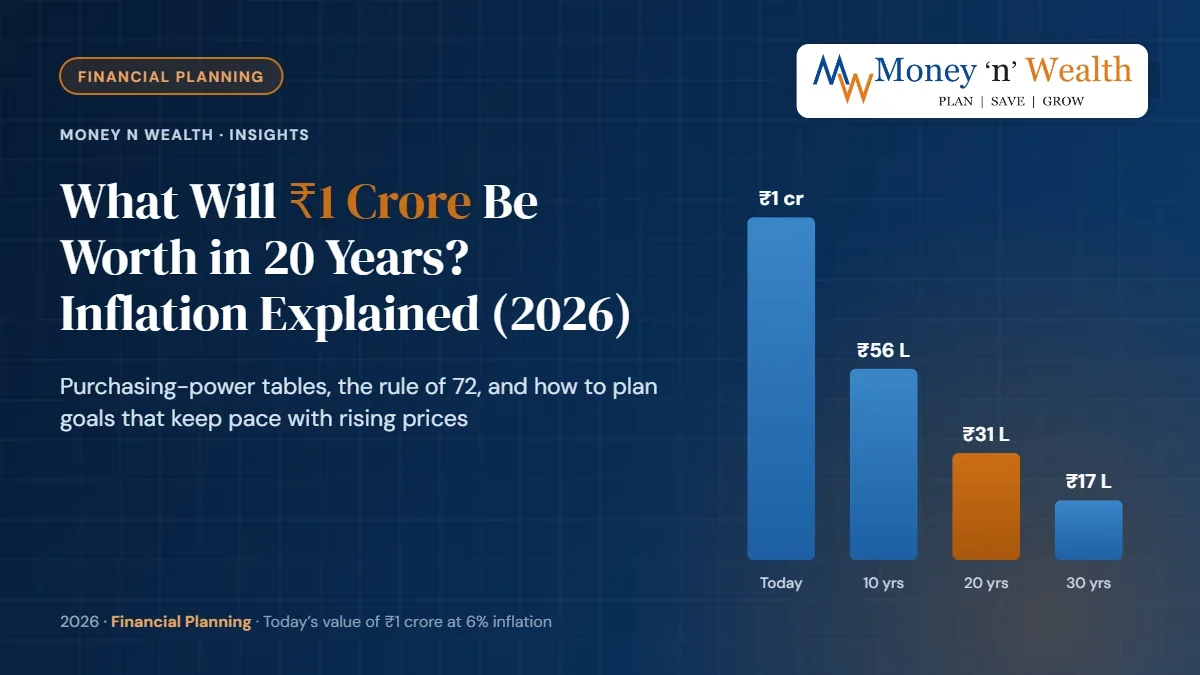
Quick answer: At 6% average inflation, ₹1 crore received 20 years from now will buy roughly what ₹31 lakh buys today. At 5% it is worth about ₹38 lakh; at 7%, about ₹26 lakh. Put the other way, to have today's ₹1 crore of purchasing power in 2046 you need about ₹3.2 crore. Plan long-term goals in future rupees, not today's.
Last updated: 13 October 2026 Quick answer: At 6% average inflation, ₹1 crore received 20 years from now will buy roughly what ₹31 lakh buys today. At 5% it is worth about ₹38 lakh; at 7%, about ₹26 lakh. Put the other way, to have today's ₹1 crore of purchasing power in 2046 you need about ₹3.2 crore. Plan long-term goals in future rupees, not today's. Key takeaways Formula: today's value = future amount ÷ (1 + inflation) years . 20 years at 6%: ₹1 crore shrinks to about ₹31.2 lakh in today's money. Rule of 72: at 6% inflation, prices double roughly every 12 years. Recent history: from FY15 to FY26, CPI averaged about 4.8% a year, cutting cash's purchasing power by 43%. Category inflation: education and healthcare usually rise faster than CPI; India's 2026 medical trend is projected at 11.5%. "One crore" has been the Indian shorthand for financial security for a generation. Many people still set it as a retirement or child's education target without asking a simple question: one crore in which year's rupees? The answer matters more than most people expect. Retail inflation was 5.54% in September 2026, according to the latest MoSPI data, and has risen every month this year. Even at modest rates, two decades of compounding prices cut a big number down to size. This guide shows what ₹1 crore will be worth in 10, 20 and 30 years , explains the arithmetic, and shows how to set targets that still mean something when you reach them. What is inflation, and why does it shrink money? Inflation is the rate at which the general level of prices rises over time. In India it is measured mainly by the Consumer Price Index (CPI), published monthly by the Ministry of Statistics and Programme Implementation (MoSPI). The RBI is mandated to keep CPI inflation at 4%, within a 2-6% band, a target the Government has retained until 31 March 2031. When prices rise 6% in a year, a rupee buys 6% less. Because each year's price rise builds on the previous year's higher base, the effect compounds, exactly like interest on a deposit, only in reverse. That is why inflation is sometimes called a silent tax on savings. What will ₹1 crore be worth in 10, 20 and 30 years? To find today's value of a future sum, divide by (1 + inflation) raised to the number of years. At 6% for 20 years: ₹1,00,00,000 ÷ 1.06 20 = ₹1,00,00,000 ÷ 3.207 = about ₹31.2 lakh . Years from now At 4% At 5% At 6% At 7% 10 years (2036) ₹67.6 lakh ₹61.4 lakh ₹55.8 lakh ₹50.8 lakh 15 years (2041) ₹55.5 lakh ₹48.1 lakh ₹41.7 lakh ₹36.2 lakh 20 years (2046) ₹45.6 lakh ₹37.7 lakh ₹31.2 lakh ₹25.8 lakh 25 years (2051) ₹37.5 lakh ₹29.5 lakh ₹23.3 lakh ₹18.4 lakh 30 years (2056) ₹30.8 lakh ₹23.1 lakh ₹17.4 lakh ₹13.1 lakh Purchasing power of ₹1 crore received in the future, expressed in today's rupees. Money n Wealth calculations. Line chart showing the value of 1 crore after 10, 20 and 30 years at 5%, 6% and 7% inflation in India The gap between 5% and 7% looks small on paper but becomes large over time. After 30 years, ₹1 crore is worth ₹23.1 lakh at 5% but only ₹13.1 lakh at 7%. A two-point difference in inflation nearly halves what your corpus can buy. How much do you need in future to match ₹1 crore today? Flip the calculation and multiply instead: future need = today's amount × (1 + inflation) years . To have the buying power of today's ₹1 crore in 20 years, you need about ₹2.65 crore at 5% inflation, ₹3.21 crore at 6% and ₹3.87 crore at 7%. This is the number to aim for if "₹1 crore in today's money" is your real goal. Has Indian inflation really been that high? Yes, over long periods. Annual average CPI inflation has ranged from 2.1% (FY26, the lowest on record) to 6.7% (FY23) in the past four years alone, according to the Economic Survey 2025-26 (https://www.indiabudget.gov.in/economicsurvey/doc/eschapter/echap05.pdf) and the RBI. Over the 12 financial years from FY15 to FY26, it averaged about 4.8% a year. Period Average CPI inflation ₹1 lakh at the start buys, at the end FY22-FY26 (5 years) about 4.8% ₹78,900 FY15-FY26 (12 years) about 4.8% ₹57,000 Calendar 2026, Jan-Sep rising from 2.7% to 5.5% — Annual averages: FY15 5.9%, FY16 4.9%, FY17 4.5%, FY18 3.6%, FY19 3.4%, FY20 4.8%, FY21 6.2%, FY22 5.5%, FY23 6.7%, FY24 5.4%, FY25 4.6%, FY26 2.1%. Compounded by Money n Wealth. In other words, ₹1 crore kept in cash at the start of FY15 would now buy what about ₹57 lakh did then. That is not a forecast; it already happened. If you want the asset-by-asset picture of which investments kept up, read Inflation at 5.5%: is your portfolio beating it after tax? (/insights/inflation-real-returns-india-2026) Why do education and medical costs rise faster than CPI? CPI is an average across thousands of items, weighted heavily towards food and everyday goods. Your household may face very different inflation. Two categories routinely outpace the headline number. Healthcare Aon's Global Medical Trend Rates report (https://www.aon.com/apac/in-the-press/asia-newsroom/2025/india-outpaces-global-average-with-2026-medical-trend-at-11-5-percent-aon-reports) projects India's medical cost trend at 11.5% for 2026, after 13% in 2025, against a global average of 9.8%. These figures track employer health plans, but they reflect what hospital bills are doing. The official CPI health index rose just 1.3% in August 2026, so do not rely on it for healthcare planning. A strong health insurance plan (/insights/health-insurance-for-parents-senior-citizens) is the main defence. Education Private school and college fees often rise 8-10% a year, and overseas education adds currency depreciation on top. Our child education planning guide (/insights/child-education-planning-guide-india) and study-abroad planning guide (/insights/study-abroad-education-planning-india) work through realistic numbers. Bar chart of future cost after 20 years of household expenses, a car, surgery and an engineering degree at different inflation rates The chart uses illustrative planning rates. A ₹15 lakh engineering degree today could cost about ₹70 lakh in 20 years at 8%. A ₹5 lakh surgery could cost about ₹34 lakh at 10%. Monthly household spending of ₹75,000 becomes about ₹2.4 lakh at 6%. What is the rule of 72, and how does it help? The rule of 72 is a mental shortcut: divide 72 by an annual rate to estimate how many years it takes for something to double. It works for inflation (prices doubling) and returns (money doubling). Rule of 72 tiles showing years for prices to double at 4%, 6%, 8% and 10% inflation At 6% inflation, prices double in about 12 years, so a 35-year-old today will see living costs roughly quadruple by the age of 59. The rule is accurate enough for planning: at 6%, the exact doubling time is 11.9 years. At 3%, the rule says 24 years against an exact 23.4. The same rule shows why returns matter. Money earning 12% doubles in about six years; money earning 4.5% after tax doubles in about 16. If inflation is 6%, the second investment is losing ground. Is ₹1 crore enough for retirement or other goals? It depends entirely on when you need it and how you will use it. Take a 40-year-old in Pune spending ₹75,000 a month today. At 6% inflation, the same lifestyle costs about ₹2.4 lakh a month at 60. A ₹1 crore corpus at that point would cover only about 3.5 years of expenses before any returns. Global retirement research such as William Bengen's "4% rule" suggests a sustainable first-year withdrawal of around 4% of the corpus for US retirees over 30 years. Indian planners usually advise lower starting rates, because inflation here has historically been higher. We cover this in detail in Is ₹1 crore enough to retire? (/insights/is-1-crore-enough-to-retire-india-magic-number) and SWP: how to draw a monthly income (/insights/swp-systematic-withdrawal-plan-guide) . How do you protect ₹1 crore from inflation? A corpus beats inflation only when its post-tax return exceeds the inflation rate. Here is how ₹1 crore invested today might look in 20 years under three illustrative return paths, measured in today's rupees at 6% inflation. Where ₹1 crore is invested Assumed post-tax return Nominal value in 20 years Value in today's rupees Bank FD, 30% slab (6.45% pre-tax) 4.44% ₹2.38 crore ₹74 lakh PPF-like tax-free debt 7.1% ₹3.94 crore ₹1.23 crore Diversified equity (illustrative) 11% ₹8.06 crore ₹2.51 crore Illustrative only. PPF has a ₹1.5 lakh annual limit, so a lump sum cannot actually go into it; the row shows what a tax-free 7.1% would do. Equity returns are not guaranteed and can be negative for years. Money n Wealth calculations. The FD route grows the rupee figure more than twofold but still loses about a quarter of purchasing power. A tax-free 7.1% roughly preserves it with a small gain. Only growth assets meaningfully increase it, at the cost of volatility. Most families need a blend sized to each goal's timeline, as explained in our portfolio-first framework for choosing mutual funds (/insights/how-to-choose-mutual-funds-portfolio-framework) . How much SIP builds an inflation-adjusted crore? To accumulate ₹1 crore in 20 years, you need a monthly SIP of about ₹13,060 at an assumed 10% return or ₹10,010 at 12%. To accumulate ₹3.21 crore, which equals today's ₹1 crore at 6% inflation, the SIP rises to about ₹41,900 at 10% or ₹32,100 at 12%. A step-up SIP (/insights/step-up-sip-calculator-guide) that grows 10% a year lets you start much lower. Our ₹1 crore SIP guide (/insights/build-1-crore-corpus-sip-calculator-guide) and goal calculators (/tools) show the trade-offs. Six steps to plan a financial goal adjusted for inflation in India How do other countries think about long-term inflation? The global long-run record is a useful sanity check. The UBS Global Investment Returns Yearbook 2026 (https://www.ubs.com/global/en/media/display-page-ndp/en-20260303-global-investment-returns-yearbook-2026.html) notes that US inflation averaged 2.9% a year from 1900 to 2025, enough that something costing one dollar in 1900 costs about $38 today. India's inflation has been higher than that, so the erosion here is faster. Many developed economies target 2% inflation; India targets 4% because it is a faster-growing emerging economy with a large food component in its price index. For an Indian household, a 4% target means prices are designed to roughly double every 18 years even when policy works perfectly. Planning on 6% builds in a margin for the years when it does not. Related reading Inflation at 5.5%: Is Your Portfolio Beating It After Tax? (/insights/inflation-real-returns-india-2026) Is ₹1 Crore Enough to Retire? (/insights/is-1-crore-enough-to-retire-india-magic-number) How to Build a ₹1 Crore Corpus (/insights/build-1-crore-corpus-sip-calculator-guide) Your FIRE Number: How Much You Need to Retire Early (/insights/fire-number-retire-early-india) Retirement Planning in India: How Much Corpus (/insights/retirement-planning-guide-india) Frequently Asked Questions What will be the value of ₹1 crore after 20 years? At 6% average inflation, ₹1 crore received in 20 years will have the purchasing power of about ₹31.2 lakh today. At 5% it is about ₹37.7 lakh, and at 7% about ₹25.8 lakh. The formula is ₹1 crore ÷ (1 + inflation) 20 . India's average CPI inflation over FY15-FY26 was about 4.8%. What will ₹1 crore be worth in 30 years? At 6% inflation, ₹1 crore received 30 years from now will buy what about ₹17.4 lakh buys today. At 5% it is about ₹23.1 lakh, and at 7% about ₹13.1 lakh. That is why a 30-year retirement target set in today's rupees needs to be multiplied about 5.7 times at 6% inflation. How do I calculate the future value of money with inflation? Multiply today's cost by (1 + inflation rate) raised to the number of years. For example, ₹50,000 monthly expenses growing at 6% for 15 years become ₹50,000 × 1.06 15 = about ₹1.2 lakh. To find today's value of a future amount, divide instead of multiplying. What inflation rate should I assume for financial planning in India? Use about 6% for general living costs, 8-10% for education and 10% or more for healthcare. CPI averaged about 4.8% from FY15 to FY26 but has ranged from 2.1% to 6.7% in recent years, and was 5.54% in September 2026. A margin above the RBI's 4% target protects against bad years. How does the rule of 72 work for inflation? Divide 72 by the inflation rate to estimate how many years prices take to double. At 6% it is 12 years; at 8%, nine years; at 4%, 18 years. The shortcut is accurate to within a few months for rates between 4% and 12%, so it is handy for quick goal checks. Is ₹1 crore enough to retire in India in 2026? For most urban families, no, unless expenses are low or other income exists. A household spending ₹50,000 a month needs ₹6 lakh a year, which is 6% of ₹1 crore, a withdrawal rate most planners consider too high to last 25-30 years. The right number depends on expenses, age, pension and health cover. Which investments beat inflation over 20 years? Historically, diversified equity has delivered the largest real returns over long periods, while tax-free debt such as PPF and EPF has modestly beaten inflation. Taxable FDs often fail to keep pace for investors in higher slabs. Gold has helped as a diversifier but is volatile. A goal-based mix of these usually works better than any single asset. Sources: MoSPI CPI release, August 2026 (https://www.mospi.gov.in/uploads/latestreleasesfiles/1789382372004-Press%20Release%20of%20CPI%20for%20August%202026.pdf) ; Economic Survey 2025-26, Chapter 5 (Inflation) (https://www.indiabudget.gov.in/economicsurvey/doc/eschapter/echap05.pdf) ; Aon Global Medical Trend Rates 2026 (https://www.aon.com/apac/in-the-press/asia-newsroom/2025/india-outpaces-global-average-with-2026-medical-trend-at-11-5-percent-aon-reports) ; UBS Global Investment Returns Yearbook 2026 (https://www.ubs.com/global/en/media/display-page-ndp/en-20260303-global-investment-returns-yearbook-2026.html) ; Business Today, small savings rates Oct-Dec 2026 (https://www.businesstoday.in/personal-finance/story/small-savings-scheme-interest-rates-unchanged-for-q3-fy27-check-ppf-scss-ssy-rates-558892-2026-09-30) . Worked examples are Money n Wealth calculations. Is your ₹1 crore goal big enough for the year you will need it? Re-pricing goals for inflation, tax and your own spending pattern changes the plan, often significantly. Talk to Money n Wealth (/contact) for a free portfolio review. This article is for general educational purposes only and does not constitute financial advice. Figures and examples are illustrative. Please consult a qualified financial adviser for guidance specific to your situation. Money n Wealth (Predics Fintech Services Pvt Ltd) is an AMFI-registered Mutual Fund Distributor (ARN-121995) and APMI-registered PMS Distributor (APRN07444); it is not a SEBI-registered investment adviser and may earn distribution commission on investments made through it.
Frequently Asked Questions
What will be the value of ₹1 crore after 20 years?
At 6% average inflation, ₹1 crore received in 20 years will have the purchasing power of about ₹31.2 lakh today. At 5% it is about ₹37.7 lakh, and at 7% about ₹25.8 lakh. The formula is ₹1 crore ÷ (1 + inflation) 20 . India's average CPI inflation over FY15-FY26 was about 4.8%.
What will ₹1 crore be worth in 30 years?
At 6% inflation, ₹1 crore received 30 years from now will buy what about ₹17.4 lakh buys today. At 5% it is about ₹23.1 lakh, and at 7% about ₹13.1 lakh. That is why a 30-year retirement target set in today's rupees needs to be multiplied about 5.7 times at 6% inflation.
How do I calculate the future value of money with inflation?
Multiply today's cost by (1 + inflation rate) raised to the number of years. For example, ₹50,000 monthly expenses growing at 6% for 15 years become ₹50,000 × 1.06 15 = about ₹1.2 lakh. To find today's value of a future amount, divide instead of multiplying.
What inflation rate should I assume for financial planning in India?
Use about 6% for general living costs, 8-10% for education and 10% or more for healthcare. CPI averaged about 4.8% from FY15 to FY26 but has ranged from 2.1% to 6.7% in recent years, and was 5.54% in September 2026. A margin above the RBI's 4% target protects against bad years.
How does the rule of 72 work for inflation?
Divide 72 by the inflation rate to estimate how many years prices take to double. At 6% it is 12 years; at 8%, nine years; at 4%, 18 years. The shortcut is accurate to within a few months for rates between 4% and 12%, so it is handy for quick goal checks.
Is ₹1 crore enough to retire in India in 2026?
For most urban families, no, unless expenses are low or other income exists. A household spending ₹50,000 a month needs ₹6 lakh a year, which is 6% of ₹1 crore, a withdrawal rate most planners consider too high to last 25-30 years. The right number depends on expenses, age, pension and health cover.
Which investments beat inflation over 20 years?
Historically, diversified equity has delivered the largest real returns over long periods, while tax-free debt such as PPF and EPF has modestly beaten inflation. Taxable FDs often fail to keep pace for investors in higher slabs. Gold has helped as a diversifier but is volatile. A goal-based mix of these usually works better than any single asset.
Is your ₹1 crore goal big enough for the year you will need it?
Re-pricing goals for inflation, tax and your own spending pattern changes the plan, often significantly. Talk to Money n Wealth for a free portfolio review.