Credit Card Minimum Due Trap: Why ₹1 Lakh Can Take 16 Years to Repay
Last updated: 13 October 2026
Quick answer: Paying only the credit card minimum due avoids a late fee and credit-score damage, but interest of up to 3.75% a month (45% a year, plus 18% GST) keeps running on the full balance. A ₹1 lakh balance repaid by minimum due alone takes about 16.5 years and costs ₹2.17 lakh in interest and GST. Pay in full, or refinance at a lower rate.
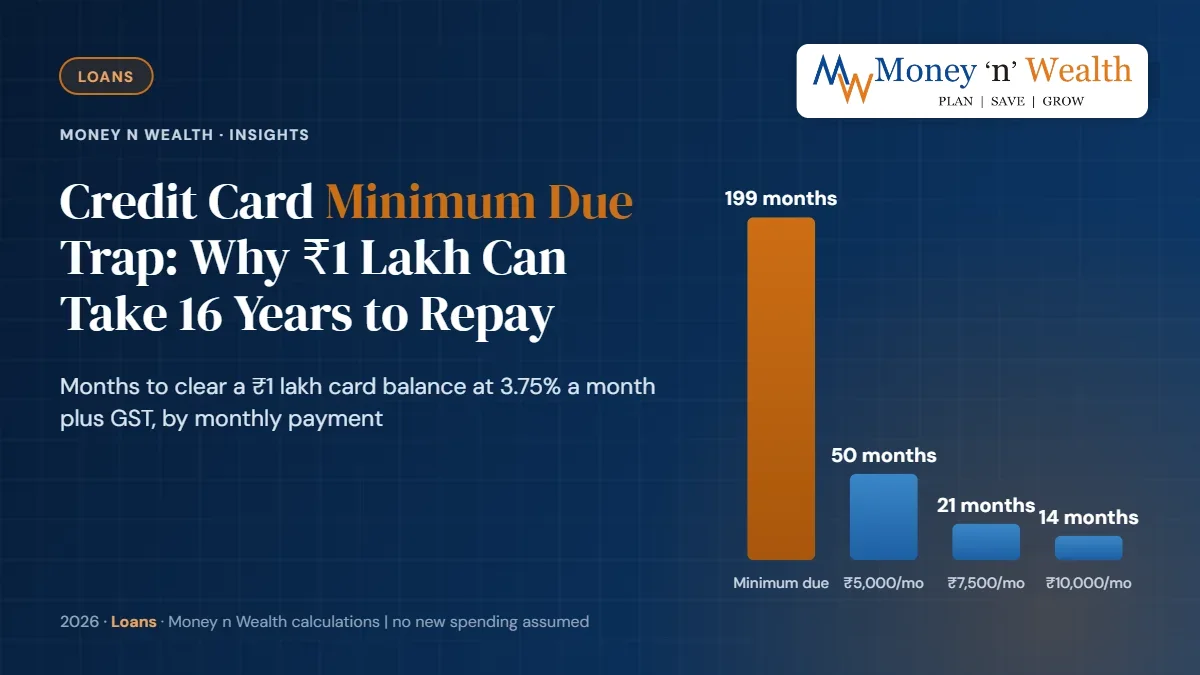
Last updated: 13 October 2026 Quick answer: Paying only the credit card minimum due avoids a late fee and credit-score damage, but interest of up to 3.75% a month (45% a year, plus 18% GST) keeps running on the full balance. A ₹1 lakh balance repaid by minimum due alone takes about 16.5 years and costs ₹2.17 lakh in interest and GST. Pay in full, or refinance at a lower rate. Key takeaways Card interest: up to 3.75% a month at major issuers, which compounds to about 55% a year. Minimum due: typically interest, fees, GST and EMIs plus about 2% of the balance. Hidden cost: once you carry a balance, new purchases lose their interest-free period. Fix it: ₹7,500 a month clears ₹1 lakh in 21 months instead of 199. Cheaper debt: over 24 months, a 14% personal loan costs about a quarter of the interest of revolving on the card. The credit card bill shows two figures: the total amount due and a much smaller minimum amount due. On a ₹1 lakh balance the minimum might be about ₹6,400. Paying it feels responsible. There is no late fee, no call from the bank and no damage to your CIBIL score. Yet that habit is one of the costliest money mistakes an Indian household can make. This guide shows exactly how card interest and the credit card minimum due work in 2026, what RBI rules protect you, and the cheapest ways to get out of credit card debt, with calculations for every option. What is the credit card minimum due? The minimum amount due (MAD) is the smallest payment your card issuer accepts by the due date to treat your account as regular. Pay it and you avoid a late payment fee and a "past due" report to credit bureaus. You do not avoid interest. Issuers set their own formula. SBI Card's terms, for example, define the MAD as 100% of GST, EMIs, fees and finance charges, plus any over-limit amount, plus 2% of the remaining balance. On a ₹50,000 purchase with no other charges, that works out to ₹1,000. RBI's Master Direction on credit and debit cards (2022, updated March 2024) requires the MAD to be set so that it does not cause negative amortisation, meaning your balance should not grow if you pay it. Every statement must also carry a warning that paying only the minimum stretches repayment and adds compounded interest. How much interest do credit cards charge in India? Unsecured cards at major Indian issuers typically charge up to about 3.75% a month on revolving balances. SBI Card lists up to 3.75% a month (45% a year) on unsecured cards and 2.75% on secured cards, and ICICI Bank's credit card page states a maximum of 3.75% a month. A few issuers advertise much lower starting rates for selected customers. Monthly rate Quoted annual rate (×12) Effective annual rate, compounded 2.50% 30% 34.5% 3.00% 36% 42.6% 3.50% 42% 51.1% 3.75% 45% 55.5% On top of this, GST at 18% applies to interest and fees. At 3.75% a month, that lifts the effective monthly cost to about 4.4%. Check your own card's Most Important Terms and Conditions (MITC) for its exact rate; RBI requires issuers to quote the APR and show monthly and annualised rates. How Indian rates compare globally US card rates are often cited as high. The US Federal Reserve's G.19 release of 7 October 2026 puts the average rate on accounts assessed interest at 22.15% for Q2 2026. A typical Indian card at 42–45% a year costs roughly twice that. Why paying only the minimum due is a trap Take a ₹1 lakh balance at 3.75% a month with no new spending. The first month's interest is ₹3,750 and GST adds ₹675. The minimum due of about ₹6,425 therefore reduces your debt by only ₹2,000. Because the 2% component shrinks as the balance falls, repayment slows each year. In our calculation (assuming a ₹200 floor on the minimum once the balance is small, as many issuers apply), minimum payments alone take 199 months, or about 16.5 years. You pay ₹3.17 lakh in total, of which ₹1.84 lakh is interest and ₹33,000 is GST. Credit card minimum due repayment versus fixed payments chart Monthly payment on ₹1 lakh Time to clear Interest + GST Total paid Minimum due (interest + GST + 2%) 199 months ₹2.17 lakh ₹3.17 lakh ₹4,425 (interest + GST only) Never ₹53,100 a year, forever Balance stays ₹1 lakh ₹5,000 fixed 50 months ₹1.50 lakh ₹2.50 lakh ₹7,500 fixed 21 months ₹54,500 ₹1.54 lakh ₹10,000 fixed 14 months ₹35,000 ₹1.35 lakh Two lessons stand out. Paying a fixed amount, even ₹5,000, cuts the time from 16 years to about four. And paying only the interest keeps you in debt indefinitely. Interest cost of paying only the credit card minimum due versus fixed payments You also lose the interest-free period The interest-free period applies only if you pay the full previous balance. RBI's direction allows issuers to withdraw it when any part of the bill is unpaid. So if you carry a balance, new purchases attract interest from the transaction date. At 45% a year, ₹30,000 of fresh spending carried for 30 days costs about ₹1,100 in interest before GST. What happens if you miss even the minimum? Late fees kick in. SBI Card, for example, charges ₹750 on an amount due between ₹1,000 and ₹10,000, rising to ₹1,300 above ₹50,000, plus ₹100 per cycle after two consecutive misses. Under RBI rules, the late fee applies only to the amount outstanding after the due date, and a card is reported as past due only after it is more than three days overdue. Repeated defaults can seriously hurt your credit score (/insights/credit-score-cibil-check-improve) . What RBI rules protect credit card users? RBI's Master Direction – Credit Card and Debit Card – Issuance and Conduct Directions, 2022 sets several protections worth knowing: No interest on charges: unpaid fees, levies and taxes cannot be capitalised to earn interest. Minimum due warning: every statement must warn about the cost of paying only the minimum. Disclosure: APR for purchases, cash advances and balance transfers must be published with examples. No "no-cost" EMI spin: interest-bearing EMIs must not be called zero-cost, and the discount must be shown separately. Billing cycle: you can change your billing date at least once. Closure: a closure request must be honoured within seven working days once dues are paid, or the issuer pays ₹500 a day. The US CARD Act goes a step further: statements must show how long repayment takes on minimums and the total cost. Indian statements carry only a general warning, so you need to do the maths yourself, which is what this guide does. How to get out of credit card debt: five practical routes Steps to get out of credit card minimum due debt 1. Convert the balance to EMIs Most issuers let you convert large spends or the outstanding balance into EMIs. Rates are usually well below revolving rates, though a processing fee and GST on interest apply. Insist on the full schedule and APR first. 2. Use a balance transfer A balance transfer moves debt to another card at a promotional rate. SBI Card, for instance, lists a 180-day balance transfer at 1.7% a month (20.4% a year), plus a one-time processing fee. Use it only with a plan to clear the debt within the promotional window. 3. Refinance with a personal loan A personal loan, priced on your credit profile, is usually far cheaper than card debt, and its interest attracts no GST. It also imposes discipline: a fixed EMI and an end date. 4. Borrow against your investments A loan against mutual funds or securities often costs less than a personal loan. It keeps your investments intact, though a market fall can trigger a margin call. Our comparison of personal loan vs loan against mutual funds vs gold loan (/insights/personal-loan-vs-lamf-vs-gold-loan) covers the trade-offs. 5. Pay from savings, carefully Few investments reliably earn 40%+ after tax, so using surplus savings or an FD to clear card debt is usually sensible. Keep at least three months of expenses as an emergency fund (/insights/emergency-fund-guide-india) so you do not end up back on the card. Comparison of credit card debt refinancing options in India Route for ₹1 lakh over 24 months Monthly payment Total interest Revolving on card (3.75% a month + GST) about ₹6,850 about ₹64,300 Card EMI conversion at 18% (+ GST on interest) about ₹5,150 about ₹23,600 Personal loan at 14% ₹4,801 ₹15,231 Loan against mutual funds at 10.5% ₹4,638 ₹11,302 Rates are illustrative; processing fees apply on most routes. The point is the ranking, which rarely changes. Several debts? Avalanche vs snowball The debt avalanche method pays minimums on everything and directs every extra rupee to the highest-rate debt first. The snowball method targets the smallest balance first for quicker psychological wins. Consider ₹1.5 lakh on a card at 42%, ₹40,000 on another at 36%, and a ₹2 lakh personal loan at 14% with an EMI of ₹9,603. With ₹30,000 a month available, both methods clear everything in 16 months. Avalanche costs about ₹66,100 in interest; snowball about ₹68,000. Debt avalanche versus snowball method for credit card debt The gap is modest here because the balances are similar in rate. It widens with bigger rate differences. Behavioural economists note that many borrowers prefer closing small accounts first. If snowball keeps you motivated, the small extra cost can be worth it. Our debt management guide (/insights/debt-management-guide-india) goes deeper. How to use a credit card without paying interest Auto-debit the full amount: set the mandate to "total amount due", not the minimum. Align the billing date: choose a due date a few days after salary credit. Spend only what you have: treat the card as a payment tool, not credit. Keep utilisation low: lenders view high balances relative to limits as a risk signal. Avoid cash withdrawals: they carry a fee (SBI Card: 2.5%, minimum ₹500) and interest from day one. Read EMI offers carefully: "no-cost" EMIs can still carry processing fees and GST. If card debt is squeezing your ability to invest, clearing it is the best guaranteed return available. Once it is gone, redirect the same amount into a SIP (/insights/sip-planning-guide-india) . For bigger loans, our EMI calculator guide (/insights/emi-calculator-guide-reduce-loan-interest) shows how to cut interest further. Related reading Debt management: get out of debt faster (/insights/debt-management-guide-india) Personal loan vs loan against MF vs gold loan (/insights/personal-loan-vs-lamf-vs-gold-loan) Credit score (CIBIL): how to check and improve it (/insights/credit-score-cibil-check-improve) EMI calculator guide: cut total interest on any loan (/insights/emi-calculator-guide-reduce-loan-interest) Budgeting with the 50/30/20 rule (/insights/budgeting-guide-india) Emergency fund: how much and where (/insights/emergency-fund-guide-india) Frequently Asked Questions Does paying the minimum due affect my credit score? Paying the minimum due on time keeps your account regular, so it does not trigger a default report. However, a large revolving balance raises your credit utilisation, which lenders treat as a risk signal and which can weigh on your score. It also makes new loans harder to get because your debt burden looks high. How is credit card interest calculated in India? Interest is calculated daily from the transaction date at the monthly rate converted to an annual rate. SBI Card's example: ₹6,000 carried for 38 days at 3.75% a month costs 45% × 38/365 × ₹6,000, or about ₹281, plus 18% GST. If any of the previous bill is unpaid, new purchases also attract interest from day one. What happens if I pay less than the minimum due? You are charged a late payment fee based on the outstanding amount, interest continues, and if the account stays overdue for more than three days past the due date it can be reported to credit bureaus as past due. Repeated misses can lead to the card being blocked and the debt going to collections. Is converting a credit card bill to EMI a good idea? It is usually better than revolving the balance, because EMI rates are typically far below 3.75% a month and the loan has an end date. Check the processing fee, GST and foreclosure charges, and compare the APR with a personal loan. Do not keep using the card for new spending while repaying. Can I settle credit card debt for less than I owe? Issuers sometimes offer one-time settlements, but a "settled" status on your credit report signals that you did not repay in full and can hurt your borrowing for years. Consider it only in genuine hardship, after trying EMI conversion or refinancing. Get the settlement terms in writing and keep the closure letter. What is a good credit card utilisation ratio? Many lenders and credit educators suggest keeping card balances well below your limit; a commonly cited guideline is under 30%. Bureaus do not publish exact thresholds. The simplest rule is to pay the full statement balance every month, which keeps reported utilisation low and costs nothing in interest. Should I break an FD to repay credit card debt? Usually yes. An FD earning single-digit interest before tax cannot compete with card interest of 40%+ a year. Breaking it may cost a small premature withdrawal penalty, which is far less than the interest saved. Keep enough aside as an emergency fund so you do not need the card again. Sources: RBI Master Direction – Credit Card and Debit Card – Issuance and Conduct Directions, 2022 (updated 7 Mar 2024) (https://rbi.org.in/Scripts/BS_ViewMasDirections.aspx?id=12300) ; SBI Card Most Important Terms and Conditions (https://www.sbicard.com/en/most-important-terms-and-conditions.page) ; ICICI Bank credit cards (https://www.icici.bank.in/personal-banking/cards/credit-card) ; US Federal Reserve G.19 Consumer Credit (7 Oct 2026) (https://www.federalreserve.gov/releases/g19/current/default.htm) ; CFPB, Regulation Z §1026.7 minimum payment disclosure (https://www.consumerfinance.gov/rules-policy/regulations/1026/7/) ; TransUnion CIBIL FAQs (https://www.cibil.com/faq/understand-your-credit-score-and-report) . Worked examples are Money n Wealth calculations. Carrying card debt while trying to invest? A debt-first plan that sequences repayment, emergency savings and SIPs can save you lakhs. Talk to Money n Wealth (/contact) for a free portfolio review. This article is for general educational purposes only and does not constitute financial advice. Figures and examples are illustrative. Please consult a qualified financial adviser for guidance specific to your situation. Money n Wealth (Predics Fintech Services Pvt Ltd) is an AMFI-registered Mutual Fund Distributor (ARN-121995) and APMI-registered PMS Distributor (APRN07444); it is not a SEBI-registered investment adviser and may earn distribution commission on investments made through it.
Frequently Asked Questions
Does paying the minimum due affect my credit score?
Paying the minimum due on time keeps your account regular, so it does not trigger a default report. However, a large revolving balance raises your credit utilisation, which lenders treat as a risk signal and which can weigh on your score. It also makes new loans harder to get because your debt burden looks high.
How is credit card interest calculated in India?
Interest is calculated daily from the transaction date at the monthly rate converted to an annual rate. SBI Card's example: ₹6,000 carried for 38 days at 3.75% a month costs 45% × 38/365 × ₹6,000, or about ₹281, plus 18% GST. If any of the previous bill is unpaid, new purchases also attract interest from day one.
What happens if I pay less than the minimum due?
You are charged a late payment fee based on the outstanding amount, interest continues, and if the account stays overdue for more than three days past the due date it can be reported to credit bureaus as past due. Repeated misses can lead to the card being blocked and the debt going to collections.
Is converting a credit card bill to EMI a good idea?
It is usually better than revolving the balance, because EMI rates are typically far below 3.75% a month and the loan has an end date. Check the processing fee, GST and foreclosure charges, and compare the APR with a personal loan. Do not keep using the card for new spending while repaying.
Can I settle credit card debt for less than I owe?
Issuers sometimes offer one-time settlements, but a "settled" status on your credit report signals that you did not repay in full and can hurt your borrowing for years. Consider it only in genuine hardship, after trying EMI conversion or refinancing. Get the settlement terms in writing and keep the closure letter.
What is a good credit card utilisation ratio?
Many lenders and credit educators suggest keeping card balances well below your limit; a commonly cited guideline is under 30%. Bureaus do not publish exact thresholds. The simplest rule is to pay the full statement balance every month, which keeps reported utilisation low and costs nothing in interest.
Should I break an FD to repay credit card debt?
Usually yes. An FD earning single-digit interest before tax cannot compete with card interest of 40%+ a year. Breaking it may cost a small premature withdrawal penalty, which is far less than the interest saved. Keep enough aside as an emergency fund so you do not need the card again.
Carrying card debt while trying to invest?
A debt-first plan that sequences repayment, emergency savings and SIPs can save you lakhs. Talk to Money n Wealth for a free portfolio review.