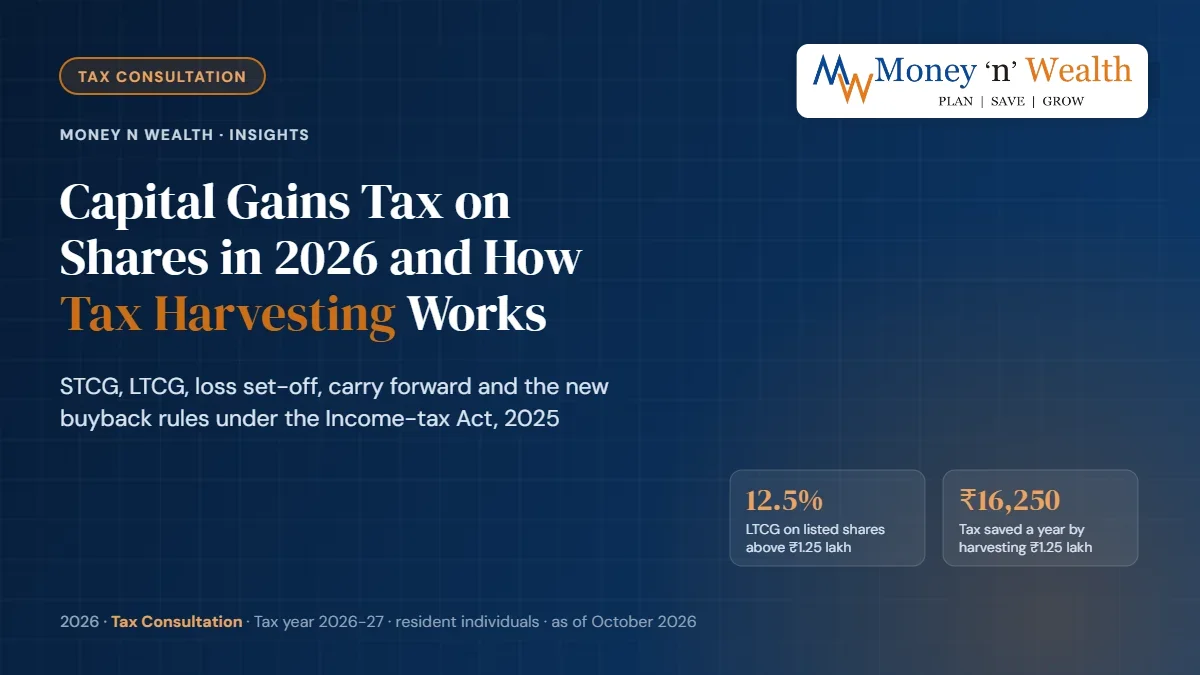
Capital Gains Tax on Shares in 2026 and How Tax Harvesting Works
Last updated: 13 October 2026
Quick answer: Capital gains tax on listed shares in 2026 is 20% if you sell within 12 months and 12.5% on long-term gains above ₹1.25 lakh a year, plus 4% cess. Tax harvesting means booking long-term gains up to ₹1.25 lakh each year, and booking losses to offset taxable gains, so that you pay less tax without changing your portfolio.
Last updated: 13 October 2026 Quick answer: Capital gains tax on listed shares in 2026 is 20% if you sell within 12 months and 12.5% on long-term gains above ₹1.25 lakh a year, plus 4% cess. Tax harvesting means booking long-term gains up to ₹1.25 lakh each year, and booking losses to offset taxable gains, so that you pay less tax without changing your portfolio. Key takeaways Rates: STCG 20% (s. 196), LTCG 12.5% above ₹1.25 lakh (s. 198) under the Income-tax Act, 2025. Gain harvesting: using the ₹1.25 lakh exemption every year saves up to ₹16,250 a year per person. Losses: short-term losses offset any capital gain; long-term losses only long-term gains; carry forward 8 tax years. Buybacks: from 1 April 2026, proceeds are capital gains again, not deemed dividend. No wash-sale rule: India has no 30-day rule, but a same-day sell and rebuy is treated as intraday. Deadline: losses carry forward only if your return is filed by the due date. An IT manager in Baner sold shares worth ₹6.5 lakh in October and paid ₹16,250 in tax. Her colleague, holding the same stock for the same period, paid nothing on his gain. He had simply booked ₹1.25 lakh of long-term gains in each of the previous two years and reset his cost. This guide explains capital gains tax on shares as of October 2026, under the new Income-tax Act, 2025: the rates, holding periods, how losses are set off and carried forward, the April 2026 change to buyback taxation, and how gain and loss tax harvesting actually works, with rupee examples worked out by our team. What is capital gains tax on shares? Capital gains tax on shares is the tax on the profit you make when you sell shares held as an investment: sale value minus purchase cost, less transfer expenses such as brokerage. Whether the gain is short-term or long-term depends on how long you held the shares. Listed shares turn long-term after 12 months; unlisted shares after 24 months. From 1 April 2026, the Income-tax Act, 2025 replaced the 1961 Act. The rates set in July 2024 continue, but the sections have new numbers. Old section 111A (short-term gains) is now section 196, section 112 is section 197, and section 112A (long-term gains on listed equity) is section 198. "Previous year" and "assessment year" have been replaced by a single "tax year". If you trade frequently, the tax department may treat your activity as a business rather than investment. Intraday and F&O trades are always business income. Our guide on tax on F&O and intraday trading (/insights/tax-on-fno-intraday-trading) covers that side. How much tax do you pay on shares in 2026? Type of share Long-term after Short-term gain Long-term gain Listed equity share, STT paid 12 months 20% (s. 196) 12.5% above ₹1.25 lakh a year (s. 198) Unlisted share (including pre-IPO, startup and most foreign shares) 24 months Slab rate 12.5%, no indexation (s. 197) Shares bought before 1 February 2018, sold now Already long-term Not applicable 12.5% above ₹1.25 lakh, on gain above 31 January 2018 value Dividends Not a capital gain Taxed at slab rate; 10% TDS above ₹10,000 per company a year Add 4% health and education cess to every rate. Surcharge on these capital gains is capped at 15%. The ₹1.25 lakh exemption is a single limit per person per tax year, shared between listed shares, equity mutual funds and business trust units such as REITs. The special rates apply only if securities transaction tax (STT) was paid. For delivery trades on Indian exchanges, STT is 0.1% on both purchase and sale, unchanged from April 2026 according to the NSE circular of 31 March 2026. Shares of foreign companies and unlisted Indian companies follow the 24-month rule; see our guides on unlisted and pre-IPO shares (/insights/unlisted-pre-ipo-shares-risks) and ESOP and RSU taxation (/insights/esop-rsu-taxation-india) . Capital gains tax on shares 2026: short-term, long-term and unlisted share tax rates compared Worked examples Example 1: long-term gain. Priya bought shares for ₹4 lakh in February 2024 and sells them for ₹6.5 lakh in October 2026. Her long-term gain is ₹2.5 lakh. After the ₹1.25 lakh exemption, ₹1.25 lakh is taxed at 12.5%: ₹15,625, plus cess = ₹16,250 . Example 2: short-term gain. Had she sold after eight months with a ₹1 lakh gain, the whole amount would be taxed at 20% plus cess: ₹20,800 . The exemption does not apply to short-term gains. Example 3: low-income investor. A retiree under the new regime has ₹2 lakh of pension and a ₹4 lakh long-term gain. His other income is ₹2 lakh short of the ₹4 lakh basic exemption, and section 198 lets a resident use that shortfall. So the taxable gain is ₹4 lakh minus ₹1.25 lakh minus ₹2 lakh = ₹75,000, and tax is ₹9,750 with cess. The section 156 rebate (up to ₹12 lakh income) cannot be used against this special-rate tax. How does grandfathering work for old shares? Long-term gains on listed shares were tax-free until 31 January 2018. For shares bought before 1 February 2018, the cost is the higher of the actual cost and the lower of the highest price quoted on 31 January 2018 and the sale price. Example 4. You bought 200 shares in 2016 at ₹600. The highest price on 31 January 2018 was ₹900. You sell at ₹1,500. Your deemed cost is ₹900, so the taxable gain is ₹1.2 lakh, not ₹1.8 lakh, and it falls inside the ₹1.25 lakh exemption if you have no other long-term gains. What is tax harvesting, and how does it work? Tax harvesting is the practice of selling investments deliberately to use a tax allowance or a loss, and then reinvesting, so your portfolio stays roughly the same while your tax bill falls. In India it comes in two forms: gain harvesting and loss harvesting. How does gain harvesting save tax? The ₹1.25 lakh exemption is use-it-or-lose-it: it cannot be carried forward. Gain harvesting means selling long-term holdings with gains of up to ₹1.25 lakh before 31 March and buying them back. Your holding is unchanged, but the cost resets higher, so future taxable gains shrink. Example 5. Rohan's ₹20 lakh portfolio has large unrealised long-term gains. Each March he sells shares worth about ₹5 lakh carrying ₹1.25 lakh of gain and rebuys them the next trading day. Each year he avoids ₹16,250 of future tax. Over five years that adds up to ₹81,250. The cost is STT of about ₹1,000 (0.1% each way on ₹5 lakh), stamp duty of ₹75 on the purchase, plus brokerage and DP charges. For a couple each holding their own portfolios, the saving doubles, because the exemption is per person. Adult children with their own money get their own limits too. Gifts to a spouse or minor child are clubbed with your income, so the exemption only helps when each person invests their own money. Bar chart showing tax harvesting of ₹1.25 lakh long-term gains saves ₹81,250 over five years How does loss harvesting work? Loss harvesting means selling shares that are below cost to realise a capital loss, which then offsets gains made in the same year. If you still like the company, you can rebuy it. Example 6. Anjali has booked ₹2 lakh of short-term gains this year. She also holds a stock bought six months ago that is down ₹80,000. Without action, she pays ₹41,600 in tax. By selling the loss-making stock, her net short-term gain falls to ₹1.2 lakh and tax to ₹24,960. She saves ₹16,640 , and can rebuy the stock on a later day if she still wants it. Loss harvesting example cutting capital gains tax on shares from ₹41,600 to ₹24,960 Is there a wash-sale rule in India? No. Unlike the United States, which disallows a loss if you rebuy the same security within 30 days, India's income-tax law has no specific wash-sale rule as of October 2026. Two practical cautions apply, though. Do not sell and rebuy on the same day. The exchange nets your buy and sell in the same share on the same day, and the matched quantity is treated as an intraday trade. That turns a capital gain or loss into speculative business income. Rebuy on the next trading day instead. Keep it genuine. Transactions should be real market trades at market prices. Arranged trades with related parties, or circular deals designed only to manufacture losses, can be challenged under general anti-avoidance principles. How are capital losses on shares set off and carried forward? The rules sit in sections 108, 109 and 111 of the Income-tax Act, 2025. Capital losses can never be set off against salary, interest, rent or business income. Within capital gains: Type of loss Can be set off against Cannot be set off against Carry forward Short-term capital loss Short-term and long-term capital gains Any other head of income 8 tax years Long-term capital loss Long-term capital gains only Short-term gains, other heads 8 tax years Carry-forward works only if you file your return by the due date (section 121), even in a year when you have no gains. Brought-forward losses must be used at the first opportunity, and they are set off before the ₹1.25 lakh exemption is applied. That has a sting: a long-term loss carried forward will be absorbed by next year's long-term gains even if those gains would have been tax-free anyway. Which gain should a short-term loss offset first? A short-term loss can offset either 20% short-term gains or 12.5% long-term gains. Using it against the 20% gains saves more. Example 7. Vikram has ₹1.5 lakh short-term gains, ₹2.25 lakh long-term gains and a ₹1 lakh short-term loss. Set against short-term gains, his tax is ₹23,400. Set against long-term gains, it would be ₹31,200. The capital gains schedule in the ITR lets you allocate losses across gains taxed at different rates, so check how your software or CA has done it. How are share buybacks taxed from April 2026? Buyback taxation has changed three times in three years. Until 30 September 2024, the company paid the buyback tax and shareholders were exempt. From 1 October 2024, the whole buyback amount was treated as a deemed dividend, taxed at your slab rate, while the cost of the shares became a capital loss. Budget 2026 reversed that. For buybacks on or after 1 April 2026, the Finance Act 2026 treats the proceeds as sale consideration. You pay capital gains tax only on the profit: buyback price minus cost. Promoters face an additional tax that takes their effective rate to 30%, or 22% for a promoter company, according to analyses of the Finance Act by Vinod Kothari Consultants and ELP. Example 8. You hold 100 shares bought three years ago at ₹1,000 and tender them at ₹1,500. Under the deemed-dividend rule, ₹1.5 lakh would have been taxed at 30% plus cess: ₹46,800, with a ₹1 lakh capital loss to use later. Under the 2026 rule, you have a ₹50,000 long-term gain. If your ₹1.25 lakh exemption is unused, tax is nil; if it is used up, ₹6,500. Buyback tax comparison: deemed dividend regime versus capital gains regime from April 2026 Buyback offers are now usually made through the tender route on the exchange, and only part of your holding may be accepted. Check the acceptance ratio and the tax note in the letter of offer before tendering. More on corporate actions in our guide to buybacks, bonuses, splits and dividends (/insights/corporate-actions-buyback-bonus-split-dividend) . How do bonus shares, splits and mergers affect your tax? Bonus shares: cost is nil, and the holding period starts from the allotment date. Selling bonus shares within 12 months gives a short-term gain on the full sale price. Stock splits: the original cost is spread across the new shares, and the holding period runs from the original purchase. Mergers and demergers: shares received in an approved scheme generally carry over the old cost (apportioned for demergers) and holding period. Use the company's cost-apportionment ratio when you sell. How to do tax harvesting before 31 March: a checklist Five-step tax harvesting routine for capital gains tax on shares Download your tax P&L. Every broker provides a capital gains report with lot-wise purchase dates. Include mutual fund redemptions from your CAS, since the ₹1.25 lakh limit is shared. Our guide to capital gains tax on mutual funds (/insights/capital-gains-tax-mutual-funds-2026) explains fund rules. Total what you have already realised this tax year: short-term gains, long-term gains and losses. Book losses first on positions you no longer believe in, or that you are happy to rebuy a day later. Top up long-term gains to ₹1.25 lakh by selling older lots with the biggest gains per share, then rebuy the next trading day. Mind costs and timing. STT, brokerage and slippage on illiquid stocks can eat the saving. Do it in February or early March, not on the last trading day. Plan advance tax. Large gains may need advance tax (/insights/advance-tax-for-investors) instalments, with the last one due by 15 March. File on time. Report gains in ITR-2 (or ITR-3 if you have business income) by the due date. See which ITR form to file (/insights/which-itr-form-to-file) . Is tax harvesting worth it for every investor? For most long-term equity investors with gains in the lakhs, yes: ₹16,250 a year per person, for an hour's work, is a high return. It is less useful when your unrealised gains are small, when stocks are illiquid with wide spreads, or when you will hold until death, since inherited shares carry the original cost and the heirs pay tax only when they sell. Harvesting is a tax decision, not an investment one. Selling a holding only to book a loss, or keeping a stock only to avoid tax, can cost more than the tax saved. For the bigger picture on owning stocks, read our direct equity investing and taxation guide (/insights/direct-equity-investing-india-taxation-guide) and the overview of the Income-tax Act, 2025 changes (/insights/income-tax-act-2025-changes-individuals) . Related reading Capital gains tax on mutual funds in 2026 (/insights/capital-gains-tax-mutual-funds-2026) Tax on F&O and intraday trading (/insights/tax-on-fno-intraday-trading) Buybacks, bonuses, splits and dividends explained (/insights/corporate-actions-buyback-bonus-split-dividend) Advance tax for investors and retirees (/insights/advance-tax-for-investors) Tax planning FY 2026-27: old vs new regime (/insights/tax-planning-guide-india) Money n Wealth tax consultation (/products/tax) Frequently Asked Questions What is the LTCG tax on shares in 2026? Long-term capital gains on listed shares held for more than 12 months are taxed at 12.5% on the amount above ₹1.25 lakh in a tax year, plus 4% cess, under section 198 of the Income-tax Act, 2025. STT must have been paid on purchase and sale. The ₹1.25 lakh limit is shared with equity mutual funds and cannot be carried forward. What is the STCG tax rate on shares? Short-term capital gains on listed shares sold within 12 months of purchase are taxed at a flat 20% plus 4% cess under section 196, whatever your slab. There is no ₹1.25 lakh exemption for short-term gains. Short-term gains on unlisted shares, held 24 months or less, are taxed at your slab rate instead. Is tax loss harvesting legal in India? Yes. Selling shares at a loss to offset gains is a normal, legal transaction, and India has no wash-sale rule as of October 2026. The trades should be genuine market trades. Avoid selling and rebuying on the same day, because the matched quantity is treated as an intraday trade, which is speculative business income rather than a capital loss. Can I set off a long-term capital loss against short-term gains? No. A long-term capital loss can be set off only against long-term capital gains, in the same year or in the next eight tax years. A short-term capital loss is more flexible: it can offset both short-term and long-term gains. Neither can be set off against salary or other income. How many years can I carry forward a capital loss on shares? Eight tax years after the year in which the loss arose, under section 111 of the Income-tax Act, 2025. The condition is that you file your income tax return by the due date for the loss year. A late or belated return loses the carry-forward, so file on time even in years with no gains. How is a share buyback taxed in 2026? For buybacks on or after 1 April 2026, non-promoter shareholders pay capital gains tax on the difference between the buyback price and their cost, at the normal short-term or long-term rates. Between 1 October 2024 and 31 March 2026, the full amount was taxed as dividend at slab rates. Promoters face a higher effective rate of 22% to 30%. Do I pay tax on shares if I do not sell them? No. Capital gains tax arises only on transfer, which means a sale, a buyback, or in some cases a gift-related or corporate event. Rising share prices are not taxed while you hold. Dividends, however, are taxed at your slab rate in the year you receive them, with 10% TDS above ₹10,000 per company. Sources: Income Tax Department: section 198, Income-tax Act, 2025 (https://www.incometaxindia.gov.in/w/section-198-78) ; section 111 (carry forward of capital losses) (https://www.incometaxindia.gov.in/w/section-111-98) ; NSE circular on STT rates from 1 April 2026 (https://nsearchives.nseindia.com/content/circulars/FATAX73524.pdf) ; Vinod Kothari Consultants: buyback taxation after Budget 2026 (https://vinodkothari.com/2026/02/buyback-taxation-rationalised-with-limited-relief-to-promoter-shareholders/) ; ELP: Budget 2026 buyback tax (https://elplaw.in/wp-content/uploads/2026/02/Budget-Buzz-BuyBack-Tax.pdf) . Worked examples are Money n Wealth calculations. Want your harvesting done right this March? Lot-wise planning across shares, funds and family members can save more than a generic rule of thumb. Talk to Money n Wealth (/contact) for a free portfolio review. This article is for general educational purposes only and does not constitute financial advice. Figures and examples are illustrative. Please consult a qualified financial adviser for guidance specific to your situation. Money n Wealth (Predics Fintech Services Pvt Ltd) is an AMFI-registered Mutual Fund Distributor (ARN-121995) and APMI-registered PMS Distributor (APRN07444); it is not a SEBI-registered investment adviser and may earn distribution commission on investments made through it.
Frequently Asked Questions
What is the LTCG tax on shares in 2026?
Long-term capital gains on listed shares held for more than 12 months are taxed at 12.5% on the amount above ₹1.25 lakh in a tax year, plus 4% cess, under section 198 of the Income-tax Act, 2025. STT must have been paid on purchase and sale. The ₹1.25 lakh limit is shared with equity mutual funds and cannot be carried forward.
What is the STCG tax rate on shares?
Short-term capital gains on listed shares sold within 12 months of purchase are taxed at a flat 20% plus 4% cess under section 196, whatever your slab. There is no ₹1.25 lakh exemption for short-term gains. Short-term gains on unlisted shares, held 24 months or less, are taxed at your slab rate instead.
Is tax loss harvesting legal in India?
Yes. Selling shares at a loss to offset gains is a normal, legal transaction, and India has no wash-sale rule as of October 2026. The trades should be genuine market trades. Avoid selling and rebuying on the same day, because the matched quantity is treated as an intraday trade, which is speculative business income rather than a capital loss.
Can I set off a long-term capital loss against short-term gains?
No. A long-term capital loss can be set off only against long-term capital gains, in the same year or in the next eight tax years. A short-term capital loss is more flexible: it can offset both short-term and long-term gains. Neither can be set off against salary or other income.
How many years can I carry forward a capital loss on shares?
Eight tax years after the year in which the loss arose, under section 111 of the Income-tax Act, 2025. The condition is that you file your income tax return by the due date for the loss year. A late or belated return loses the carry-forward, so file on time even in years with no gains.
How is a share buyback taxed in 2026?
For buybacks on or after 1 April 2026, non-promoter shareholders pay capital gains tax on the difference between the buyback price and their cost, at the normal short-term or long-term rates. Between 1 October 2024 and 31 March 2026, the full amount was taxed as dividend at slab rates. Promoters face a higher effective rate of 22% to 30%.
Do I pay tax on shares if I do not sell them?
No. Capital gains tax arises only on transfer, which means a sale, a buyback, or in some cases a gift-related or corporate event. Rising share prices are not taxed while you hold. Dividends, however, are taxed at your slab rate in the year you receive them, with 10% TDS above ₹10,000 per company.
Want your harvesting done right this March?
Lot-wise planning across shares, funds and family members can save more than a generic rule of thumb. Talk to Money n Wealth for a free portfolio review.